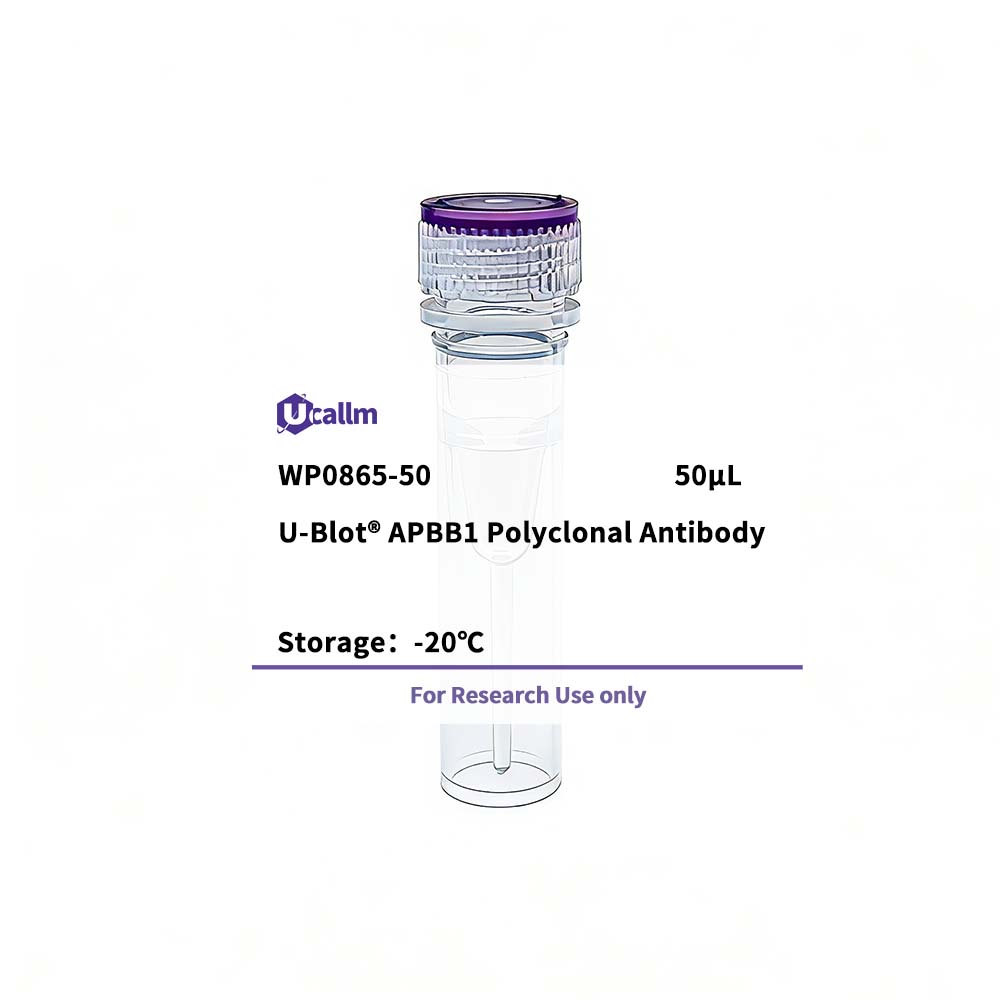
SKU: WP0865 Categories: ,

APBB1 Polyclonal Antibody

Price range: $268.00 through $328.00

SKU: WP0865-100
Enter the quantity you would like, or drag the panel to find the quantity and price that best for you
Bulk QuoteAuthorize OEM & ODM

Product details

Background:

amyloid beta precursor protein binding family B member 1(APBB1) Homo sapiens The protein encoded by this gene is a member of the Fe65 protein family. It is an adaptor protein localized in the nucleus. It interacts with the Alzheimer's disease amyloid precursor protein (APP), transcription factor CP2/LSF/LBP1 and the low-density lipoprotein receptor-related protein. APP functions as a cytosolic anchoring site that can prevent the gene product's nuclear translocation. This encoded protein could play an important role in the pathogenesis of Alzheimer's disease. It is thought to regulate transcription. Also it is observed to block cell cycle progression by downregulating thymidylate synthase expression. Multiple alternatively spliced transcript variants encoding different isoforms have been described for this gene. [provided by RefSeq, Mar 2012],


Specifications

Size50μL/100μL
TargetAPBB1
ReactivityHuman, Mouse, Rat
ApplicationsWB, ELISA
MW(Calculated)
MW(Observed)78kD
Host SpeciesRabbit
IsotypeIgG
Conjugate/ModificationUnmodified
Recommended Dilution RatioWB 1:500-2000; ELISA 1:5000-20000
FormulationLiquid in PBS containing 50% glycerol,0.5% BSA and 0.02% sodium azide.
PurificationThe antibody was affinity-purified from rabbit antiserum by affinity-chromatography using epitope-specific immunogen.
Storage-15°C to -25°C/1 year(Do not lower than -25°C)
Concentration1 mg/ml
ClonalityPolyclonal
Clone Number
ImmunogenSynthesized peptide derived from human protein . at AA range: 400-480
SpecificityAPBB1 Polyclonal Antibody detects endogenous levels of protein.
Gene NameAPBB1 FE65 RIR
Protein NameAmyloid beta A4 precursor protein-binding family B member 1 (Protein Fe65)
Other Name
SpeciesHuman
Gene ID322
UniprotO00213,
Species.1Mouse
Gene ID.1
Uniprot.1Q9QXJ1,
Species.2Rat
Gene ID.2
Uniprot.2P46933
Cellular LocalizationCell membrane . Cytoplasm . Nucleus . Cell projection, growth cone . Nucleus speckle . Colocalizes with TSHZ3 in axonal growth cone (By similarity). Colocalizes with TSHZ3 in the nucleus (PubMed:19343227). In normal conditions, it mainly localizes to the cytoplasm, while a small fraction is tethered to the cell membrane via its interaction with APP (PubMed:18468999). Following exposure to DNA damaging agents, it is released from cell membrane and translocates to the nucleus (PubMed:18468999). Nuclear translocation is under the regulation of APP (PubMed:18468999). Colocalizes with NEK6 at the nuclear speckles (PubMed:17512906). Phosphorylation at Ser-610 by SGK1 promotes its localization to the nucleus (By similarity). .
Tissue ExpressionHighly expressed in brain; strongly reduced in post-mortem elderly subjects with Alzheimer disease.; [Isoform 4]: Expressed preferentially in the brain.
Signaling_pathwayHuman Diseases >> Neurodegenerative disease >> Alzheimer disease
Research Areas>>Alzheimer disease
FunctionFunction:Adapter protein that forms a transcriptionally active complex with the gamma-secretase-derived amyloid precursor protein (APP) intracellular domain. Plays a central role in the response to DNA damage by translocating to the nucleus and inducing apoptosis. May act by specifically recognizing and binding histone H2AX phosphorylated on 'Tyr-142' (H2AXY142ph) at double-strand breaks (DSBs), recruiting other pro-apoptosis factors such as MAPK8/JNK1. Required for histone H4 acetylation at double-strand breaks (DSBs). Its ability to specifically bind modified histones and chromatin modifying enzymes such as HTATIP/TIP60, probably explains its trancription activation activity.,PTM:Phosphorylated following nuclear translocation. Phosphorylation at Tyr-546 enhances the transcription activation activity and reduces the affinity with RASD1/DEXRAS1.,similarity:Contains 1 WW domain.,similarity:Contains 2 PID domains.,subcellular location:In normal conditions, it mainly localizes to the cytoplasm, while a small fraction is tethered to the cell membrane via its interaction with APP. Following exposure to DNA damaging agents, it is released from cell membrane and translocates to the nucleus. Nuclear translocation is under the regulation of APP.,subunit:Component of a complex, at least composed of APBB1, RASD1/DEXRAS1 and APP. Interacts (via PID domain 2) with APP (with the intracellular domain of the beta-amyloid precursor protein). Interacts (via PID domain 2) with RASD1/DEXRAS1; impairs the trancription activation activity. Interacts (via PID domain 1) with HTATIP/TIP60. Interacts (via the WW domain) with proline-rich regions of APBB1IP and ENAH (By similarity). Interacts (via the WW domain) with histone H2AX (when phosphorylated on 'Tyr-142). Interacts with MAPK8.,tissue specificity:Highly expressed in brain.,
Please login to post questions
Back to Top
Product has been added to your cart
