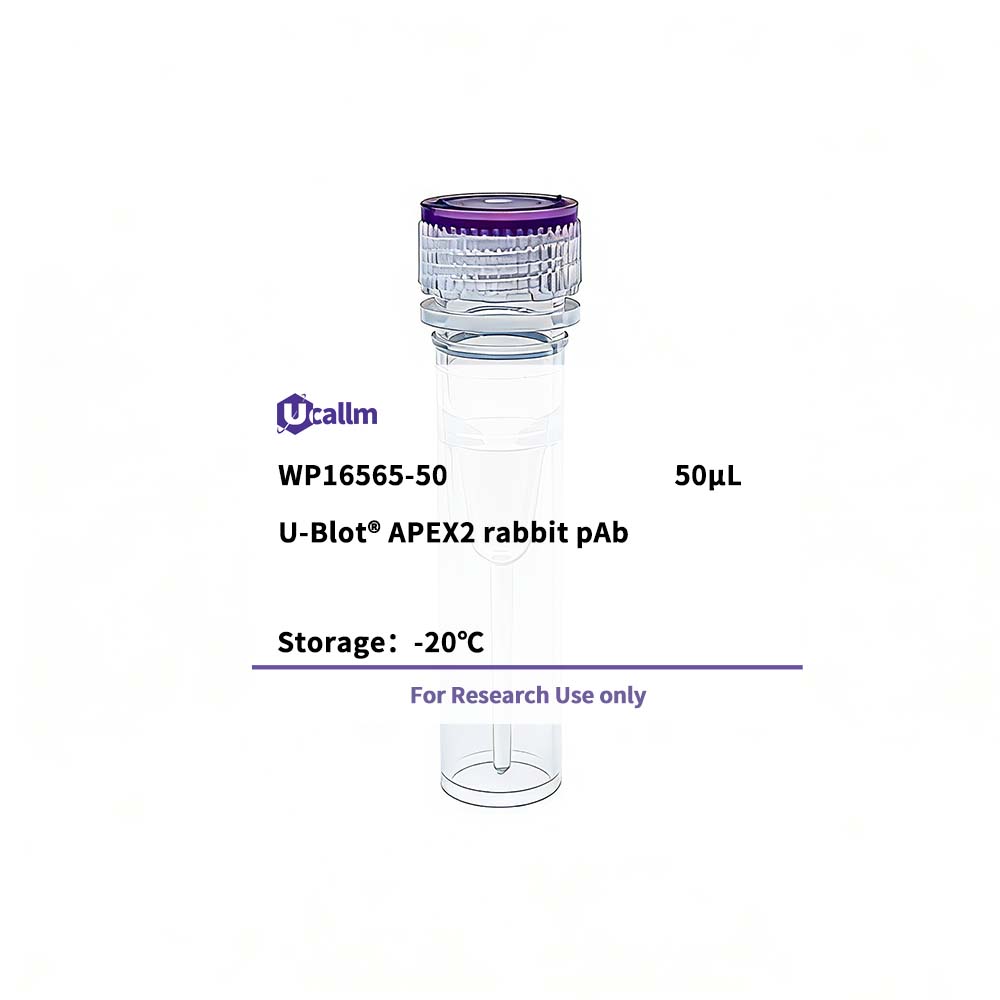
SKU: WP16565 Categories: ,

APEX2 rabbit pAb

Price range: $268.00 through $328.00

SKU: WP16565-100
Enter the quantity you would like, or drag the panel to find the quantity and price that best for you
Bulk QuoteAuthorize OEM & ODM

Product details

Background:

Apurinic/apyrimidinic (AP) sites occur frequently in DNA molecules by spontaneous hydrolysis, by DNA damaging agents or by DNA glycosylases that remove specific abnormal bases. AP sites are pre-mutagenic lesions that can prevent normal DNA replication so the cell contains systems to identify and repair such sites. Class II AP endonucleases cleave the phosphodiester backbone 5' to the AP site. This gene encodes a protein shown to have a weak class II AP endonuclease activity. Most of the encoded protein is located in the nucleus but some is also present in mitochondria. This protein may play an important role in both nuclear and mitochondrial base excision repair. Alternatively spliced transcript variants encoding multiple isoforms have been observed for this gene. [provided by RefSeq, Nov 2012],

Specifications

Size50μL/100μL
TargetAPEX2
ReactivityHuman, Mouse
ApplicationsWB
MW(Calculated)57kD
MW(Observed)
Host SpeciesRabbit
IsotypeIgG
Conjugate/ModificationUnmodified
Recommended Dilution RatioWB 1:500-2000
FormulationLiquid in PBS containing 50% glycerol, 0.5% BSA and 0.02% sodium azide.
PurificationThe antibody was affinity-purified from rabbit antiserum by affinity-chromatography using epitope-specific immunogen.
Storage-15°C to -25°C/1 year(Do not lower than -25°C)
Concentration1 mg/ml
ClonalityPolyclonal
Clone Number
ImmunogenSynthesized peptide derived from human APEX2 AA range: 196-246
SpecificityThis antibody detects endogenous levels of APEX2 at Human/Mouse
Gene NameAPEX2 APE2 APEXL2 XTH2
Protein NameAPEX2
Other Name
SpeciesHuman
Gene ID27301
UniprotQ9UBZ4,
Species.1Mouse
Gene ID.177622
Uniprot.1Q68G58
Species.2
Gene ID.2
Uniprot.2
Cellular LocalizationNucleus. Cytoplasm. Mitochondrion . Together with PCNA, is redistributed in discrete nuclear foci in presence of oxidative DNA damaging agents.
Tissue ExpressionHighly expressed in brain and kidney. Weakly expressed in the fetal brain.
Signaling_pathway
Research Areas>>Base excision repair
FunctionCatalytic activity:The C-O-P bond 3' to the apurinic or apyrimidinic site in DNA is broken by a beta-elimination reaction, leaving a 3'-terminal unsaturated sugar and a product with a terminal 5'-phosphate.,Function:May participate in both nuclear and mitochondrial post-replicative base excision repair (BER). In the nucleus functions in the PCNA-dependent BER pathway.,similarity:Belongs to the DNA repair enzymes AP/exoA family.,subcellular location:Colocalized partly with PCNA in nuclear foci.,subunit:Interacts with PCNA. This interaction is increased by misincorporation of uracil in nuclear DNA.,tissue specificity:Highly expressed in cells, adult brain and kidney. Weakly expressed in the fetal brain.,
Please login to post questions
Back to Top
Product has been added to your cart

