


ApoC-III Polyclonal Antibody
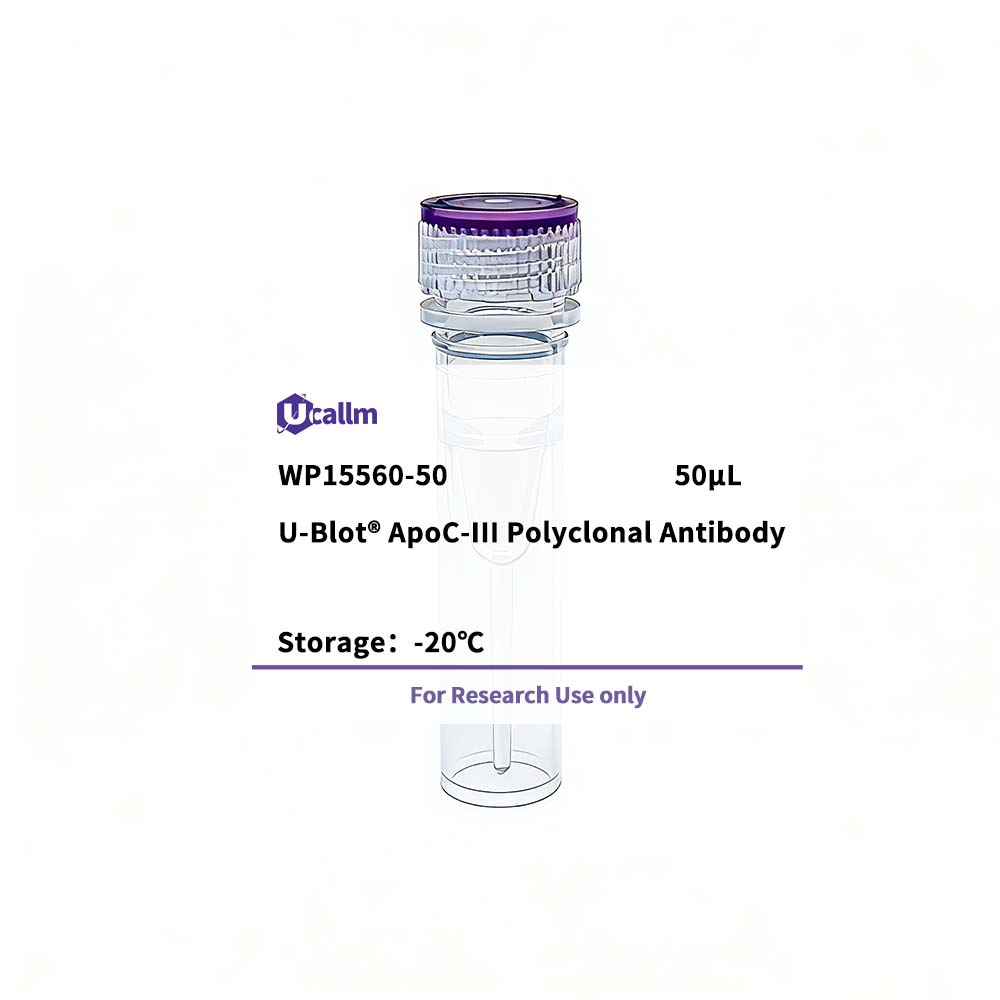
Ucallm_WP15560-50
Price range: $268.00 through $328.00
Product details
Background:
Apolipoprotein C-III is a very low density lipoprotein (VLDL) protein. APOC3 inhibits lipoprotein lipase and hepatic lipase; it is thought to delay catabolism of triglyceride-rich particles. The APOA1, APOC3 and APOA4 genes are closely linked in both rat and human genomes. The A-I and A-IV genes are transcribed from the same strand, while the A-1 and C-III genes are convergently transcribed. An increase in apoC-III levels induces the development of hypertriglyceridemia. [provided by RefSeq, Jul 2008],
Specifications
| Size | 50μL/100μL |
| Target | ApoC-III |
| Reactivity | Human, Mouse, Rat |
| Applications | WB, IHC, IF, ELISA |
| MW(Calculated) | |
| MW(Observed) | 11kD |
| Host Species | Rabbit |
| Isotype | IgG |
| Conjugate/Modification | Unmodified |
| Recommended Dilution Ratio | WB 1:500-1:2000; IHC: 1:100-1:300; ELISA 1:10000; IF 1:50-200 / Note: For IHC, we suggest antigen retrieval with TE buffer pH 9.0 (Cat#WT1004) |
| Formulation | Liquid in PBS containing 50% glycerol, 0.5% BSA and 0.02% sodium azide. |
| Purification | The antibody was affinity-purified from rabbit antiserum by affinity-chromatography using epitope-specific immunogen. |
| Storage | -15°C to -25°C/1 year(Do not lower than -25°C) |
| Concentration | 1 mg/ml |
| Clonality | Polyclonal |
| Clone Number | |
| Immunogen | The antiserum was produced against synthesized peptide derived from the C-terminal region of human APOC3. AA range:46-95 |
| Specificity | ApoC-III Polyclonal Antibody detects endogenous levels of ApoC-III protein. |
| Gene Name | APOC3 |
| Protein Name | Apolipoprotein C-III |
| Other Name | APOC3; / Apolipoprotein C-III; / Apo-CIII; / ApoC-III; / Apolipoprotein C3 |
| Species | Human |
| Gene ID | 345 |
| Uniprot | P02656, |
| Species.1 | Mouse |
| Gene ID.1 | |
| Uniprot.1 | P33622 |
| Species.2 | |
| Gene ID.2 | |
| Uniprot.2 | |
| Cellular Localization | Secreted . |
| Tissue Expression | Liver. |
| Signaling_pathway | Organismal Systems >> Endocrine system >> PPAR signaling pathway |
| Research Areas | >>PPAR signaling pathway; / >>Cholesterol metabolism |
| Function | Disease:Defects in APOC3 may be a cause of hyperalphalipoproteinemia [MIM:143470]. Affected individuals show high levels of alpha-lipoprotein (high density lipoprotein/HDL).,Function:Inhibits lipoprotein lipase and hepatic lipase and decreases the uptake of lymph chylomicrons by hepatic cells. This suggests that it delays the catabolism of triglyceride-rich particles.,PTM:O-linked glycan consists of Gal-GalNAc disaccharide, further modified with up to 3 sialic acid residues.,similarity:Belongs to the apolipoprotein C3 family.,tissue specificity:Constitutes 50% of the protein fraction of VLDL and 2% of that of HDL. Synthesized predominantly in liver and to a lesser degree in intestine., |
Please login to post questions
Related products


