

ASCC2 rabbit pAb
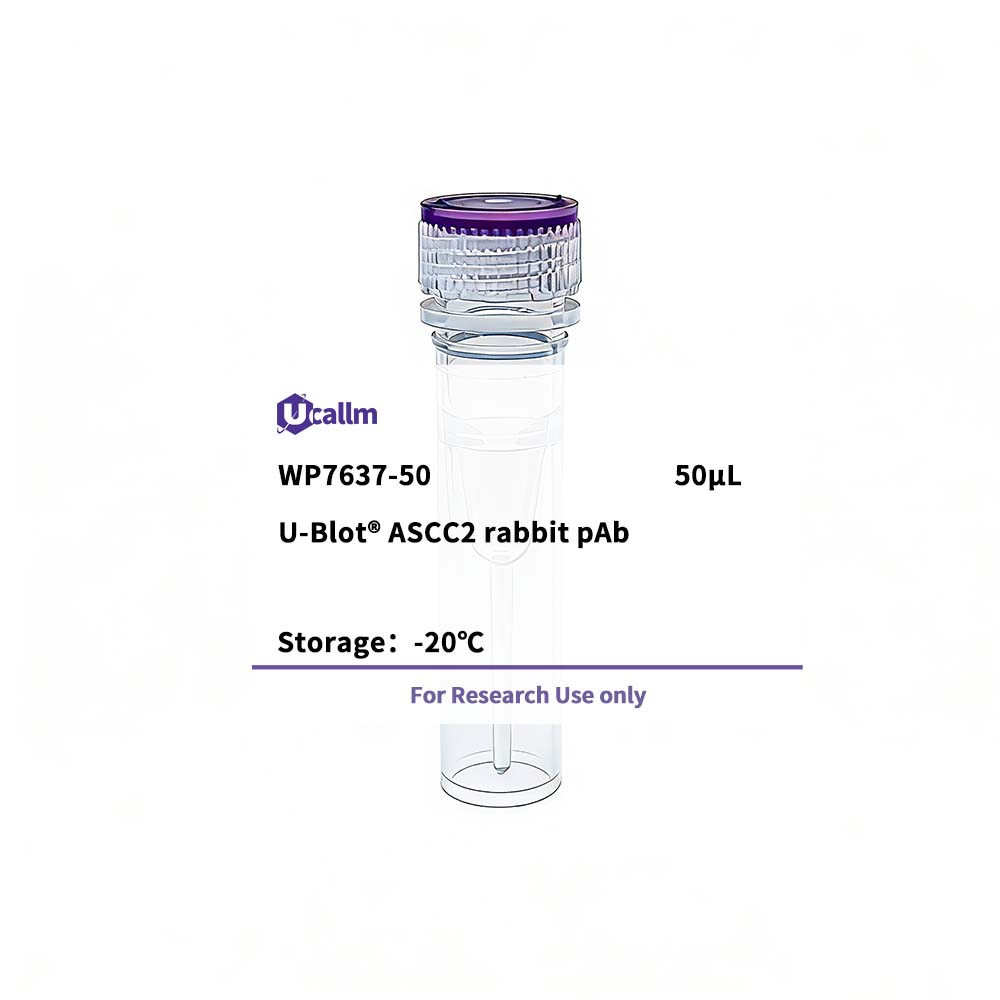
Ucallm_WP7637-50
Price range: $268.00 through $328.00
Product details
Background:
Specifications
| Size | 50μL/100μL |
| Target | ASCC2 |
| Reactivity | Human, Mouse |
| Applications | WB |
| MW(Calculated) | 83kD |
| MW(Observed) | |
| Host Species | Rabbit |
| Isotype | IgG |
| Conjugate/Modification | Unmodified |
| Recommended Dilution Ratio | WB 1:500-2000 |
| Formulation | Liquid in PBS containing 50% glycerol, 0.5% BSA and 0.02% sodium azide. |
| Purification | The antibody was affinity-purified from rabbit antiserum by affinity-chromatography using epitope-specific immunogen. |
| Storage | -15°C to -25°C/1 year(Do not lower than -25°C) |
| Concentration | 1 mg/ml |
| Clonality | Polyclonal |
| Clone Number | |
| Immunogen | Synthesized peptide derived from human ASCC2 |
| Specificity | This antibody detects endogenous levels of ASCC2 at Human, Mouse |
| Gene Name | ASCC2 ASC1P100 |
| Protein Name | Activating signal cointegrator 1 complex subunit 2 (ASC-1 complex subunit p100) (Trip4 complex subunit p100) |
| Other Name | |
| Species | Human |
| Gene ID | 84164 |
| Uniprot | Q9H1I8, |
| Species.1 | Mouse |
| Gene ID.1 | 75452 |
| Uniprot.1 | Q91WR3 |
| Species.2 | |
| Gene ID.2 | |
| Uniprot.2 | |
| Cellular Localization | Nucleus . Nucleus speckle . Colocalizes with the spliceosomal components PRPF8 and SNRNP200/BRR2 in nuclear foci when cells have been exposed to alkylating agents that cause DNA damage. Colocalizes with RNF113A and 'Lys-63'-linked polyubiquitinated proteins, ALKBH3 and ASCC3 in nuclear foci when cells have been exposed to alkylating agents that cause DNA damage. . |
| Tissue Expression | Ubiquitous. |
| Signaling_pathway | |
| Research Areas | |
| Function | Plays a role in DNA damage repair as component of the ASCC complex. Recruits ASCC3 and ALKBH3 to sites of DNA damage by binding to polyubiquitinated proteins that have 'Lys-63'-linked polyubiquitin chains . Part of the ASC-1 complex that enhances NF-kappa-B, SRF and AP1 transactivation . Involved in activation of the ribosome quality control (RQC) pathway, a pathway that degrades nascent peptide chains during problematic translation . As part of the ribosome quality control trigger (RQT) complex, recognizes ZNF598-dependent ubiquitination of stalled ribosomes (By similarity). |
Please login to post questions
Related products


