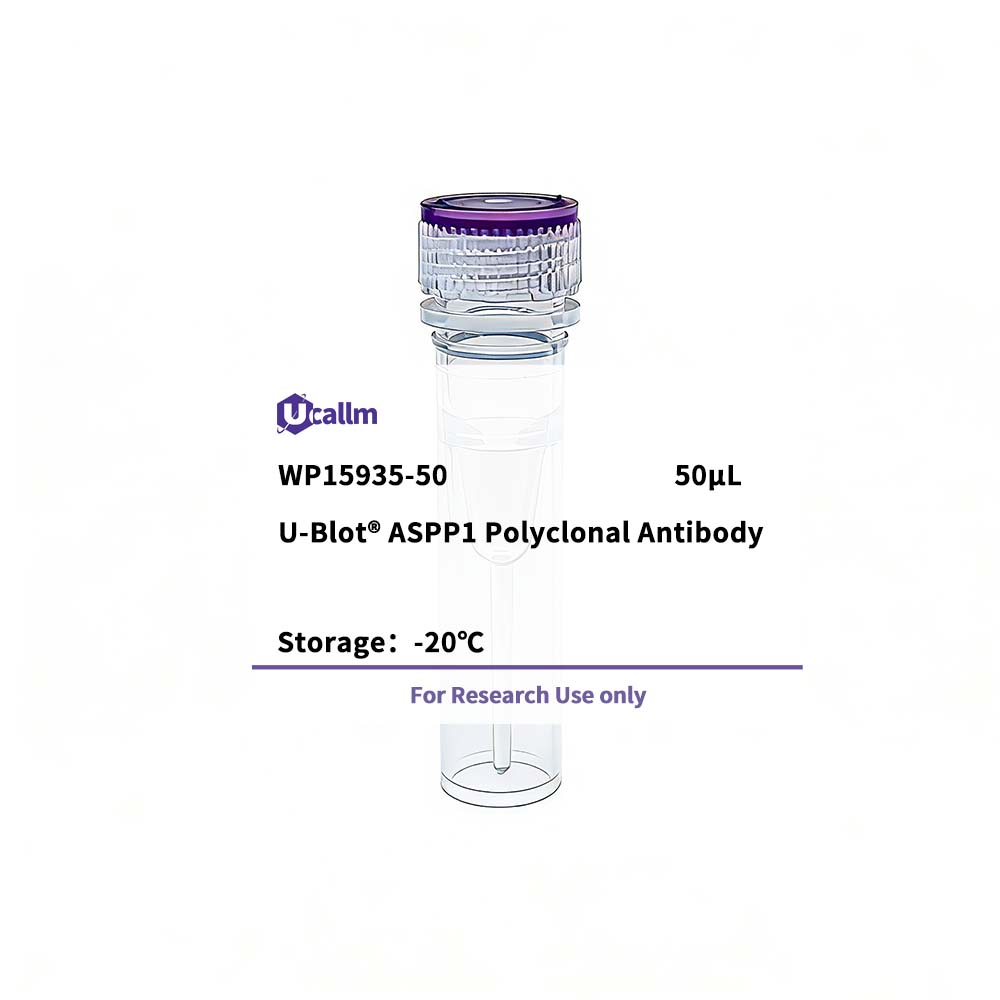
SKU: WP15935 Categories: ,

ASPP1 Polyclonal Antibody

Price range: $268.00 through $328.00

SKU: WP15935-100
Enter the quantity you would like, or drag the panel to find the quantity and price that best for you
Bulk QuoteAuthorize OEM & ODM

Product details

Background:

This gene encodes a member of the ASPP (apoptosis-stimulating protein of p53) family of p53 interacting proteins. The protein contains four ankyrin repeats and an SH3 domain involved in protein-protein interactions. ASPP proteins are required for the induction of apoptosis by p53-family proteins. They promote DNA binding and transactivation of p53-family proteins on the promoters of proapoptotic genes. Expression of this gene is regulated by the E2F transcription factor. [provided by RefSeq, Jul 2008],

Specifications

Size50μL/100μL
TargetASPP1
ReactivityHuman, Mouse
ApplicationsIHC, IF, ELISA
MW(Calculated)
MW(Observed)
Host SpeciesRabbit
IsotypeIgG
Conjugate/ModificationUnmodified
Recommended Dilution RatioIHC 1:50-200; ELISA 1:10000-20000; IF 1:50-200 / Note: For IHC, we suggest antigen retrieval with TE buffer pH 9.0 (Cat#WT1004)
FormulationLiquid in PBS containing 50% glycerol, 0.5% BSA and 0.02% sodium azide.
PurificationThe antibody was affinity-purified from rabbit antiserum by affinity-chromatography using epitope-specific immunogen.
Storage-15°C to -25°C/1 year(Do not lower than -25°C)
Concentration1 mg/ml
ClonalityPolyclonal
Clone Number
ImmunogenSynthetic peptide from human protein at AA range: 630-680
SpecificityThe antibody detects endogenous ASPP1
Gene NamePPP1R13B ASPP1 KIAA0771
Protein NameApoptosis-stimulating of p53 protein 1 (Protein phosphatase 1 regulatory subunit 13B)
Other NameApoptosis-stimulating of p53 protein 1; / Protein phosphatase 1 regulatory subunit 13B
SpeciesHuman
Gene ID23368
UniprotQ96KQ4,
Species.1Mouse
Gene ID.121981
Uniprot.1Q62415
Species.2
Gene ID.2
Uniprot.2
Cellular LocalizationCytoplasm . Nucleus . Predominantly cytoplasmic. Some fraction is nuclear.
Tissue ExpressionReduced expression in breast carcinomas expressing a wild-type TP53 protein.
Signaling_pathway
Research Areas
FunctionDisease:Defects in PPP1R13B may be a cause of breast cancers. It is overexpressed in many patients suffering from breast carcinomas and expressing a wild-type TP53 protein.,Domain:The ankyrin repeats and the SH3 domain are required for specific interactions with TP53.,Function:Regulator that plays a central role in regulation of apoptosis via its interaction with p53/TP53. Regulates TP53 by enhancing the DNA binding and transactivation function of TP53 on the promoters of proapoptotic genes in vivo.,miscellaneous:In contrast to its official gene name, it is not a regulatory subunit of protein phosphatase 1. This name was given due to its similarity with a protein that binds to protein phosphatase 1.,similarity:Belongs to the ASPP family.,similarity:Contains 1 SH3 domain.,similarity:Contains 2 ANK repeats.,subcellular location:Predominantly cytoplasmic. Some fraction is nuclear.,subunit:Interacts with TP53.,
Please login to post questions
Back to Top
Product has been added to your cart
