

Product details
Background:
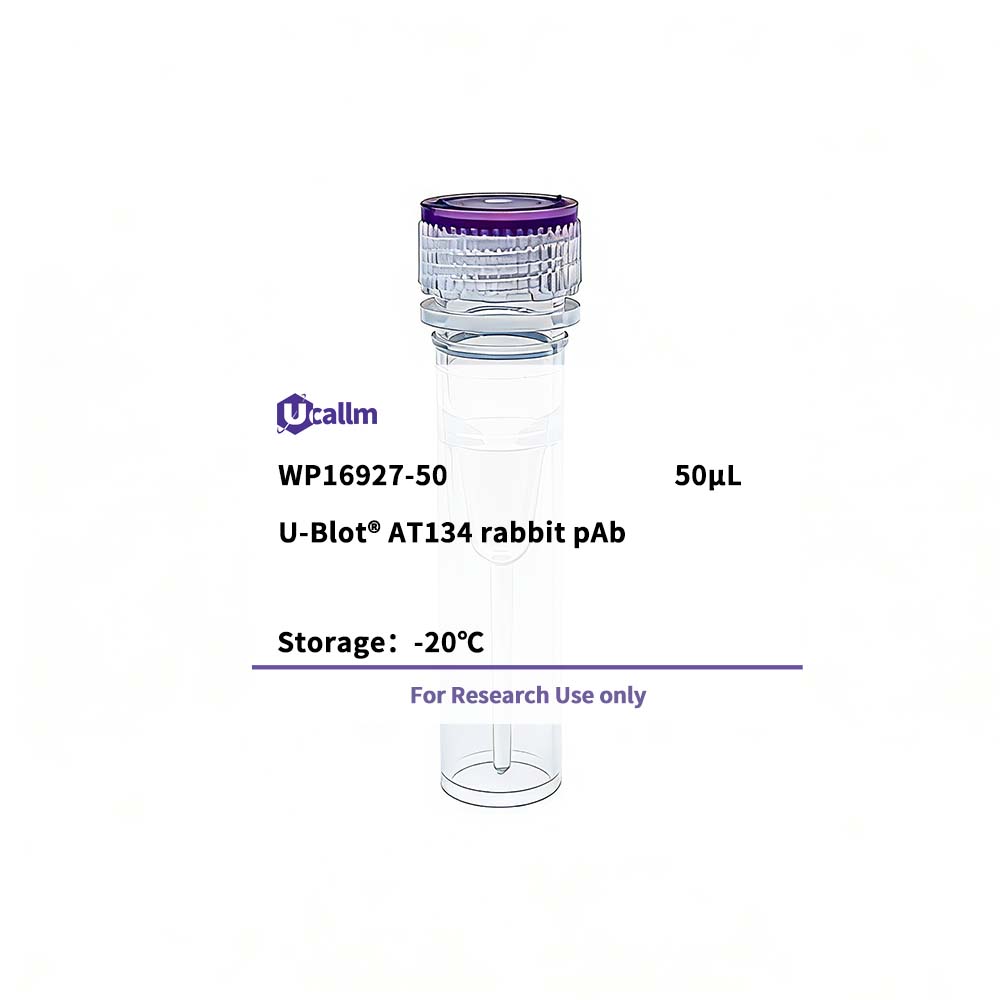
Price range: $268.00 through $328.00
Background:
| Size | 50μL/100μL |
| Target | AT134 |
| Reactivity | Human, Mouse |
| Applications | WB |
| MW(Calculated) | 132kD |
| MW(Observed) | |
| Host Species | Rabbit |
| Isotype | IgG |
| Conjugate/Modification | Unmodified |
| Recommended Dilution Ratio | WB 1:500-2000 |
| Formulation | Liquid in PBS containing 50% glycerol, 0.5% BSA and 0.02% sodium azide. |
| Purification | The antibody was affinity-purified from rabbit antiserum by affinity-chromatography using epitope-specific immunogen. |
| Storage | -15°C to -25°C/1 year(Do not lower than -25°C) |
| Concentration | 1 mg/ml |
| Clonality | Polyclonal |
| Clone Number | |
| Immunogen | Synthesized peptide derived from human AT134 AA range: 719-769 |
| Specificity | This antibody detects endogenous levels of AT134 at Human/Mouse |
| Gene Name | ATP13A4 UNQ3052/PRO9871 |
| Protein Name | AT134 |
| Other Name | |
| Species | Human |
| Gene ID | 84239 |
| Uniprot | Q4VNC1, |
| Species.1 | Mouse |
| Gene ID.1 | 224079 |
| Uniprot.1 | Q5XF90 |
| Species.2 | |
| Gene ID.2 | |
| Uniprot.2 | |
| Cellular Localization | Early endosome membrane; Multi-pass membrane protein . Late endosome membrane; Multi-pass membrane protein . Recycling endosome membrane; Multi-pass membrane protein . |
| Tissue Expression | Expressed in heart, placenta, liver, skeletal muscles, and pancreas. Lower levels of expression are also detected in brain, lung and kidney. Weakly expressed in the adult brain. Expression in fetal brain is higher than in adult brain, with levels similar to several other fetal tissues including spleen and skeletal muscle. In adult brain expressed at low levels in all tissues examined, including the temporal lobe and putamen (PubMed:15925480). Highly expressed in the respiratory and integumentary systems (PubMed:29505581). |
| Signaling_pathway | |
| Research Areas | |
| Function | Catalytic activity:ATP + H(2)O = ADP + phosphate.,Disease:A chromosomal aberration involving ATP13A4 is found in 2 patients with specific language impairment (SLI) disorders. Paracentric inversion inv(3)(q25; q29). The inversion produces a disruption of the protein.,induction:Decreased by half in the SLI patient lymphoblasts.,sequence Caution:Wrong choice of CDS.,similarity:Belongs to the cation transport ATPase (P-type) family.,similarity:Belongs to the cation transport ATPase (P-type) family. Type V subfamily.,tissue specificity:Expressed in heart, placenta, liver, skeletal muscles, and pancreas. Lower levels of expression are also detected in brain, lung and kidney. Weakly expressed in the adult brain. Expression in fetal brain is higher than in adult brain, with levels similar to several other fetal tissues including spleen and skeletal muscle. In adult brain expressed at low levels in all tissues examined, including the temporal lobe and putamen., |




