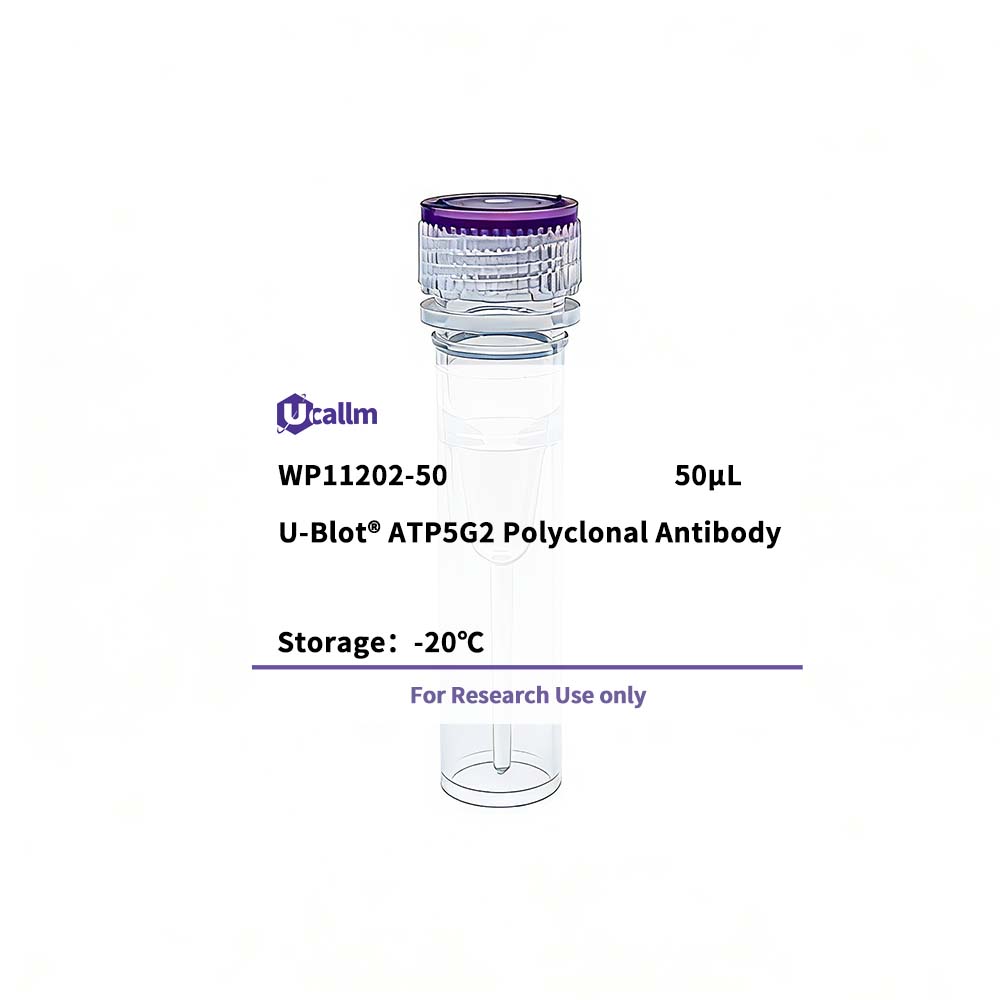
SKU: WP11202 Categories: ,

ATP5G2 Polyclonal Antibody

Price range: $268.00 through $328.00

SKU: WP11202-100
Enter the quantity you would like, or drag the panel to find the quantity and price that best for you
Bulk QuoteAuthorize OEM & ODM

Product details

Background:

This gene encodes a subunit of mitochondrial ATP synthase. Mitochondrial ATP synthase catalyzes ATP synthesis, utilizing an electrochemical gradient of protons across the inner membrane during oxidative phosphorylation. ATP synthase is composed of two linked multi-subunit complexes: the soluble catalytic core, F1, and the membrane-spanning component, Fo, comprising the proton channel. The catalytic portion of mitochondrial ATP synthase consists of 5 different subunits (alpha, beta, gamma, delta, and epsilon) assembled with a stoichiometry of 3 alpha, 3 beta, and single representatives of the gamma, delta, and epsilon subunits. The proton channel likely has nine subunits (a, b, c, d, e, f, g, F6 and 8). There are three separate genes which encode subunit c of the proton channel and they specify precursors with different import sequences but iden


Specifications

Size50μL/100μL
TargetATP5G2
ReactivityHuman, Mouse, Rat
ApplicationsWB, IHC, IF, ELISA
MW(Calculated)20kD
MW(Observed)
Host SpeciesRabbit
IsotypeIgG
Conjugate/ModificationUnmodified
Recommended Dilution RatioWB 1:500-2000; IHC 1:100-1:300; ELISA 1:40000; IF 1:50-200 / Note: For IHC, we suggest antigen retrieval with TE buffer pH 9.0 (Cat#WT1004)
FormulationLiquid in PBS containing 50% glycerol, 0.5% BSA and 0.02% sodium azide.
PurificationThe antibody was affinity-purified from rabbit antiserum by affinity-chromatography using epitope-specific immunogen.
Storage-15°C to -25°C/1 year(Do not lower than -25°C)
Concentration1 mg/ml
ClonalityPolyclonal
Clone Number
ImmunogenThe antiserum was produced against synthesized peptide derived from human ATP5G2. AA range:1-50
SpecificityATP5G2 Polyclonal Antibody detects endogenous levels of ATP5G2 protein.
Gene NameATP5G2
Protein NameATP synthase lipid-binding protein mitochondrial
Other NameATP5G2; / PSEC0033; / ATP synthase lipid-binding protein; / mitochondrial; / ATP synthase proteolipid P2; / ATPase protein 9; / ATPase subunit c
SpeciesHuman
Gene ID517
UniprotQ06055,
Species.1Mouse
Gene ID.1
Uniprot.1P56383
Species.2
Gene ID.2
Uniprot.2
Cellular LocalizationMitochondrion membrane; Multi-pass membrane protein.
Tissue ExpressionLiver,Lung,
Signaling_pathwayHuman Diseases >> Neurodegenerative disease >> Alzheimer disease;Human Diseases >> Neurodegenerative disease >> Parkinson disease;Human Diseases >> Neurodegenerative disease >> Amyotrophic lateral sclerosis;Human Diseases >> Neurodegenerative disease >> Huntington disease;Human Diseases >> Neurodegenerative disease >> Prion disease;Human Diseases >> Neurodegenerative disease >> Pathways of neurodegeneration - multiple diseases
Research Areas>>Oxidative phosphorylation; / >>Metabolic pathways; / >>Thermogenesis; / >>Alzheimer disease; / >>Parkinson disease; / >>Amyotrophic lateral sclerosis; / >>Huntington disease; / >>Prion disease; / >>Pathways of neurodegeneration - multiple diseases; / >>Chemical carcinogenesis - reactive oxygen species; / >>Diabetic cardiomyopathy
FunctionDisease:This protein is the major protein stored in the storage bodies of animals or humans affected with ceroid lipofuscinosis (Batten disease).,Function:Mitochondrial membrane ATP synthase (F(1)F(0) ATP synthase or Complex V) produces ATP from ADP in the presence of a proton gradient across the membrane which is generated by electron transport complexes of the respiratory chain. F-type ATPases consist of two structural domains, F(1) - containing the extramembraneous catalytic core and F(0) - containing the membrane proton channel, linked together by a central stalk and a peripheral stalk. During catalysis, ATP synthesis in the catalytic domain of F(1) is coupled via a rotary mechanism of the central stalk subunits to proton translocation. Part of the complex F(0) domain. A homomeric c-ring of probably 10 subunits is part of the complex rotary element.,miscellaneous:There are three genes which encode the mitochondrial ATP synthase proteolipid and they specify precursors with different import sequences but identical mature proteins.,similarity:Belongs to the ATPase C chain family.,subunit:F-type ATPases have 2 components, CF(1) - the catalytic core - and CF(0) - the membrane proton channel. CF(1) has five subunits: alpha(3), beta(3), gamma(1), delta(1), epsilon(1). CF(0) has three main subunits: a, b and c.,
Please login to post questions
Back to Top
Product has been added to your cart
