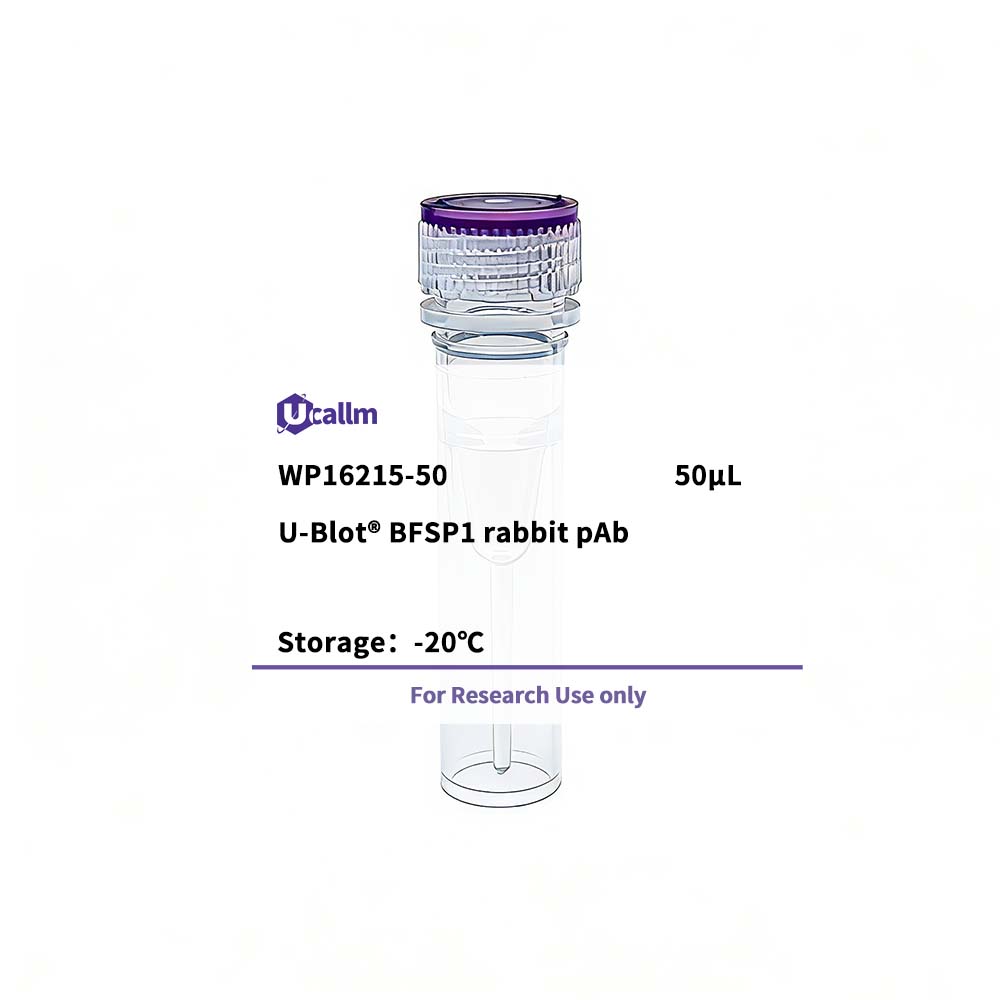
SKU: WP16215 Categories: ,

BFSP1 rabbit pAb

Price range: $268.00 through $328.00

SKU: WP16215-100
Enter the quantity you would like, or drag the panel to find the quantity and price that best for you
Bulk QuoteAuthorize OEM & ODM

Product details

Background:

This gene encodes a lens-specific intermediate filament-like protein named filensin. The encoded protein is expressed in lens fiber cells after differentiation has begun. This protein functions as a component of the beaded filament which is a cytoskeletal structure found in lens fiber cells. Mutations in this gene are the cause of autosomal recessive cortical juvenile-onset cataract. Alternate splicing results in multiple transcript variants. [provided by RefSeq, Jul 2013],

Specifications

Size50μL/100μL
TargetBFSP1
ReactivityHuman, Mouse, Rat
ApplicationsWB
MW(Calculated)73kD
MW(Observed)
Host SpeciesRabbit
IsotypeIgG
Conjugate/ModificationUnmodified
Recommended Dilution RatioWB 1:500-2000
FormulationLiquid in PBS containing 50% glycerol, 0.5% BSA and 0.02% sodium azide.
PurificationThe antibody was affinity-purified from rabbit antiserum by affinity-chromatography using epitope-specific immunogen.
Storage-15°C to -25°C/1 year(Do not lower than -25°C)
Concentration1 mg/ml
ClonalityPolyclonal
Clone Number
ImmunogenSynthesized peptide derived from human BFSP1 AA range: 494-544
SpecificityThis antibody detects endogenous levels of BFSP1 at Human/Mouse/Rat
Gene NameBFSP1
Protein NameBFSP1
Other Name
SpeciesHuman
Gene ID631
UniprotQ12934,
Species.1Mouse
Gene ID.112075
Uniprot.1A2AMT1,
Species.2Rat
Gene ID.225394
Uniprot.2Q02435
Cellular LocalizationCell membrane; Peripheral membrane protein; Cytoplasmic side . Cytoplasm . Cytoplasm, cytoskeleton . Cytoplasm, cell cortex .
Tissue ExpressionExpressed in the cortex and nucleus of the retina lens (at protein level).
Signaling_pathway
Research Areas
FunctionDisease:Defects in BFSP1 are the cause of autosomal recessive cortical juvenile-onset cataract [MIM:611391]. Cataract is the most frequent cause of visual impairment and blindness worldwide. While congenital cataracts are less frequent than age related cataracts, if not treated promptly they can result in irreversible neural blindness. The frequency of non-syndromic congenital cataract is estimated to be 1-6 cases per 10'000 children with one additional case being diagnosed during childhood. Developmental or juvenile onset cataract is distinguished from congenital cataract by initial clarity of the lens at birth and development of opacities progressively with maturation during childhood or adolescence. Approximately 25% of non-syndromic cataracts are inherited, and they are phenotypically and genetically heterogeneous, with autosomal dominant generally considered to be more common than autosomal recessive and X-linked inheritance.,similarity:Belongs to the intermediate filament family.,subcellular location:Membrane- and cytoskeleton-associated.,subunit:Associates with BFSP2.,tissue specificity:Lens.,
Please login to post questions
Back to Top
Product has been added to your cart
