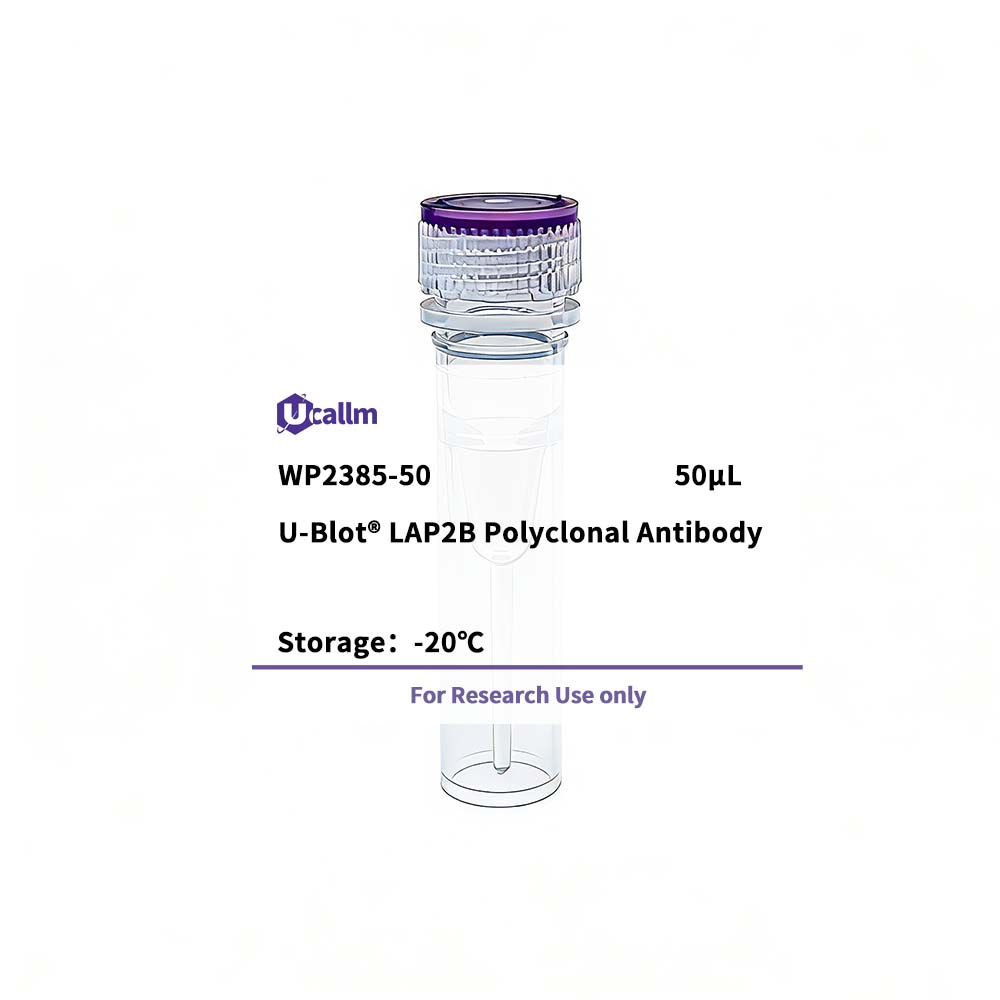
SKU: WP2385 Categories: ,

LAP2B Polyclonal Antibody

Price range: $268.00 through $328.00

SKU: WP2385-100
Enter the quantity you would like, or drag the panel to find the quantity and price that best for you
Bulk QuoteAuthorize OEM & ODM

Product details

Background:

alternative products:Additional isoforms seem to exist, domain:Has two structurally independent, non-interacting domains: LEM-like (also called LAP2-N or LEM-D) and LEM (also called LAP2-C or LEM-B). LEM-like binds DNA while LEM interacts with BANF1., function:May be involved in the structural organization of the nucleus and in the post-mitotic nuclear assembly. Play an important role, together with LMNA, in the nuclear anchorage of RB1., function:May help direct the assembly of the nuclear lamina and thereby help maintain the structural organization of the nuclear envelope. Possible receptor for attachment of lamin filaments to the inner nuclear membrane. May be involved in the control of initiation of DNA replication through its interaction with NAKAP95., function:TP and TP5 may play a role in T-cell development and function. TP5 is an immunomodulating pentapeptide., pharmaceutical:TP5 is available under the names Timunox (Cilag), Sintomodulina (Italofarmaco) and Mepentil (Recordati). Used in primary and secondary immune deficiencies, autoimmunity, infections and cancer., PTM:Mitosis-specific phosphorylation specifically abolishes its binding to lamin B and chromosomes., PTM:Phosphorylated in a mitose-specific manner., similarity:Belongs to the LEM family., similarity:Contains 1 LEM domain., similarity:Contains 1 LEM-like domain., subcellular location:Expressed diffusely throughout the nucleus., subcellular location:Tightly associated with the nuclear lamina., subunit:Interacts with LMNA, BANF1 and RB1 and with chromosomes. Associates directly or indirectly with lamins at specific cell-cycle stages., subunit:Interacts with LMNB1, LMNB2, BANF1, NAKAP95, GMCL and chromosomes., tissue specificity:Expressed in many tissues. Most abundant in adult thymus and fetal liver.,


Specifications

Size50μL/100μL
TargetLAP2B
ReactivityHuman, Mouse
ApplicationsWB, ELISA
MW(Calculated)
MW(Observed)49kD
Host SpeciesRabbit
IsotypeIgG
Conjugate/ModificationUnmodified
Recommended Dilution RatioWB 1:500-2000; ELISA 1:5000-20000
FormulationLiquid in PBS containing 50% glycerol,0.5% BSA and 0.02% sodium azide.
PurificationThe antibody was affinity-purified from rabbit antiserum by affinity-chromatography using epitope-specific immunogen.
Storage-15°C to -25°C/1 year(Do not lower than -25°C)
Concentration1 mg/ml
ClonalityPolyclonal
Clone Number
ImmunogenSynthesized peptide derived from part region of human protein
SpecificityLAP2B Polyclonal Antibody detects endogenous levels of protein.
Gene NameTMPO LAP2
Protein NameLamina-associated polypeptide 2, isoforms beta/gamma (Thymopoietin, isoforms beta/gamma) (TP beta/gamma) (Thymopoietin-related peptide isoforms beta/gamma) (TPRP isoforms beta/gamma) [Cleaved into: Thymopoietin (TP) (Splenin); Thymopentin (TP5)]
Other Name
SpeciesHuman
Gene ID7112
UniprotP42167,
Species.1Mouse
Gene ID.1
Uniprot.1Q61029
Species.2
Gene ID.2
Uniprot.2
Cellular LocalizationNucleus inner membrane; Single-pass type II membrane protein. Tightly associated with the nuclear lamina.; [Isoform Zeta]: Cytoplasm .
Tissue ExpressionExpressed in many tissues. Most abundant in adult thymus and fetal liver.
Signaling_pathway
Research Areas
FunctionAlternative products:Additional isoforms seem to exist,Domain:Has two structurally independent, non-interacting domains: LEM-like (also called LAP2-N or LEM-D) and LEM (also called LAP2-C or LEM-B). LEM-like binds DNA while LEM interacts with BANF1.,Function:May be involved in the structural organization of the nucleus and in the post-mitotic nuclear assembly. Play an important role, together with LMNA, in the nuclear anchorage of RB1.,Function:May help direct the assembly of the nuclear lamina and thereby help maintain the structural organization of the nuclear envelope. Possible receptor for attachment of lamin filaments to the inner nuclear membrane. May be involved in the control of initiation of DNA replication through its interaction with NAKAP95.,Function:TP and TP5 may play a role in T-cell development and function. TP5 is an immunomodulating pentapeptide.,pharmaceutical:TP5 is available under the names Timunox (Cilag), Sintomodulina (Italofarmaco) and Mepentil (Recordati). Used in primary and secondary immune deficiencies, autoimmunity, infections and cancer.,PTM:Mitosis-specific phosphorylation specifically abolishes its binding to lamin B and chromosomes.,PTM:Phosphorylated in a mitose-specific manner.,similarity:Belongs to the LEM family.,similarity:Contains 1 LEM domain.,similarity:Contains 1 LEM-like domain.,subcellular location:Expressed diffusely throughout the nucleus.,subcellular location:Tightly associated with the nuclear lamina.,subunit:Interacts with LMNA, BANF1 and RB1 and with chromosomes. Associates directly or indirectly with lamins at specific cell-cycle stages.,subunit:Interacts with LMNB1, LMNB2, BANF1, NAKAP95, GMCL and chromosomes.,tissue specificity:Expressed in many tissues. Most abundant in adult thymus and fetal liver.,
Please login to post questions
Back to Top
Product has been added to your cart
