

BMAL2 rabbit pAb
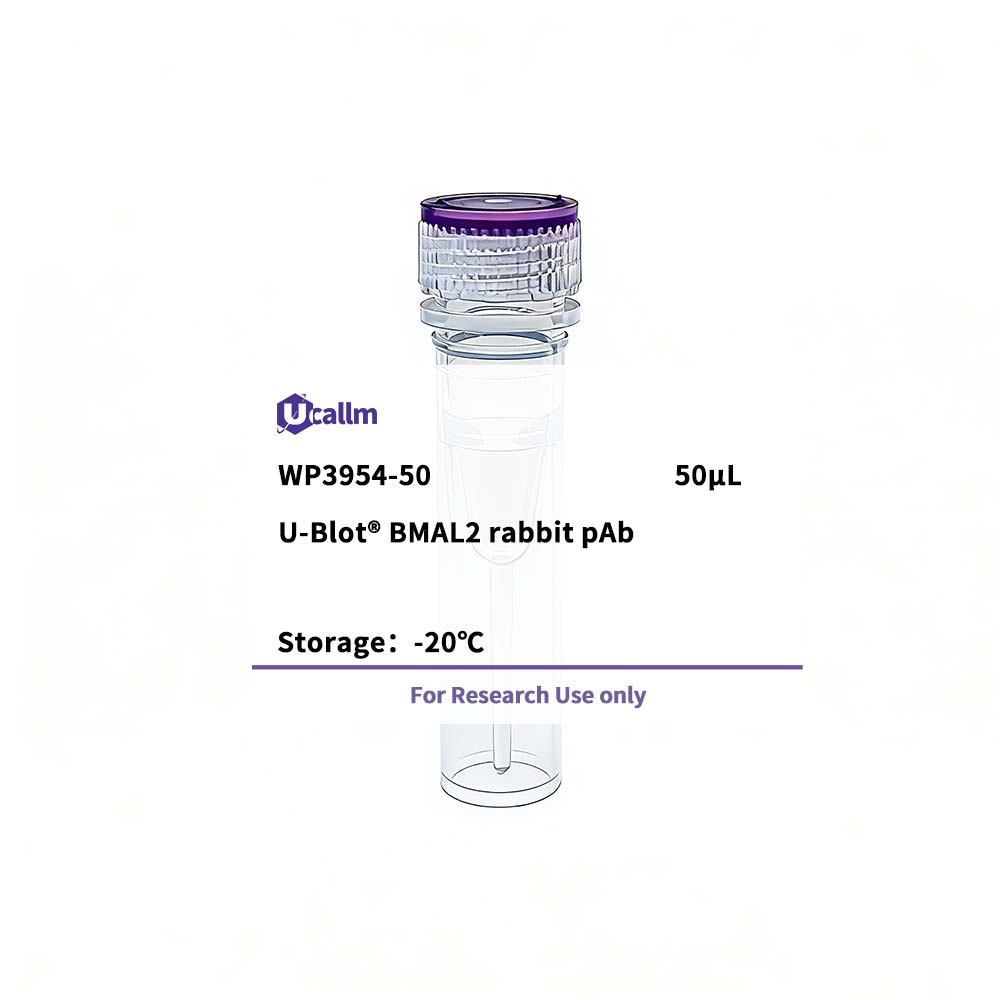
Ucallm_WP3954-50
Price range: $268.00 through $328.00
Product details
Background:
This gene encodes a basic helix-loop-helix transcription factor belonging to the PAS (PER, ARNT, SIM) superfamily. The PAS proteins play important roles in adaptation to low atmospheric and cellular oxygen levels, exposure to certain environmental pollutants, and diurnal oscillations in light and temperature. This protein forms a transcriptionally active heterodimer with the circadian CLOCK protein, the structurally related MOP4, and hypoxia-inducible factors, such as HIF1alpha. Consistent with its role as a biologically relevant partner of circadian and hypoxia factors, this protein is coexpressed in regions of the brain such as the thalamus, hypothalamus, and amygdala. Alternatively spliced transcript variants encoding different isoforms have been described for this gene. [provided by RefSeq, Oct 2011],
Specifications
| Size | 50μL/100μL |
| Target | BMAL2 |
| Reactivity | Human, Mouse |
| Applications | WB |
| MW(Calculated) | 70kD |
| MW(Observed) | |
| Host Species | Rabbit |
| Isotype | IgG |
| Conjugate/Modification | Unmodified |
| Recommended Dilution Ratio | WB 1:500-2000 |
| Formulation | Liquid in PBS containing 50% glycerol, 0.5% BSA and 0.02% sodium azide. |
| Purification | The antibody was affinity-purified from rabbit antiserum by affinity-chromatography using epitope-specific immunogen. |
| Storage | -15°C to -25°C/1 year(Do not lower than -25°C) |
| Concentration | 1 mg/ml |
| Clonality | Polyclonal |
| Clone Number | |
| Immunogen | Synthesized peptide derived from human BMAL2 AA range: 495-545 |
| Specificity | This antibody detects endogenous levels of BMAL2 at Human/Mouse |
| Gene Name | ARNTL2 BHLHE6 BMAL2 CLIF MOP9 PASD9 |
| Protein Name | BMAL2 |
| Other Name | |
| Species | Human |
| Gene ID | 56938 |
| Uniprot | Q8WYA1, |
| Species.1 | Mouse |
| Gene ID.1 | 272322 |
| Uniprot.1 | Q2VPD4 |
| Species.2 | |
| Gene ID.2 | |
| Uniprot.2 | |
| Cellular Localization | Nucleus . |
| Tissue Expression | Expressed in fetal brain. Highly expressed in brain and placenta. Lower levels in heart, liver, thymus, kidney and lung. Located to endothelial cells and neuronal cells of the suprachiasmatic nucleus (SCN). Also detected in endothelial cells of the heart, lung and kidney. In the brain, specifically expressed in the thalamus, hippocampus and amygdala. |
| Signaling_pathway | |
| Research Areas | |
| Function | Function:ARNTL2-CLOCK heterodimers activate E-box element (3'-CACGTG-5') transcription. Also, in umbilical vein endothelial cells, activates SERPINE1 through E-box sites. This transactivation is inhibited by PER2 and CRY1.,induction:Constitutively expressed. Has no circadian rhythm expression pattern.,similarity:Contains 1 basic helix-loop-helix (bHLH) domain.,similarity:Contains 1 PAC (PAS-associated C-terminal) domain.,similarity:Contains 2 PAS (PER-ARNT-SIM) domains.,subunit:Component of the circadian core oscillator, which includes the CRY proteins, CLOCK, or NPAS2, ARNTL or ARNTL2, CSNK1D and/or CSNK1E, TIMELESS and the PER proteins. Interacts directly with CLOCK to form the ARNTL2-CLOCK transactivator. Can form heterodimers or homodimers which interact directly with CLOCK to form the transcription activator. Also interacts with NPAS2 and HIF1A.,tissue specificity:Expressed in fetal brain. Highly expressed in brain and placenta. Lower levels in heart, liver, thymus, kidney and lung. Located to endothelial cells and neuronal cells of the suprachiasmatic nucleus (SCN). Also detected in endothelial cells of the heart, lung and kidney. In the brain, specifically expressed in the thalamus, hippocampus and amygdala., |
Please login to post questions
Related products





