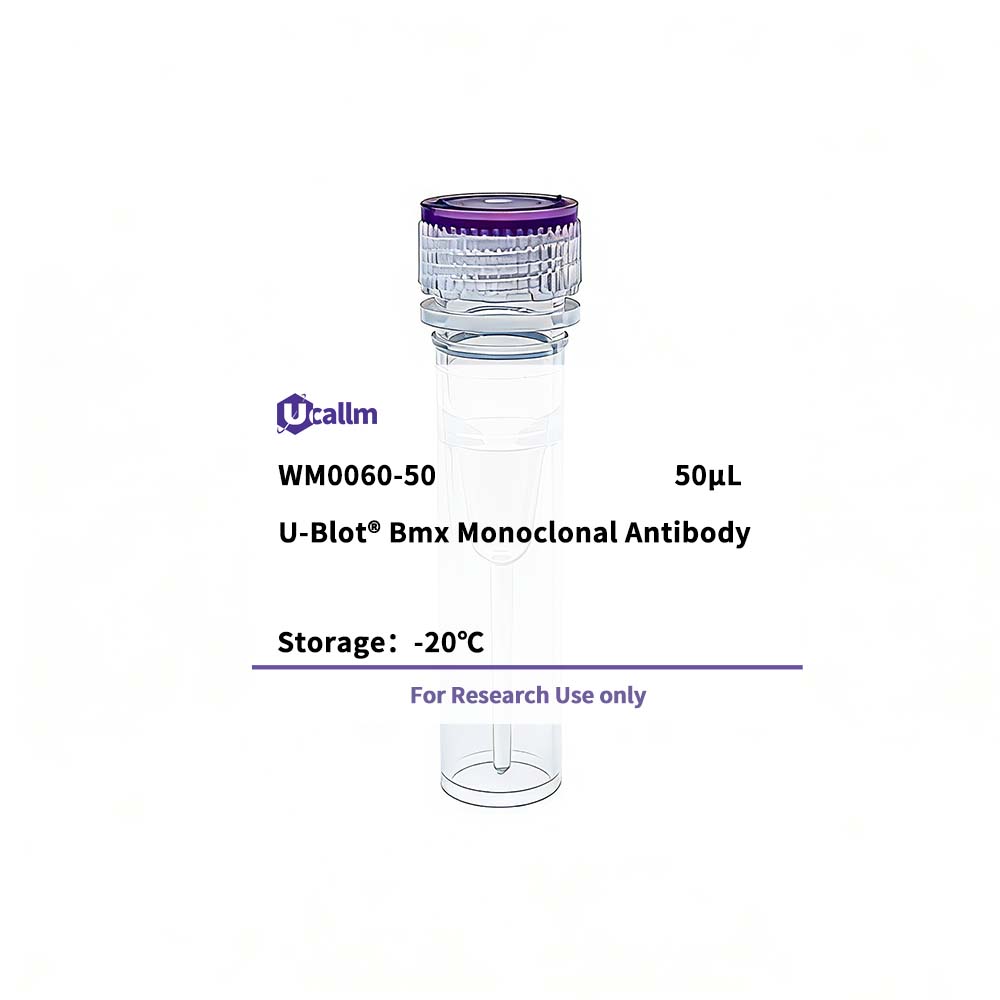
SKU: WM0060 Categories: ,

Bmx Monoclonal Antibody

Price range: $268.00 through $328.00

SKU: WM0060-50
Enter the quantity you would like, or drag the panel to find the quantity and price that best for you
Bulk QuoteAuthorize OEM & ODM

Product details

Background:
This gene encodes a non-receptor tyrosine kinase belonging to the Tec kinase family. The protein contains a PH-like domain, which mediates membrane targeting by binding to phosphatidylinositol 3, 4, 5-triphosphate (PIP3), and a SH2 domain that binds to tyrosine-phosphorylated proteins and functions in signal transduction. The protein is implicated in several signal transduction pathways including the Stat pathway, and regulates differentiation and tumorigenicity of several types of cancer cells. Alternatively spliced transcript variants have been found for this gene. [provided by RefSeq, Mar 2016],


Specifications

TargetETK
ReactivityHuman
ApplicationsWB, ELISA
MW(Calculated)78kD
MW(Observed)
Host SpeciesMouse
Isotype
Conjugate/ModificationUnmodified
Modification
Recommended Dilution RatioWB 1:500-1:2000; ELISA 1:10000; Not yet tested in other applications.
FormulationLiquid in PBS containing 50% glycerol, 0.5% BSA and 0.02% sodium azide.
Source
PurificationAffinity purification
Purity
Storage-15°C to -25°C/1 year(Do not lower than -25°C)
Concentration
ClonalityMonoclonal
Clone Number14F9
ImmunogenPurified recombinant fragment of human BMX expressed in E. Coli.
Sequence
SpecificityBMX Monoclonal Antibody detects endogenous levels of BMX protein.
Gene NameBMX
Protein NameCytoplasmic tyrosine-protein kinase BMX
Other NameBMX; / Cytoplasmic tyrosine-protein kinase BMX; / Bone marrow tyrosine kinase gene in chromosome X protein; / Epithelial and endothelial tyrosine kinase; / ETK; / NTK38
SpeciesHuman
Gene ID-1660
UniprotP51813,
Species.1Mouse
Gene ID-2
Uniprot.1P97504
Species.2
Gene ID-3
Uniprot.2
Organism-4
Gene ID-4
SwissProt-4
BackgroundThis gene encodes a non-receptor tyrosine kinase belonging to the Tec kinase family. The protein contains a PH-like domain, which mediates membrane targeting by binding to phosphatidylinositol 3,4,5-triphosphate (PIP3), and a SH2 domain that binds to tyrosine-phosphorylated proteins and functions in signal transduction. The protein is implicated in several signal transduction pathways including the Stat pathway, and regulates differentiation and tumorigenicity of several types of cancer cells. Alternatively spliced transcript variants have been found for this gene. [provided by RefSeq, Mar 2016],
Cellular LocalizationCytoplasm . Localizes to the edges of spreading cells when complexed with BCAR1.
Tissue ExpressionHighly expressed in cells with great migratory potential, including endothelial cells and metastatic carcinoma cell lines.
Signaling_pathway
Research Areas
FunctionCatalytic activity:ATP + a [protein]-L-tyrosine = ADP + a [protein]-L-tyrosine phosphate.,cofactor:Binds 1 zinc ion per subunit.,Domain:SH2 domain mediates interaction with RUFY1.,Function:Activity is required for interleukin 6 (IL-6) induced differentiation. May play a role in the growth and differentiation of hematopoietic cells. May be involved in signal transduction in endocardial and arterial endothelial cells.,induction:Activated by IL-6 through phosphatidylinositol 3-kinase (PI3-kinase) pathway. It is likely that activation occurs through binding of phosphoinositides to the PH domain.,similarity:Belongs to the protein kinase superfamily. Tyr protein kinase family. TEC subfamily.,similarity:Contains 1 Btk-type zinc finger.,similarity:Contains 1 PH domain.,similarity:Contains 1 protein kinase domain.,similarity:Contains 1 SH2 domain.,subunit:Interacts with RUFY1 and RUFY2.,tissue specificity:Preferentially expressed in epithelial and endothelial cells.,
RRID
Please login to post questions
Back to Top
Product has been added to your cart