SKU: WR4605 Categories: ,

U-Blot® BRCA1 Rabbit mAb

Price range: $268.00 through $328.00

SKU: WR4605-50
Enter the quantity you would like, or drag the panel to find the quantity and price that best for you
Bulk QuoteAuthorize OEM & ODM

Product details

Background:This gene encodes a nuclear phosphoprotein that plays a role in maintaining genomic stability, and it also acts as a tumor suppressor. The encoded protein combines with other tumor suppressors, DNA damage sensors, and signal transducers to form a large multi-subunit protein complex known as the BRCA1-associated genome surveillance complex (BASC). This gene product associates with RNA polymerase II, and through the C-terminal domain, also interacts with histone deacetylase complexes. This protein thus plays a role in transcription, DNA repair of double-stranded breaks, and recombination. Mutations in this gene are responsible for approximately 40% of inherited breast cancers and more than 80% of inherited breast and ovarian cancers. Alternative splicing plays a role in modulating the subcellular localization and physiological function of this gene. Many alternatively spliced transcript varian


Specifications

Size50μL/100μL
TargetBRCA1
ReactivityHuman
ApplicationsWB, IHC, IF, IP, ELISA
MW(Calculated)208kD
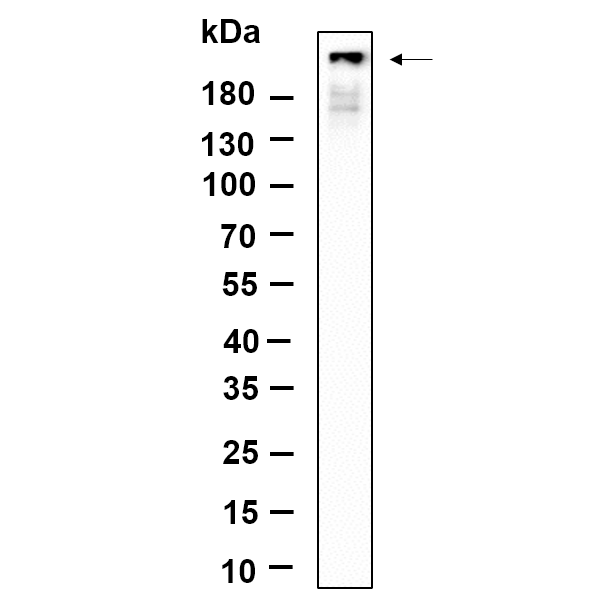
MW(Observed)270kD
Host SpeciesRabbit
IsotypeIgG,Kappa
Conjugate/ModificationUnmodified
Recommended Dilution RatioWB 1:10000-1:50000; IHC 1:100-1:500; IF 1:200-1:1000; ELISA 1:5000-1:20000; IP 1:50-1:200; / Note: For IHC, we suggest antigen retrieval with TE buffer pH 9.0 (Cat#WT1004)
FormulationPBS, 50% glycerol, 0.05% Proclin 300, 0.05%BSA
PurificationRecombinant Antibody expressed in animal component-free (ACF) media, purified via Protein A affinity chromatography.
Storage-15°C to -25°C/1 year(Do not lower than -25°C)
Concentration
ClonalityMonoclonal
Clone NumberRM0876R
ImmunogenSynthesized peptide derived from C-ternal BRCA1
SpecificityEndogenous
Gene NameBRCA1 RNF53
Protein NameBreast cancer type 1 susceptibility protein
Other NameBRCA1; / RNF53; / Breast cancer type 1 susceptibility protein; / RING finger protein 53
SpeciesHuman
Gene ID672
UniprotP38398,
Species.1Mouse
Gene ID.112189
Uniprot.1P48754,
Species.2Rat
Gene ID.2497672
Uniprot.2O54952
Cellular LocalizationNucleus . Chromosome . Cytoplasm . Localizes at sites of DNA damage at double-strand breaks (DSBs); recruitment to DNA damage sites is mediated by ABRAXAS1 and the BRCA1-A complex (PubMed:26778126). Translocated to the cytoplasm during UV-induced apoptosis (PubMed:20160719). .; [Isoform 3]: Cytoplasm.; [Isoform 5]: Cytoplasm .
Tissue ExpressionIsoform 1 and isoform 3 are widely expressed. Isoform 3 is reduced or absent in several breast and ovarian cancer cell lines.
Signaling_pathwayHuman Diseases >> Cancer: overview >> MicroRNAs in cancer;Human Diseases >> Cancer: specific types >> Breast cancer;Environmental Information Processing >> Signal transduction >> PI3K-Akt signaling pathway;Genetic Information Processing >> Folding, sorting and degradation >> Ubiquitin mediated proteolysis
Research Areas>>Platinum drug resistance; / >>Homologous recombination; / >>Fanconi anemia pathway; / >>Ubiquitin mediated proteolysis; / >>PI3K-Akt signaling pathway; / >>MicroRNAs in cancer; / >>Breast cancer
FunctionDisease:Defects in BRCA1 are a cause of genetic susceptibility to breast cancer (BC) [MIM:113705, 114480]. BC is an extremely common malignancy, affecting one in eight women during their lifetime. A positive family history has been identified as major contributor to risk of development of the disease, and this link is striking for early-onset breast cancer. Mutations in BRCA1 are thought to be responsible for 45% of inherited breast cancer. Moreover, BRCA1 carriers have a 4-fold increased risk of colon cancer, whereas male carriers face a 3-fold increased risk of prostate cancer. Cells lacking BRCA1 show defects in DNA repair by homologous recombination.,Disease:Defects in BRCA1 are a cause of genetic susceptibility to ovarian cancer [MIM:113705].,Disease:Defects in BRCA1 are a cause of susceptibility to familial breast-ovarian cancer type 1 (BROVCA1) [MIM:604370]. Mutations in BRCA1 are thought to be responsible for more than 80% of inherited breast-ovarian cancer.,Domain:The BRCT domains recognize and bind phosphorylated pSXXF motif on proteins. The interaction with the phosphorylated pSXXF motif of FAM175A/Abraxas, recruits BRCA1 at DNA damage sites.,Domain:The RING-type zinc finger domain interacts with BAP1.,Function:The BRCA1-BARD1 heterodimer coordinates a diverse range of cellular pathways such as DNA damage repair, ubiquitination and transcriptional regulation to maintain genomic stability. Acts by mediating ubiquitin E3 ligase activity that is required for its tumor suppressor function. Plays a central role in DNA repair by facilitating cellular response to DNA repair. Required for appropriate cell cycle arrests after ionizing irradiation in both the S-phase and the G2 phase of the cell cycle. Involved in transcriptional regulation of P21 in response to DNA damage. Required for FANCD2 targeting to sites of DNA damage. May function as a transcriptional regulator. Inhibits lipid synthesis by binding to inactive phosphorylated ACACA and preventing its dephosphorylation.,online information:BRCA1 entry,online information:The Singapore human mutation and polymorphism database,pathway:Protein modification; protein ubiquitination.,polymorphism:There is evidence that the presence of the rare form of Gln-356-Arg and Leu-871-Pro polymorphisms may be associated with an increased risk for developing ovarian cancer.,PTM:Phosphorylated in response to IR, UV, and various stimuli that cause checkpoint activation, probably by ATM or ATR.,similarity:Contains 1 RING-type zinc finger.,similarity:Contains 2 BRCT domains.,subcellular location:Localizes at sites of DNA damage at double-strand breaks (DSBs); recruitment to DNA damage sites is mediated by the BRCA1-A complex.,subunit:Part of the BRCA1-associated genome surveillance complex (BASC), which contains BRCA1, MSH2, MSH6, MLH1, ATM, BLM, PMS2 and the RAD50-MRE11-NBN protein complex. This association could be a dynamic process changing throughout the cell cycle and within subnuclear domains. Component of the BRCA1-A complex, at least composed of the BRCA1, BARD1, UIMC1/RAP80, FAM175A/Abraxas, BRCC3/BRCC36, BRE/BRCC45 and MERIT40/NBA1. Interacts (via BRCT domains) with FAM175A/Abraxas and RBBP8. Associates with RNA polymerase II holoenzyme. Interacts with SMC1A and COBRA1/NELFB. Interacts (via BRCT domains) with BRIP1. Interacts with FANCD2 (ubiquitinated). Interacts with BAP1. Interacts with DCLRE1C/Artemis and CLSPN. Interacts with H2AFX (phosphorylated on 'Ser-140'). Interacts with CHEK1/CHK1. Interacts with BRCC3. Interacts (via BRCT domains) with ACACA (phosphorylated); the interaction prevents dephosphorylation of ACACA.,tissue specificity:Isoform 1 and isoform 3 are widely expressed. Isoform 3 is reduced or absent in several breast and ovarian cancer cell lines.,
Please login to post questions

Back to Top
Product has been added to your cart
