

BRCA2 Polyclonal Antibody
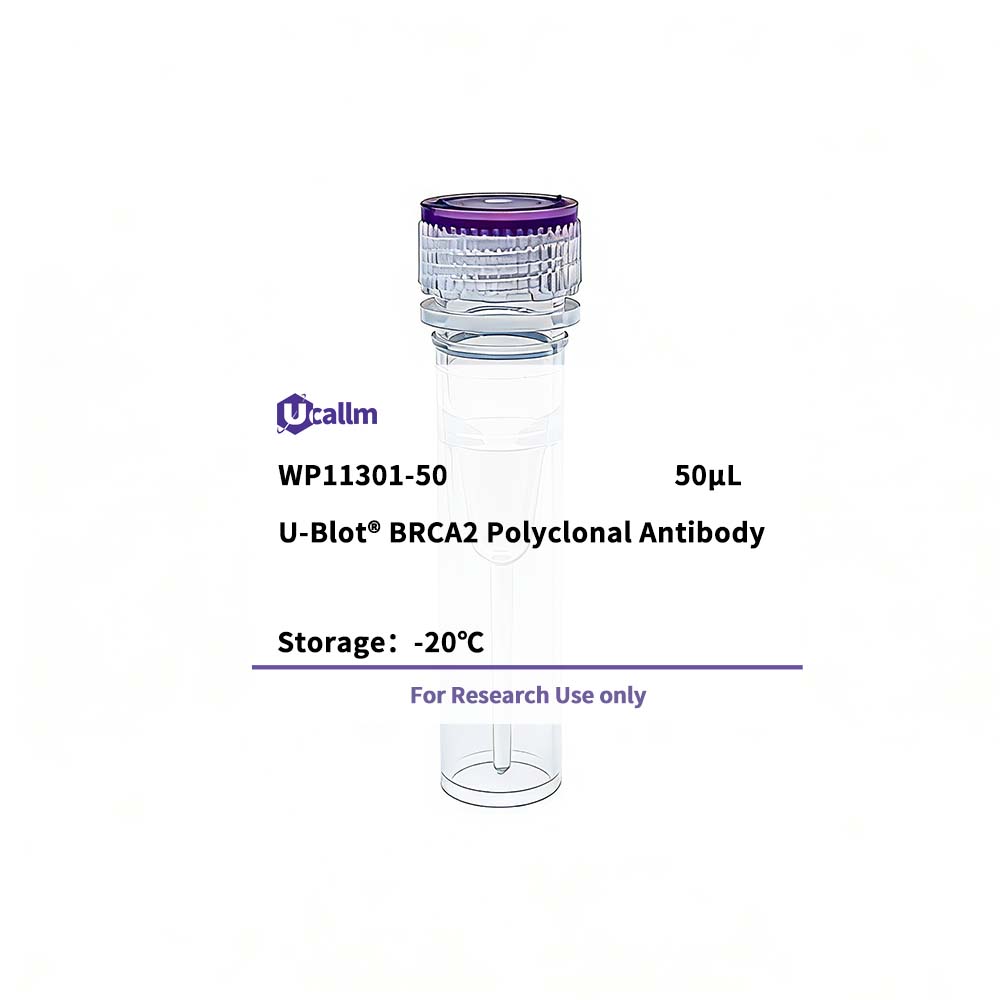
Ucallm_WP11301-50
Price range: $268.00 through $328.00
Product details
Background:
Inherited mutations in BRCA1 and this gene, BRCA2, confer increased lifetime risk of developing breast or ovarian cancer. Both BRCA1 and BRCA2 are involved in maintenance of genome stability, specifically the homologous recombination pathway for double-strand DNA repair. The BRCA2 protein contains several copies of a 70 aa motif called the BRC motif, and these motifs mediate binding to the RAD51 recombinase which functions in DNA repair. BRCA2 is considered a tumor suppressor gene, as tumors with BRCA2 mutations generally exhibit loss of heterozygosity (LOH) of the wild-type allele. [provided by RefSeq, Dec 2008],
Specifications
| Size | 50μL/100μL |
| Target | BRCA2 |
| Reactivity | Human, Rat |
| Applications | IHC, IF, ELISA |
| MW(Calculated) | 384kD |
| MW(Observed) | |
| Host Species | Rabbit |
| Isotype | IgG |
| Conjugate/Modification | Unmodified |
| Recommended Dilution Ratio | IHC 1:100-1:300; ELISA 1:20000; IF 1:50-200 / Note: For IHC, we suggest antigen retrieval with TE buffer pH 9.0 (Cat#WT1004) |
| Formulation | Liquid in PBS containing 50% glycerol, 0.5% BSA and 0.02% sodium azide. |
| Purification | The antibody was affinity-purified from rabbit antiserum by affinity-chromatography using epitope-specific immunogen. |
| Storage | -15°C to -25°C/1 year(Do not lower than -25°C) |
| Concentration | 1 mg/ml |
| Clonality | Polyclonal |
| Clone Number | |
| Immunogen | The antiserum was produced against synthesized peptide derived from human BRCA2. AA range:31-80 |
| Specificity | BRCA2 Polyclonal Antibody detects endogenous levels of BRCA2 protein. |
| Gene Name | BRCA2 |
| Protein Name | Breast cancer type 2 susceptibility protein |
| Other Name | BRCA2; / FACD; / FANCD1; / Breast cancer type 2 susceptibility protein; / Fanconi anemia group D1 protein |
| Species | Human |
| Gene ID | 675 |
| Uniprot | P51587, |
| Species.1 | Mouse |
| Gene ID.1 | 12190 |
| Uniprot.1 | P97929, |
| Species.2 | Rat |
| Gene ID.2 | |
| Uniprot.2 | O35923 |
| Cellular Localization | Nucleus . Cytoplasm, cytoskeleton, microtubule organizing center, centrosome . Colocalizes with ERCC5/XPG to nuclear foci following DNA replication stress. . |
| Tissue Expression | Highest levels of expression in breast and thymus, with slightly lower levels in lung, ovary and spleen. |
| Signaling_pathway | Human Diseases >> Cancer: overview >> Pathways in cancer;Human Diseases >> Cancer: specific types >> Pancreatic cancer;Human Diseases >> Cancer: specific types >> Breast cancer |
| Research Areas | >>Homologous recombination; / >>Fanconi anemia pathway; / >>Pathways in cancer; / >>Pancreatic cancer; / >>Breast cancer |
| Function | Disease:Defects in BRCA2 are a cause of genetic susceptibility to breast cancer (BC) [MIM:612555, 114480]; also called susceptibility to familial breast-ovarian cancer type 2 (BROVCA2). BC is an extremely common malignancy, affecting one in eight women during their lifetime. A positive family history has been identified as major contributor to risk of development of the disease, and this link is striking for early-onset breast cancer. Mutations in BRCA2 are thought to be responsible for some inherited breast cancer. It is linked with male breast cancer.,Disease:Defects in BRCA2 are the cause of Fanconi anemia complementation group D type 1 (FANCD1) [MIM:605724]. Fanconi anemia [MIM:227650] is an autosomal recessive disorder affecting all bone marrow elements and associated with cardiac, renal, and limb malformations as well as dermal pigmentary changes.,Function:Involved in double-strand break repair and/or homologous recombination. May participate in S phase checkpoint activation.,online information:BRCA2 entry,polymorphism:Genetic variations in BRCA2 may underlie susceptibility to uveal melanoma [MIM:155720]. Uveal melanoma is the most common type of ocular malignant tumor, consisting of overgrowth of uveal melanocytes and often preceded by a uveal nevus.,PTM:Phosphorylated by ATM upon irradiation-induced DNA damage.,similarity:Contains 8 BRCA2 repeats.,subunit:Interacts with RAD51 and DSS1. Interacts with ubiquitinated FANCD2. Interacts with PALB2, enables the recombinational repair and checkpoints functions. Interacts with WDR16.,tissue specificity:Highest levels of expression in breast and thymus, with slightly lower levels in lung, ovary and spleen., |
Please login to post questions
Related products





