


C8orf4 rabbit pAb
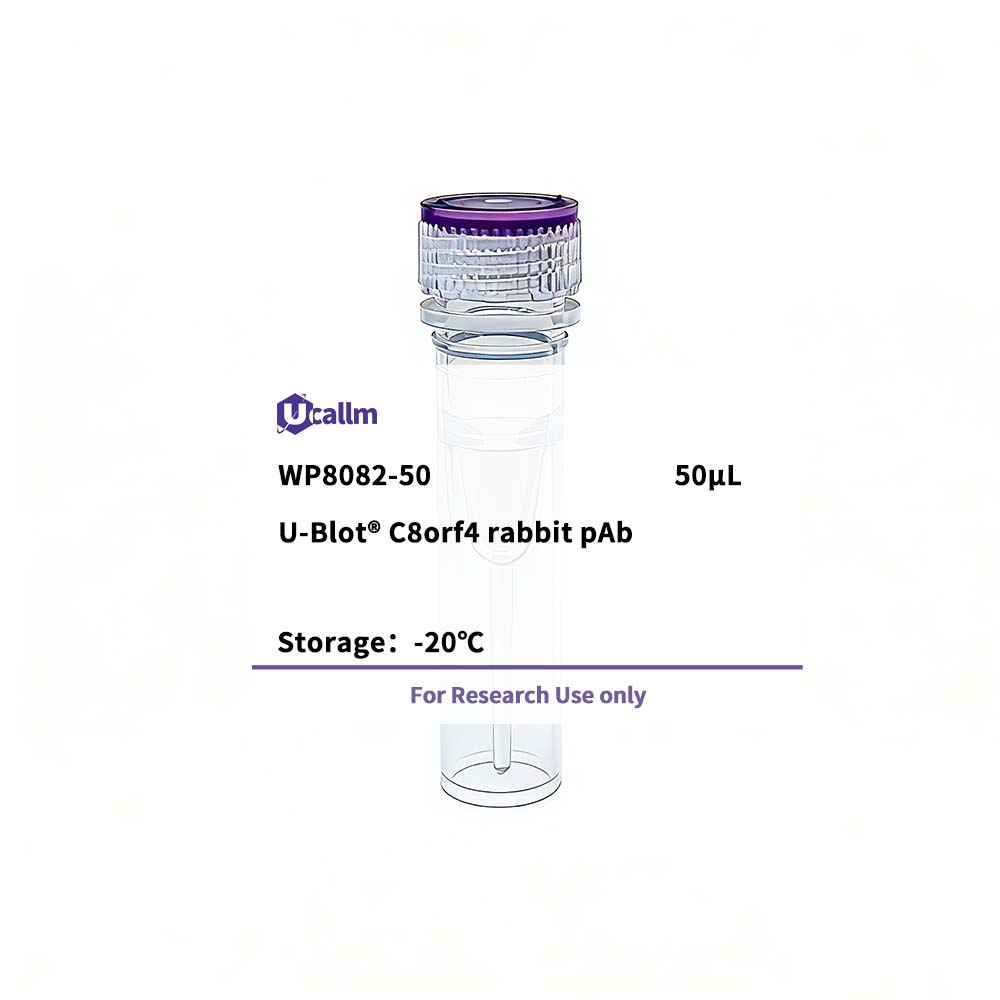
Ucallm_WP8082-50
Price range: $268.00 through $328.00
Product details
Background:
Specifications
| Size | 50μL/100μL |
| Target | TCIM |
| Reactivity | Human, Mouse |
| Applications | WB |
| MW(Calculated) | 12kD |
| MW(Observed) | |
| Host Species | Rabbit |
| Isotype | IgG |
| Conjugate/Modification | Unmodified |
| Recommended Dilution Ratio | WB 1:500-2000 |
| Formulation | Liquid in PBS containing 50% glycerol, 0.5% BSA and 0.02% sodium azide. |
| Purification | The antibody was affinity-purified from rabbit antiserum by affinity-chromatography using epitope-specific immunogen. |
| Storage | -15°C to -25°C/1 year(Do not lower than -25°C) |
| Concentration | 1 mg/ml |
| Clonality | Polyclonal |
| Clone Number | |
| Immunogen | Synthesized peptide derived from human C8orf4 |
| Specificity | This antibody detects endogenous levels of C8orf4 at Human, Mouse |
| Gene Name | C8orf4 TC1 |
| Protein Name | Uncharacterized protein C8orf4 (Thyroid cancer protein 1) (TC-1) |
| Other Name | |
| Species | Human |
| Gene ID | 56892 |
| Uniprot | Q9NR00, |
| Species.1 | Mouse |
| Gene ID.1 | 69068 |
| Uniprot.1 | Q9D915 |
| Species.2 | |
| Gene ID.2 | |
| Uniprot.2 | |
| Cellular Localization | Cytoplasm . Nucleus, nucleolus . Nucleus speckle . Nucleus . Localizes in nucleus speckles in presence of CBY1 (PubMed:16424001). Translocates to the nucleus upon cellular stress such as H(2)O(2) (PubMed:17603013). . |
| Tissue Expression | Ubiquitous. Expressed in thyroid papillary carcinoma. Expressed in liver, expression levels decrease in hepatocellular carcinoma (PubMed:25985737). Slightly detected in normal lung, its expression is highly induced in lung cancer cells (at protein level) (PubMed:24941347). |
| Signaling_pathway | |
| Research Areas | |
| Function | Seems to be involved in the regulation of cell growth an differentiation, may play different and opposite roles depending on the tissue or cell type. May enhance the WNT-CTNNB1 pathway by relieving antagonistic activity of CBY1 . Enhances the proliferation of follicular dendritic cells . Plays a role in the mitogen-activated MAPK2/3 signaling pathway, positively regulates G1-to-S-phase transition of the cell cycle . In endothelial cells, enhances key inflammatory mediators and inflammatory response through the modulation of NF-kappaB transcriptional regulatory activity . Involved in the regulation of heat shock response, seems to play a positive feedback with HSF1 to modulate heat-shock downstream gene expression . Plays a role in the regulation of hematopoiesis even if the mechanisms are unknown (By similarity). In cancers such as thyroid or lung cancer, it has been described as promoter of cell proliferation, G1-to-S-phase transition and inhibitor of apoptosis . However, it negatively regulates self-renewal of liver cancer cells via suppresion of NOTCH2 signaling . |
Please login to post questions
Related products


