SKU: WP10311 Categories: ,

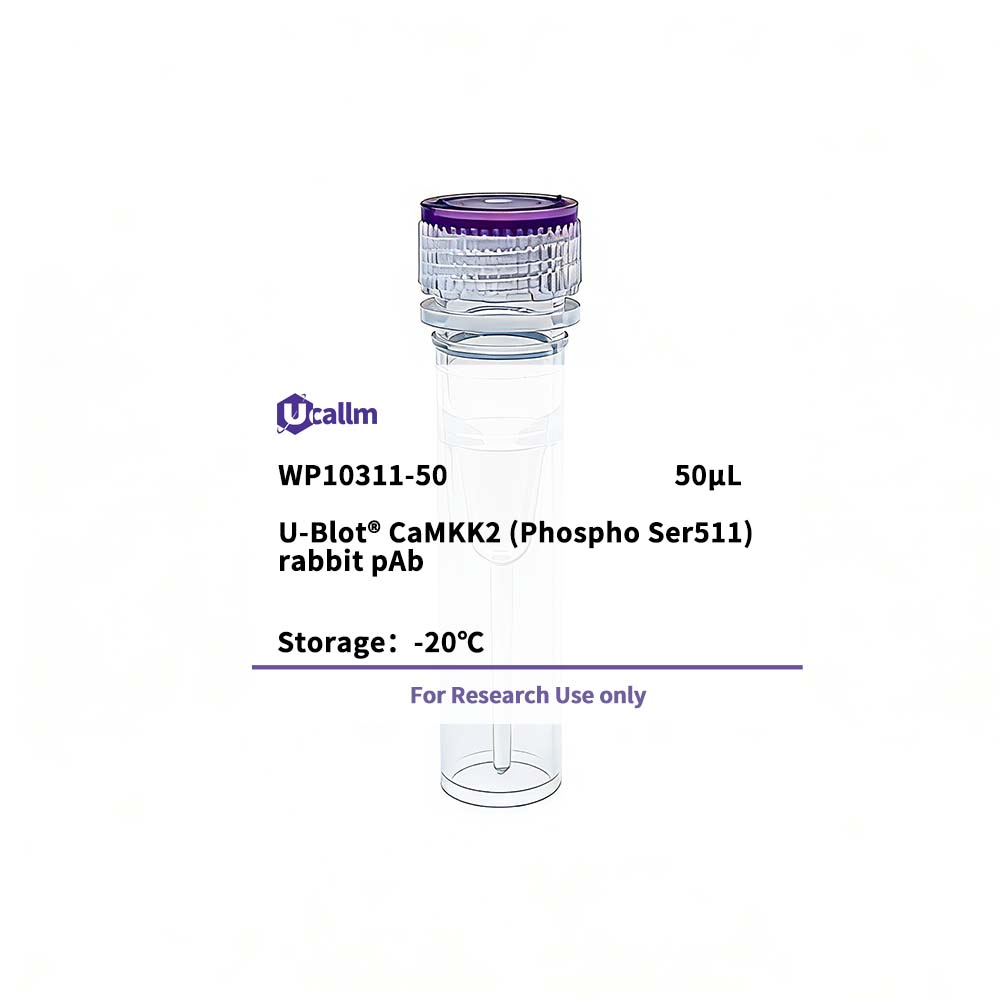
CaMKK2 (Phospho Ser511) rabbit pAb

Price range: $288.00 through $368.00

SKU: WP10311-100
Enter the quantity you would like, or drag the panel to find the quantity and price that best for you
Bulk QuoteAuthorize OEM & ODM

Product details

Background:

The product of this gene belongs to the Serine/Threonine protein kinase family, and to the Ca(2+)/calmodulin-dependent protein kinase subfamily. The major isoform of this gene plays a role in the calcium/calmodulin-dependent (CaM) kinase cascade by phosphorylating the downstream kinases CaMK1 and CaMK4. Protein products of this gene also phosphorylate AMP-activated protein kinase (AMPK). This gene has its strongest expression in the brain and influences signalling cascades involved with learning and memory, neuronal differentiation and migration, neurite outgrowth, and synapse formation. Alternative splicing results in multiple transcript variants encoding distinct isoforms. The identified isoforms differ in their ability to undergo autophosphorylation and to phosphorylate downstream kinases. [provided by RefSeq, Jul 2012],


Specifications

Size50μL/100μL
TargetCaMKK2 Phospho Ser511
ReactivityHuman, Mouse, Rat
ApplicationsWB
MW(Calculated)
MW(Observed)65kD
Host SpeciesRabbit
IsotypeIgG
Conjugate/Modificationphosphate
Recommended Dilution RatioWB 1:1000-2000
FormulationLiquid in PBS containing 50% glycerol, 0.5% BSA and 0.02% sodium azide.
PurificationThe antibody was affinity-purified from rabbit serum by affinity-chromatography using specific immunogen.
Storage-15°C to -25°C/1 year(Do not lower than -25°C)
Concentration1 mg/ml
ClonalityPolyclonal
Clone Number
ImmunogenSynthesized phosho peptide around human CaMKK2 (Ser511)
SpecificityThis antibody detects endogenous levels of Human Mouse Rat CaMKK2 (phospho-Ser511)
Gene NameCAMKK2 CAMKKB KIAA0787
Protein NameCalcium/calmodulin-dependent protein kinase kinase 2
Other NameCAMKK2; / CAMKKB; / KIAA0787; / Calcium/calmodulin-dependent protein kinase kinase 2; / CaM-KK 2; / CaM-kinase kinase 2; / CaMKK 2; / Calcium/calmodulin-dependent protein kinase kinase beta; / CaM-KK beta; / CaM-kinase kinase beta; / CaMKK beta
SpeciesHuman
Gene ID10645
UniprotQ96RR4,
Species.1Mouse
Gene ID.1207565
Uniprot.1Q8C078,
Species.2Rat
Gene ID.283506
Uniprot.2O88831
Cellular LocalizationNucleus . Cytoplasm . Cell projection, neuron projection . Predominantly nuclear in unstimulated cells, relocalizes into cytoplasm and neurites after forskolin induction. .
Tissue ExpressionUbiquitously expressed with higher levels in the brain. Intermediate levels are detected in spleen, prostate, thyroid and leukocytes. The lowest level is in lung.
Signaling_pathwayCellular Processes >> Transport and catabolism >> Autophagy - animal;Organismal Systems >> Endocrine system >> Adipocytokine signaling pathway;Organismal Systems >> Endocrine system >> Oxytocin signaling pathway;Organismal Systems >> Aging >> Longevity regulating pathway;Environmental Information Processing >> Signal transduction >> AMPK signaling pathway
Research Areas>>Autophagy - animal; / >>AMPK signaling pathway; / >>Longevity regulating pathway; / >>Adipocytokine signaling pathway; / >>Oxytocin signaling pathway; / >>Alcoholic liver disease; / >>Alcoholism
FunctionCatalytic activity:ATP + a protein = ADP + a phosphoprotein.,Domain:The autoinhibitory domain overlaps with the calmodulin binding region and may be involved in intrasteric autoinhibition.,Domain:The RP domain (arginine/proline-rich) is involved in the recognition of CAMKI and CAMK4 as substrates.,enzyme regulation:Activated by Ca(2+)/calmodulin. Binding of calmodulin may releave intrasteric autoinhibition. Autophosphorylation does not alter activity or regulation by Ca(2+)/calmodulin. In part, activity is independent on Ca(2+)/calmodulin.,Function:Calcium/calmodulin-dependent protein kinase belonging to a proposed calcium-triggered signaling cascade involved in a number of cellular processes. Isoform 1, isoform 2 and isoform 3 phosphorylate CAMK1 and CAMK4. Isoform 3 phosphorylates CAMK1D. Isoform 4, isoform 5 and isoform 6 lacking part of the calmodulin-binding domain are inactive. Seems to be involved in hippocampal activation of CREB1.,PTM:Autophosphorylated.,sequence Caution:Intron retention.,similarity:Belongs to the protein kinase superfamily. Ser/Thr protein kinase family.,similarity:Contains 1 protein kinase domain.,subunit:Interacts with calmodulin.,tissue specificity:Ubiquitously expressed with higher levels in the brain. Intermediate levels are detected in spleen, prostate, thyroid and leukocytes. The lowest level is in lung.,
Please login to post questions
Back to Top
Product has been added to your cart

