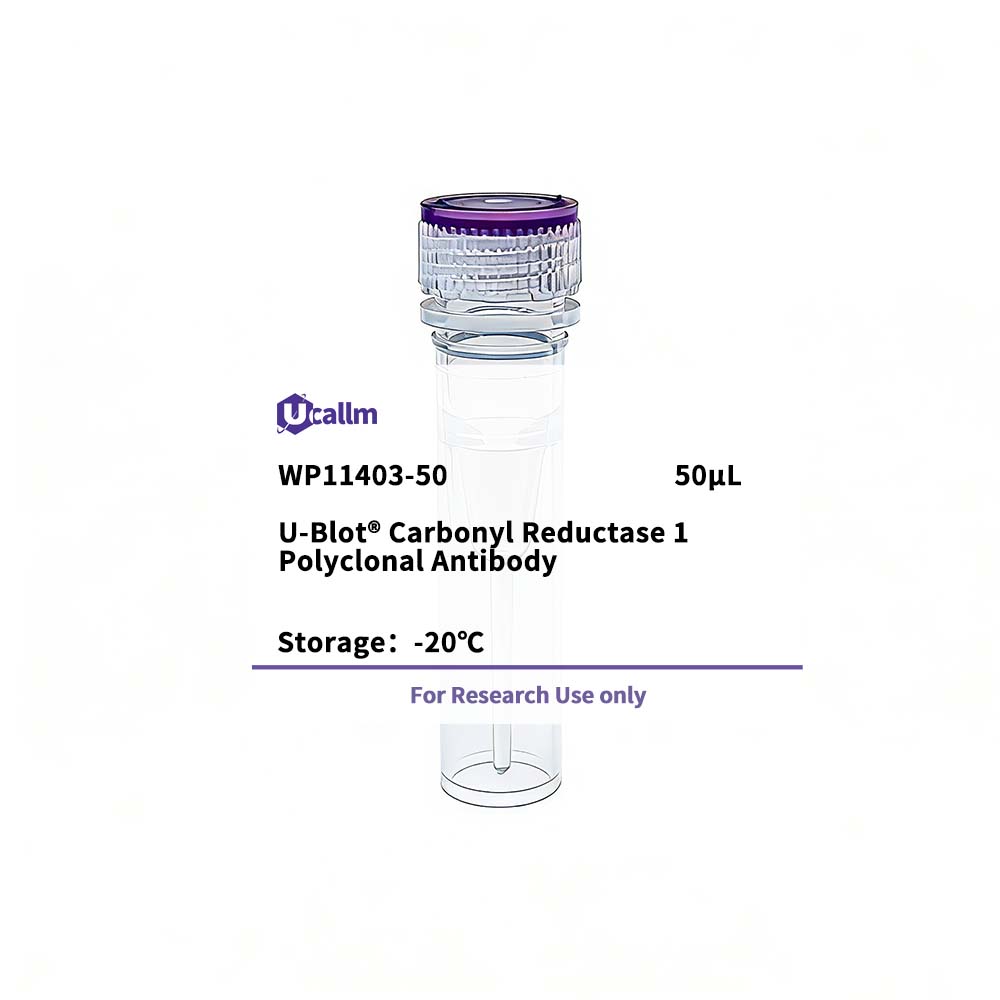
SKU: WP11403 Categories: ,

Carbonyl Reductase 1 Polyclonal Antibody

Price range: $268.00 through $328.00

SKU: WP11403-100
Enter the quantity you would like, or drag the panel to find the quantity and price that best for you
Bulk QuoteAuthorize OEM & ODM

Product details

Background:

The protein encoded by this gene belongs to the short-chain dehydrogenases/reductases (SDR) family, which function as NADPH-dependent oxidoreductases having wide specificity for carbonyl compounds, such as quinones, prostaglandins, and various xenobiotics. Alternatively spliced transcript variants have been found for this gene. [provided by RefSeq, Nov 2013],


Specifications

Size50μL/100μL
TargetCBR1
ReactivityHuman, Mouse, Rat
ApplicationsWB, IHC, IF, ELISA
MW(Calculated)
MW(Observed)32kD
Host SpeciesRabbit
IsotypeIgG
Conjugate/ModificationUnmodified
Recommended Dilution RatioWB 1:500-1:2000; IHC 1:100-1:300; ELISA 1:40000; IF 1:50-200 / Note: For IHC, we suggest antigen retrieval with TE buffer pH 9.0 (Cat#WT1004)
FormulationLiquid in PBS containing 50% glycerol, 0.5% BSA and 0.02% sodium azide.
PurificationThe antibody was affinity-purified from rabbit antiserum by affinity-chromatography using epitope-specific immunogen.
Storage-15°C to -25°C/1 year(Do not lower than -25°C)
Concentration1 mg/ml
ClonalityPolyclonal
Clone Number
ImmunogenThe antiserum was produced against synthesized peptide derived from human CBR1. AA range:181-230
SpecificityCarbonyl Reductase 1 Polyclonal Antibody detects endogenous levels of Carbonyl Reductase 1 protein.
Gene NameCBR1
Protein NameCarbonyl reductase [NADPH] 1
Other NameCBR1; / CBR; / CRN; / Carbonyl reductase [NADPH] 1; / 15-hydroxyprostaglandin dehydrogenase [NADP; / +; / ]; / NADPH-dependent carbonyl reductase 1; / Prostaglandin 9-ketoreductase; / Prostaglandin-E; / 2; / 9-reductase
SpeciesHuman
Gene ID873
UniprotP16152,
Species.1Mouse
Gene ID.1
Uniprot.1P48758
Species.2
Gene ID.2
Uniprot.2
Cellular LocalizationCytoplasm .
Tissue ExpressionExpressed in kidney (at protein level).
Signaling_pathway
Research Areas>>Arachidonic acid metabolism; / >>Folate biosynthesis; / >>Metabolism of xenobiotics by cytochrome P450; / >>Metabolic pathways; / >>Chemical carcinogenesis - DNA adducts; / >>Chemical carcinogenesis - reactive oxygen species
FunctionCatalytic activity:(13E)-(15S)-11-alpha,15-dihydroxy-9-oxoprost-13-enoate + NADP(+) = (13E)-11-alpha-hydroxy-9,15-dioxoprost-13-enoate + NADPH.,Catalytic activity:(5Z,13E)-(15S)-9-alpha,11-alpha,15-trihydroxyprosta-5,13-dienoate + NADP(+) = (5Z,13E)-(15S)-11-alpha,15-dihydroxy-9-oxoprosta-5,13-dienoate + NADPH.,Catalytic activity:R-CHOH-R' + NADP(+) = R-CO-R' + NADPH.,Function:Catalyzes the reduction of a wide variety of carbonyl compounds including the antitumor anthracycline antibiotics. Can convert prostaglandin E2 to prostaglandin F2-alpha.,similarity:Belongs to the short-chain dehydrogenases/reductases (SDR) family.,subunit:Monomer.,
Please login to post questions
Back to Top
Product has been added to your cart

