


CBR4 rabbit pAb
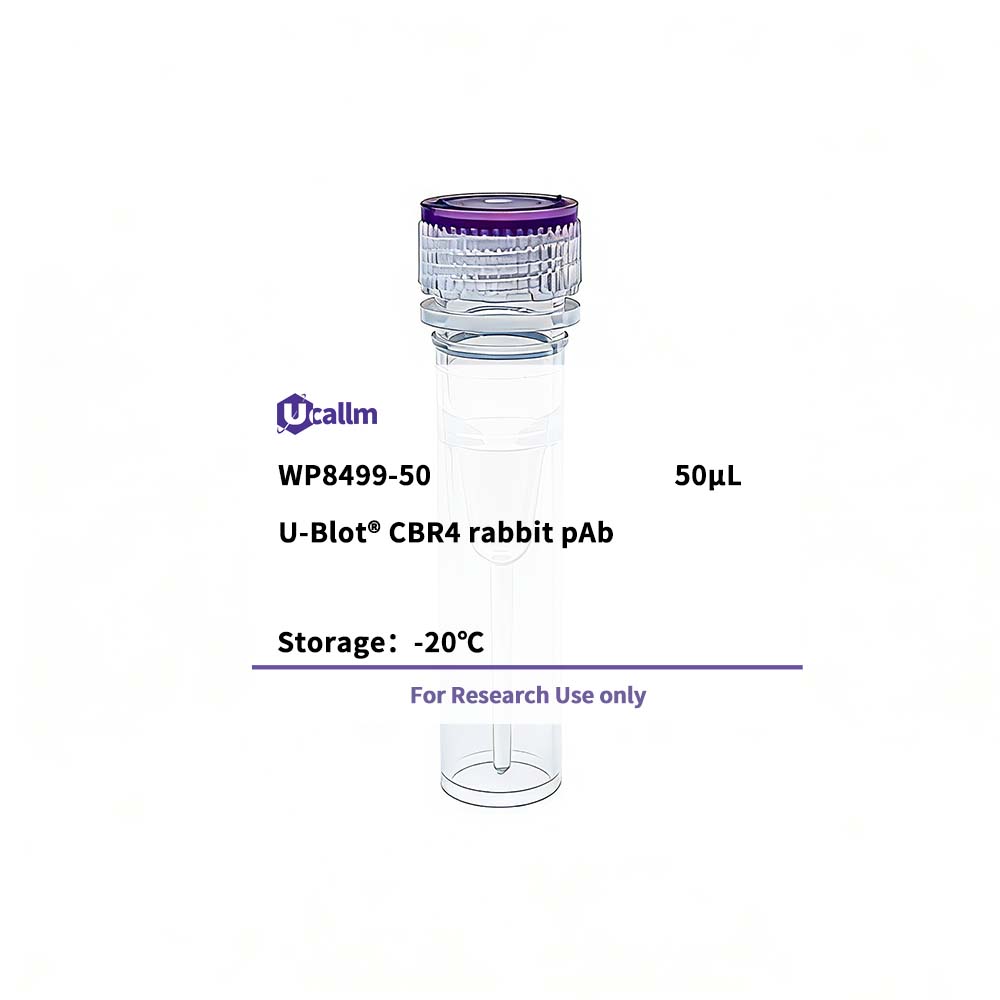
Ucallm_WP8499-50
Price range: $268.00 through $328.00
Product details
Background:
Specifications
| Size | 50μL/100μL |
| Target | CBR4 |
| Reactivity | Human, Mouse, Rat |
| Applications | WB |
| MW(Calculated) | 26kD |
| MW(Observed) | |
| Host Species | Rabbit |
| Isotype | IgG |
| Conjugate/Modification | Unmodified |
| Recommended Dilution Ratio | WB 1:500-2000 |
| Formulation | Liquid in PBS containing 50% glycerol, 0.5% BSA and 0.02% sodium azide. |
| Purification | The antibody was affinity-purified from rabbit antiserum by affinity-chromatography using epitope-specific immunogen. |
| Storage | -15°C to -25°C/1 year(Do not lower than -25°C) |
| Concentration | 1 mg/ml |
| Clonality | Polyclonal |
| Clone Number | |
| Immunogen | Synthesized peptide derived from human CBR4 |
| Specificity | This antibody detects endogenous levels of CBR4 at Human, Mouse,Rat |
| Gene Name | CBR4 |
| Protein Name | Carbonyl reductase family member 4 (3-oxoacyl-[acyl-carrier-protein] reductase) (Quinone reductase CBR4) |
| Other Name | |
| Species | Human |
| Gene ID | 84869 |
| Uniprot | Q8N4T8, |
| Species.1 | Mouse |
| Gene ID.1 | 234309 |
| Uniprot.1 | Q91VT4, |
| Species.2 | Rat |
| Gene ID.2 | 359725 |
| Uniprot.2 | Q7TS56 |
| Cellular Localization | Mitochondrion matrix . |
| Tissue Expression | Detected in liver and kidney (at protein level) (PubMed:19000905). Displays the highest expression in neuronal and muscle tissues (PubMed:25203508). |
| Signaling_pathway | |
| Research Areas | |
| Function | Component of the heterotetramer complex KAR (3-ketoacyl-[acyl carrier protein] reductase or 3-ketoacyl-[ACP] reductase) that forms part of the mitochondrial fatty acid synthase (mtFAS). Beta-subunit of the KAR heterotetramer complex, responsible for the 3-ketoacyl-ACP reductase activity of the mtFAS, reduces 3-oxoacyl-[ACP] to (3R)-hydroxyacyl-[ACP] in a NADPH-dependent manner with no chain length preference, thereby participating in mitochondrial fatty acid biosynthesis . The homotetramer has NADPH-dependent quinone reductase activity (in vitro), hence could play a role in protection against cytotoxicity of exogenous quinones . As a heterotetramer, it can also reduce 9,10-phenanthrenequinone, 1,4-benzoquinone and various other o-quinones and p-quinones (in vitro) . |
Please login to post questions
Related products


