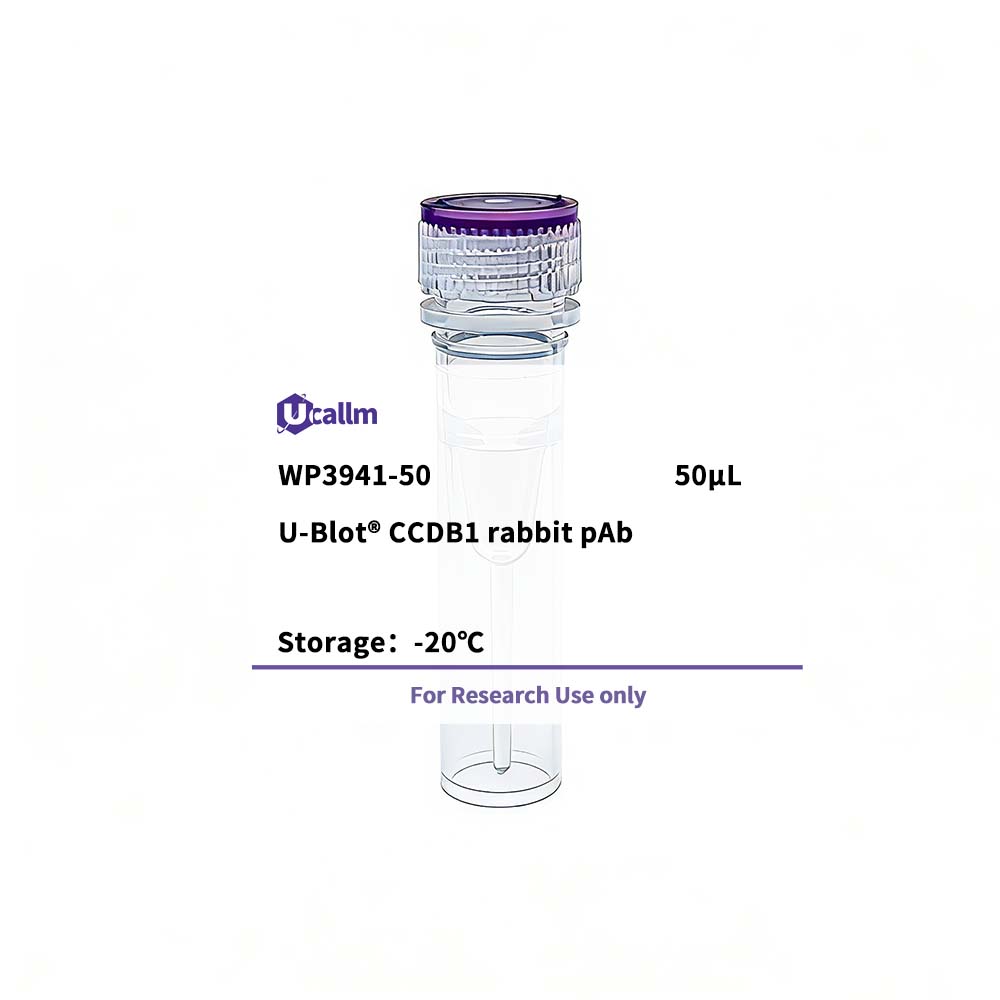
SKU: WP3941 Categories: ,

CCDB1 rabbit pAb

Price range: $268.00 through $328.00

SKU: WP3941-100
Enter the quantity you would like, or drag the panel to find the quantity and price that best for you
Bulk QuoteAuthorize OEM & ODM

Product details

Background:

This gene was identified by the interaction of its gene product with Grap2, a leukocyte-specific adaptor protein important for immune cell signaling. The protein encoded by this gene was shown to interact with cyclin D. Transfection of this gene in cells was reported to reduce the phosphorylation of Rb gene product by cyclin D-dependent protein kinase, and inhibit E2F1-mediated transcription activity. This protein was also found to interact with helix-loop-helix protein E12 and is thought to be a negative regulator of liver-specific gene expression. Several alternatively spliced variants have been found for this gene. [provided by RefSeq, Apr 2009],

Specifications

Size50μL/100μL
TargetCCDB1
ReactivityHuman, Mouse, Rat
ApplicationsWB
MW(Calculated)40kD
MW(Observed)
Host SpeciesRabbit
IsotypeIgG
Conjugate/ModificationUnmodified
Recommended Dilution RatioWB 1:500-2000
FormulationLiquid in PBS containing 50% glycerol, 0.5% BSA and 0.02% sodium azide.
PurificationThe antibody was affinity-purified from rabbit antiserum by affinity-chromatography using epitope-specific immunogen.
Storage-15°C to -25°C/1 year(Do not lower than -25°C)
Concentration1 mg/ml
ClonalityPolyclonal
Clone Number
ImmunogenSynthesized peptide derived from human CCDB1 AA range: 53-103
SpecificityThis antibody detects endogenous levels of CCDB1 at Human/Mouse/Rat
Gene NameCCNDBP1 DIP1 GCIP HHM
Protein NameCCDB1
Other Name
SpeciesHuman
Gene ID23582
UniprotO95273,
Species.1Mouse
Gene ID.117151
Uniprot.1Q3TVC7,
Species.2Rat
Gene ID.2362201
Uniprot.2Q5BK06
Cellular LocalizationCytoplasm. Nucleus.
Tissue ExpressionUbiquitously expressed. Expression is down-regulated in a variety of tumor types including breast, colon, prostate and rectal tumors, and is up-regulated in certain hepatic carcinomas.
Signaling_pathway
Research Areas
Functiondevelopmental stage:Expression may increase during differentiation.,Function:May negatively regulate cell cycle progression. May act at least in part via inhibition of the cyclin-D1/CDK4 complex, thereby preventing phosphorylation of RB1 and blocking E2F-dependent transcription.,induction:Expression is induced by sodium butyrate, an inhibitor of colon cancer cell proliferation.,PTM:Phosphorylated.,similarity:Belongs to the CCNDBP1 family.,subunit:Interacts with CCND1 and GRAP2. May also interact with COPS5, RPLP0, SIRT6, SYF2 and TCF3.,tissue specificity:Ubiquitously expressed. Expression is down-regulated in a variety of tumor types including breast, colon, prostate and rectal tumors, and is up-regulated in certain hepatic carcinomas.,
Please login to post questions
Back to Top
Product has been added to your cart