


CCL28 Polyclonal Antibody
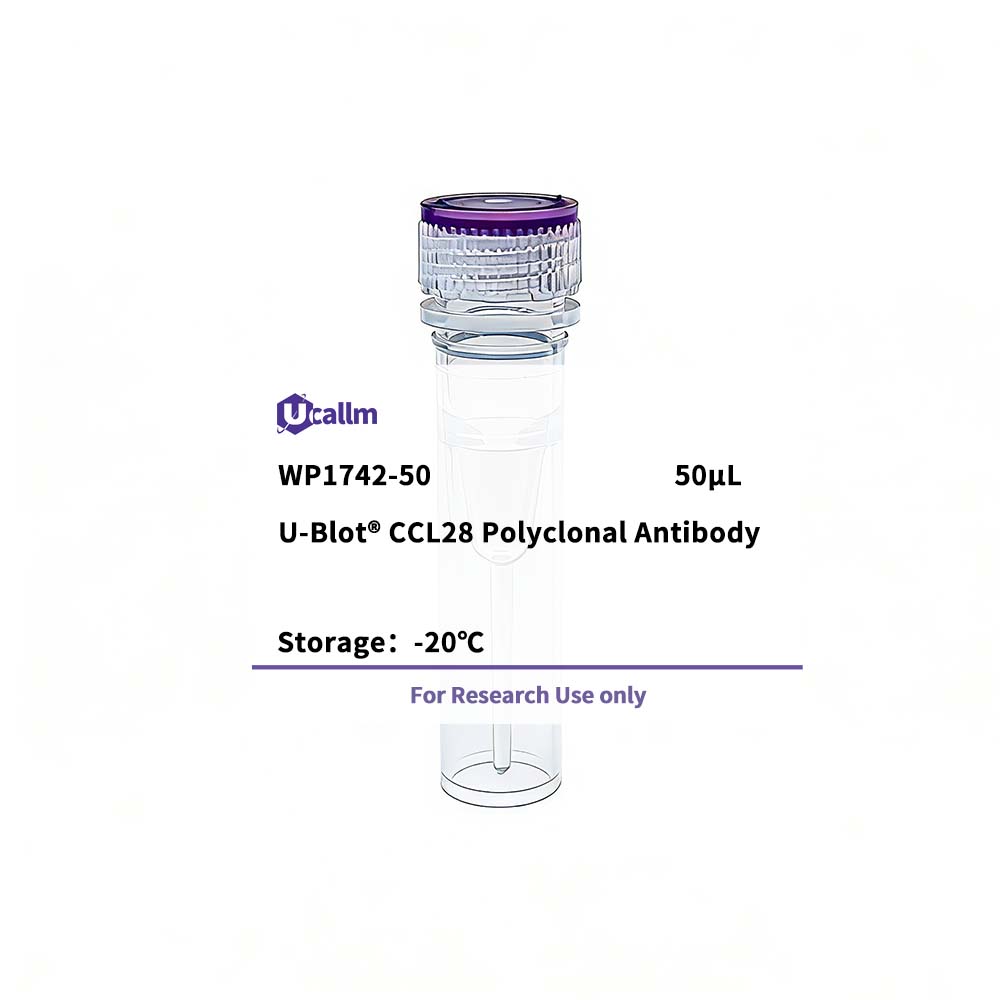
Ucallm_WP1742-50
Price range: $268.00 through $328.00
Product details
Background:
This antimicrobial gene belongs to the subfamily of small cytokine CC genes. Cytokines are a family of secreted proteins involved in immunoregulatory and inflammatory processes. The CC cytokines are proteins characterized by two adjacent cysteines. The cytokine encoded by this gene displays chemotactic activity for resting CD4 or CD8 T cells and eosinophils. The product of this gene binds to chemokine receptors CCR3 and CCR10. This chemokine may play a role in the physiology of extracutaneous epithelial tissues, including diverse mucosal organs. Multiple transcript variants encoding two different isoforms have been found for this gene. [provided by RefSeq, Sep 2014],
Specifications
| Size | 50μL/100μL |
| Target | CCL28 |
| Reactivity | Human, Mouse |
| Applications | WB, ELISA |
| MW(Calculated) | |
| MW(Observed) | 13kD |
| Host Species | Rabbit |
| Isotype | IgG |
| Conjugate/Modification | Unmodified |
| Recommended Dilution Ratio | WB 1:500-2000; ELISA 1:5000-20000 |
| Formulation | Liquid in PBS containing 50% glycerol,0.5% BSA and 0.02% sodium azide. |
| Purification | The antibody was affinity-purified from rabbit antiserum by affinity-chromatography using epitope-specific immunogen. |
| Storage | -15°C to -25°C/1 year(Do not lower than -25°C) |
| Concentration | 1 mg/ml |
| Clonality | Polyclonal |
| Clone Number | |
| Immunogen | Synthesized peptide derived from human protein . at AA range: 50-130 |
| Specificity | CCL28 Polyclonal Antibody detects endogenous levels of protein. |
| Gene Name | CCL28 SCYA28 |
| Protein Name | C-C motif chemokine 28 (Mucosae-associated epithelial chemokine) (MEC) (Protein CCK1) (Small-inducible cytokine A28) |
| Other Name | |
| Species | Human |
| Gene ID | 56477 |
| Uniprot | Q9NRJ3, |
| Species.1 | Mouse |
| Gene ID.1 | |
| Uniprot.1 | Q9JIL2 |
| Species.2 | |
| Gene ID.2 | |
| Uniprot.2 | |
| Cellular Localization | Secreted. |
| Tissue Expression | Preferentially expressed by epithelial cells of diverse tissues including normal and pathological colon, salivary gland, mammary gland, trachea and rectum. Also found in prostate, spleen, thyroid, psoriasis skin and in lower levels in peripheral blood leukocytes, small intestine, Peyer patches, stomach and normal skin. |
| Signaling_pathway | Organismal Systems >> Immune system >> Intestinal immune network for IgA production;Organismal Systems >> Immune system >> Chemokine signaling pathway;Environmental Information Processing >> Signaling molecules and interaction >> Cytokine-cytokine receptor interaction;Environmental Information Processing >> Signaling molecules and interaction >> Viral protein interaction with cytokine and cytokine receptor |
| Research Areas | >>Cytokine-cytokine receptor interaction; / >>Viral protein interaction with cytokine and cytokine receptor; / >>Chemokine signaling pathway; / >>Intestinal immune network for IgA production |
| Function | Function:Chemotactic activity for resting CD4, CD8 T-cells and eosinophils. Binds to CCR3 and CCR10 and induces calcium mobilization in a dose-dependent manner.,online information:CCL28 entry,similarity:Belongs to the intercrine beta (chemokine CC) family.,tissue specificity:Preferentially expressed by epithelial cells of diverse tissues including normal and pathological colon, salivary gland, mammary gland, trachea and rectum. Also found in prostate, spleen, thyroid, psoriasis skin and in lower levels in peripheral blood leukocytes, small intestine, Peyer patches, stomach and normal skin., |
Please login to post questions
Related products





