SKU: WR5111 Categories: ,

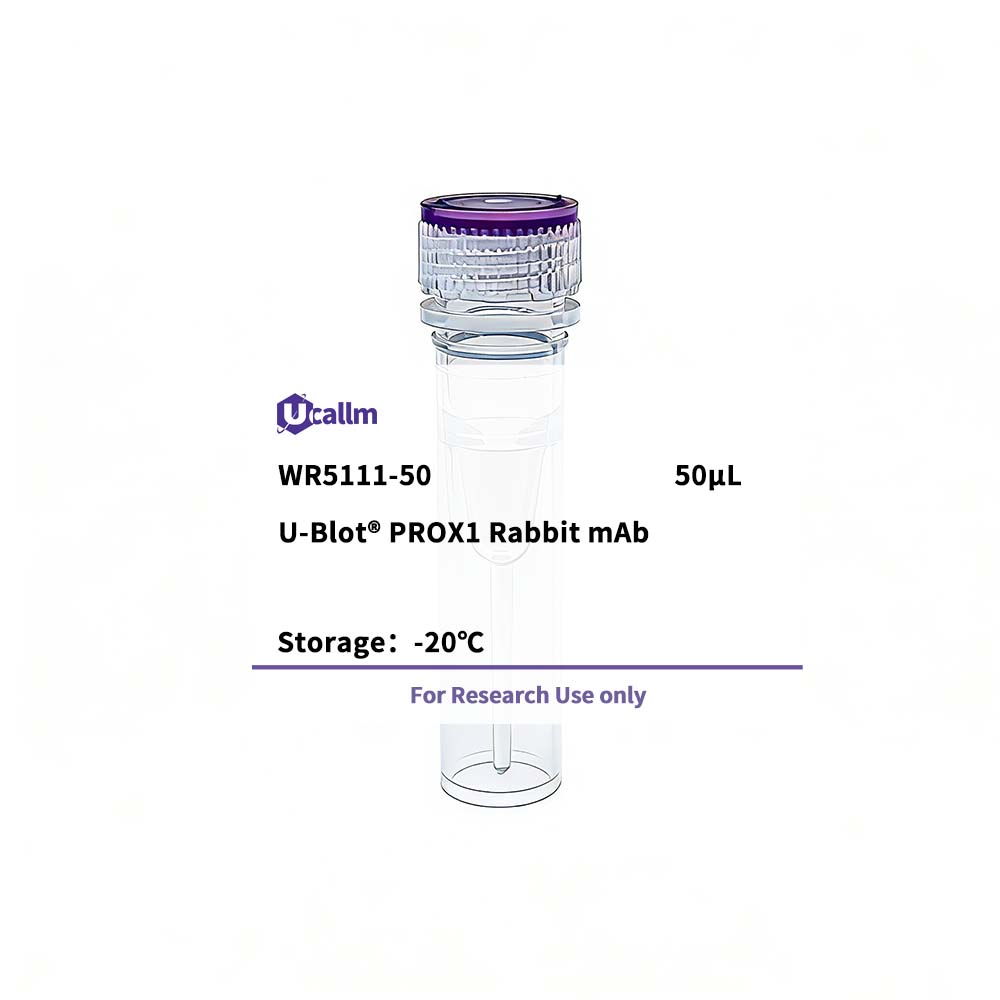
U-Blot® PROX1 Rabbit mAb

Price range: $268.00 through $328.00

SKU: WR5111-50
Enter the quantity you would like, or drag the panel to find the quantity and price that best for you
Bulk QuoteAuthorize OEM & ODM

Product details

Background:The protein encoded by this gene is a member of the homeobox transcription factor family. Members of this family contain a homeobox domain that consists of a 60-amino acid helix-turn-helix structure that binds DNA and RNA. The protein encoded by this gene is conserved across vertebrates and may play an essential role during development. Altered levels of this protein have been reported in cancers of different organs, such as colon, brain, blood, breast, pancreas, liver and esophagus. Alternative splicing results in multiple transcript variants. [provided by RefSeq, Jul 2012],

Specifications

Size50μL/100μL
TargetPROX1
ReactivityHuman, Mouse, Rat
ApplicationsWB, IHC, IF, ELISA
MW(Calculated)83kD
MW(Observed)83kD
Host SpeciesRabbit
IsotypeIgG,Kappa
Conjugate/ModificationUnmodified
Recommended Dilution RatioIHC 1:100-1:500; WB 1:2000-1:10000; IF 1:200-1:1000; ELISA 1:5000-1:20000; / Note: For IHC, we suggest antigen retrieval with TE buffer pH 9.0 (Cat#WT1004)
FormulationPBS, 50% glycerol, 0.05% Proclin 300, 0.05%BSA
PurificationRecombinant Antibody expressed in animal component-free (ACF) media, purified via Protein A affinity chromatography.
Storage-15°C to -25°C/1 year(Do not lower than -25°C)
Concentration
ClonalityMonoclonal
Clone NumberRM1306R
ImmunogenThe specific immunogen used to produce this antibody is proprietary information.
SpecificityEndogenous
Gene NamePROX1
Protein NameProspero homeobox protein 1 (Homeobox prospero-like protein PROX1) (PROX-1)
Other Name
SpeciesHuman
Gene ID5629
UniprotQ92786,
Species.1Mouse
Gene ID.1
Uniprot.1P48437
Species.2
Gene ID.2
Uniprot.2
Cellular LocalizationNucleus . RORG promotes its nuclear localization. .
Tissue ExpressionMost actively expressed in the developing lens. Detected also in embryonic brain, lung, liver and kidney. In adult, it is more abundant in heart and liver than in brain, skeletal muscle, kidney and pancreas.
Signaling_pathway
Research Areas
FunctionFunction:May play a fundamental role in early development of CNS. May regulate gene expression and development of postmitotic undifferentiated young neurons.,similarity:Belongs to the Prospero homeobox family.,similarity:Contains 1 Prospero-type homeobox DNA-binding domain.,tissue specificity:Most actively expressed in the developing lens. Detected also in embryonic brain, lung, liver and kidney. In adult, it is more abundant in heart and liver than in brain, skeletal muscle, kidney and pancreas.,
Please login to post questions
Back to Top
Product has been added to your cart

