


CD166 Monoclonal Antibody
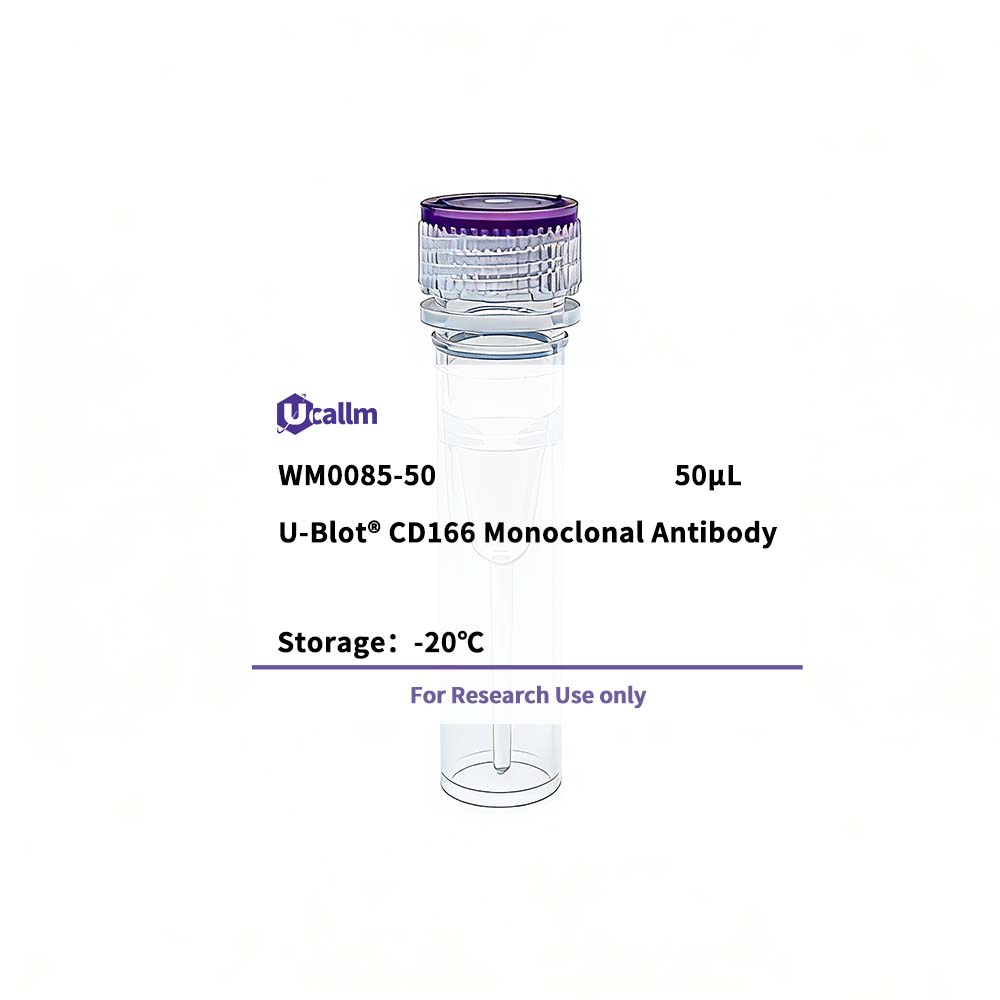
Ucallm_WM0085-50
Price range: $268.00 through $328.00
Product details
Background:
This gene encodes activated leukocyte cell adhesion molecule (ALCAM), also known as CD166 (cluster of differentiation 166), which is a member of a subfamily of immunoglobulin receptors with five immunoglobulin-like domains (VVC2C2C2) in the extracellular domain. This protein binds to T-cell differentiation antigene CD6, and is implicated in the processes of cell adhesion and migration. Multiple alternatively spliced transcript variants encoding different isoforms have been found. [provided by RefSeq, Aug 2011],
Specifications
| Size | 50μL/100μL |
| Target | CD166 |
| Reactivity | Human |
| Applications | IHC, IF, ELISA |
| MW(Calculated) | |
| MW(Observed) | |
| Host Species | Mouse |
| Isotype | |
| Conjugate/Modification | Unmodified |
| Recommended Dilution Ratio | IHC 1:200-1:1000; ELISA 1:10000; IF 1:50-200 / Note: For IHC, we suggest antigen retrieval with TE buffer pH 9.0 (Cat#WT1004) |
| Formulation | Liquid in PBS containing 50% glycerol, 0.5% BSA and 0.02% sodium azide. |
| Purification | Affinity purification |
| Storage | -15°C to -25°C/1 year(Do not lower than -25°C) |
| Concentration | |
| Clonality | Monoclonal |
| Clone Number | 18A7 |
| Immunogen | Purified recombinant fragment of CD166 (aa405-524) expressed in E. Coli. |
| Specificity | CD166 Monoclonal Antibody detects endogenous levels of CD166 protein. |
| Gene Name | ALCAM |
| Protein Name | CD166 antigen |
| Other Name | ALCAM; / MEMD; / CD166 antigen; / Activated leukocyte cell adhesion molecule; / CD antigen CD166 |
| Species | Human |
| Gene ID | 214 |
| Uniprot | Q13740, |
| Species.1 | Mouse |
| Gene ID.1 | |
| Uniprot.1 | Q61490 |
| Species.2 | |
| Gene ID.2 | |
| Uniprot.2 | |
| Cellular Localization | Cell membrane; Single-pass type I membrane protein . Cell projection, axon . Cell projection, dendrite . Detected at the immunological synapse, i.e, at the contact zone between antigen-presenting dendritic cells and T-cells (PubMed:15294938, PubMed:16352806). Colocalizes with CD6 and the TCR/CD3 complex at the immunological synapse (PubMed:15294938). .; [Isoform 3]: Secreted . |
| Tissue Expression | Detected on hematopoietic stem cells derived from umbilical cord blood (PubMed:24740813). Detected on lymph vessel endothelial cells, skin and tonsil (PubMed:23169771). Detected on peripheral blood monocytes (PubMed:15048703). Detected on monocyte-derived dendritic cells (at protein level) (PubMed:16352806). Detected at low levels in spleen, placenta, liver (PubMed:9502422). Expressed by activated T-cells, B-cells, monocytes and thymic epithelial cells (PubMed:7760007). Isoform 1 and isoform 3 are detected in vein and artery endothelial cells, astrocytes, keratinocytes and artery smooth muscle cells (PubMed:15496415). Expressed by neurons in the brain. Restricted expression in tumor cell lines. Detected in highly metastasizing melanoma cell lines (PubMed:9502422). |
| Signaling_pathway | Environmental Information Processing >> Signaling molecules and interaction >> Cell adhesion molecules |
| Research Areas | >>Cell adhesion molecules |
| Function | Domain:The CD6 binding site is located in the N-terminal Ig-like domain.,Function:Cell adhesion molecule that binds to CD6. Involved in neurite extension by neurons via heterophilic and homophilic interactions. May play a role in the binding of T- and B-cells to activated leukocytes, as well as in interactions between cells of the nervous system.,similarity:Contains 2 Ig-like V-type (immunoglobulin-like) domains.,similarity:Contains 3 Ig-like C2-type (immunoglobulin-like) domains.,tissue specificity:Spleen, placenta, liver, and weakly in liver. Expressed by activated T-cells, B-cells, monocytes and thymic epithelial cells. Expressed by neurons in the brain. Restricted expression in tumor cell lines. Preferentially expressed in highly metastasizing melanoma cell lines., |
Please login to post questions
Related products





