


CD1A Monoclonal Antibody
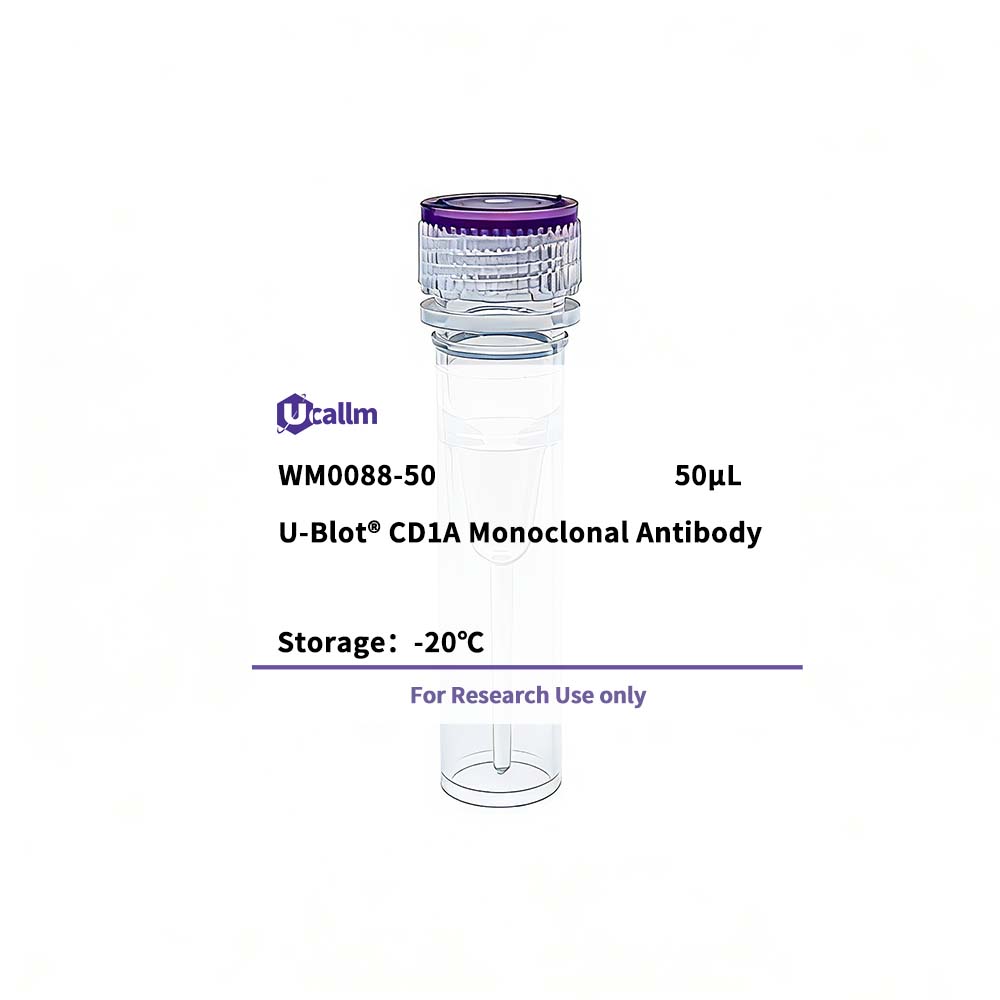
Ucallm_WM0088-50
Price range: $268.00 through $328.00
Product details
Background:
This gene encodes a member of the CD1 family of transmembrane glycoproteins, which are structurally related to the major histocompatibility complex (MHC) proteins and form heterodimers with beta-2-microglobulin. The CD1 proteins mediate the presentation of primarily lipid and glycolipid antigens of self or microbial origin to T cells. The human genome contains five CD1 family genes organized in a cluster on chromosome 1. The CD1 family members are thought to differ in their cellular localization and specificity for particular lipid ligands. The protein encoded by this gene localizes to the plasma membrane and to recycling vesicles of the early endocytic system. Alternative splicing results in multiple transcript variants. [provided by RefSeq, Mar 2016],
Specifications
| Size | 50μL/100μL |
| Target | CD1A |
| Reactivity | Human |
| Applications | WB, FC, ELISA |
| MW(Calculated) | 37kD |
| MW(Observed) | |
| Host Species | Mouse |
| Isotype | |
| Conjugate/Modification | Unmodified |
| Recommended Dilution Ratio | WB 1:500-1:2000; Flow Cyt 1:200-1:400; ELISA 1:10000; Not yet tested in other applications. |
| Formulation | Liquid in PBS containing 50% glycerol, 0.5% BSA and 0.02% sodium azide. |
| Purification | Affinity purification |
| Storage | -15°C to -25°C/1 year(Do not lower than -25°C) |
| Concentration | |
| Clonality | Monoclonal |
| Clone Number | 14D9 |
| Immunogen | Purified recombinant fragment of human CD1A expressed in E. Coli. |
| Specificity | CD1A Monoclonal Antibody detects endogenous levels of CD1A protein. |
| Gene Name | CD1A |
| Protein Name | T-cell surface glycoprotein CD1a |
| Other Name | CD1A; / T-cell surface glycoprotein CD1a; / T-cell surface antigen T6/Leu-6; / hTa1 thymocyte antigen; / CD antigen CD1a |
| Species | Human |
| Gene ID | 909 |
| Uniprot | P06126 |
| Species.1 | |
| Gene ID.1 | |
| Uniprot.1 | |
| Species.2 | |
| Gene ID.2 | |
| Uniprot.2 | |
| Cellular Localization | Cell membrane; Single-pass type I membrane protein . Membrane raft; Single-pass type I membrane protein . Endosome membrane; Single-pass type I membrane protein . Subject to intracellular trafficking between the cell membrane and endosomes (PubMed:11231314). Localizes to cell surface lipid rafts (PubMed:18178838). . |
| Tissue Expression | Expressed on cortical thymocytes, epidermal Langerhans cells, dendritic cells, on certain T-cell leukemias, and in various other tissues. |
| Signaling_pathway | Cellular Processes >> Cellular community - eukaryotes >> Tight junction;Organismal Systems >> Immune system >> Hematopoietic cell lineage |
| Research Areas | >>Tight junction; / >>Hematopoietic cell lineage; / >>Amoebiasis |
| Function | Function:Antigen-presenting protein that binds self and non-self lipid and glycolipid antigens and presents them to T-cell receptors on natural killer T-cells.,miscellaneous:During protein synthesis and maturation, CD1 family members bind endogenous lipids that are replaced by lipid or glycolipid antigens when the proteins are internalized and pass through endosomes, before trafficking back to the cell surface.,similarity:Contains 1 Ig-like (immunoglobulin-like) domain.,subcellular location:Subject to intracellular trafficking between the cell membrane and endosomes. Localizes to cell surface lipid rafts.,subunit:Heterodimer with B2M (beta-2-microglobulin). Interacts with CD74.,tissue specificity:Expressed on cortical thymocytes, epidermal Langerhans cells, dendritic cells, on certain T-cell leukemias, and in various other tissues., |
Please login to post questions
Related products


