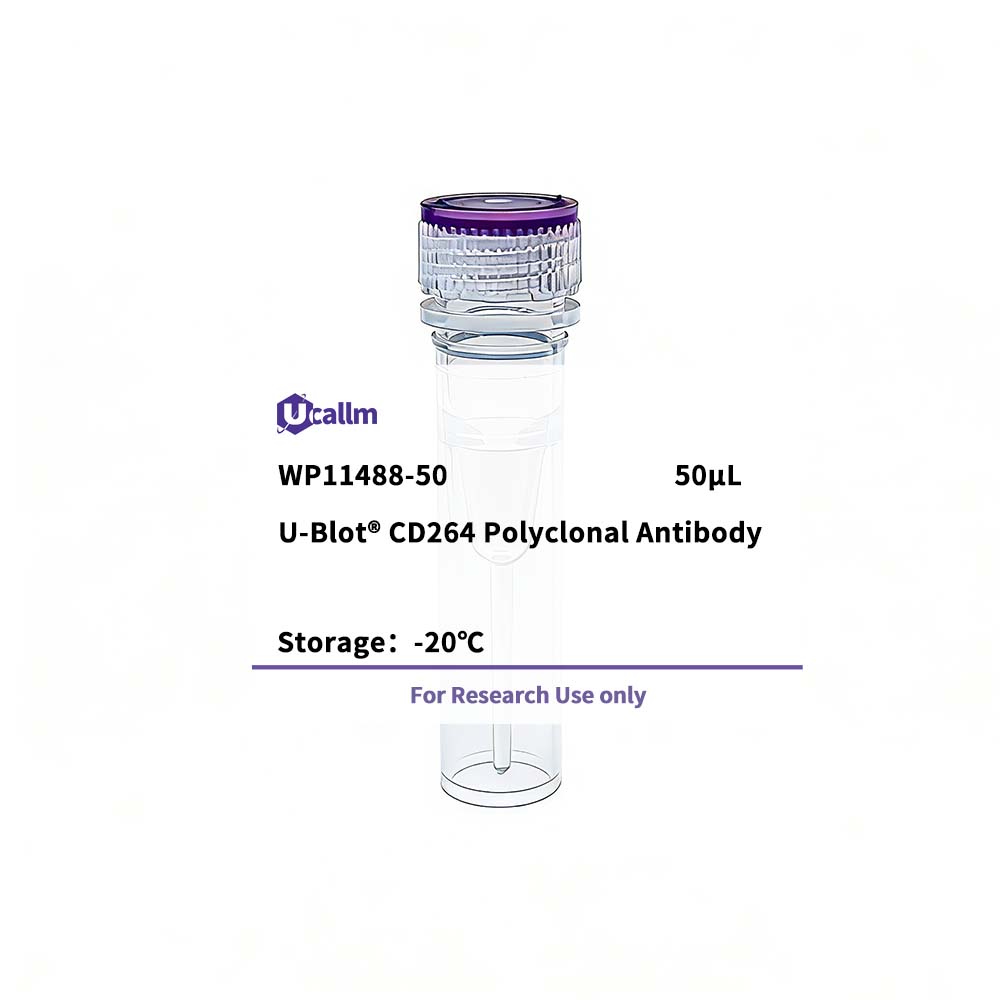
SKU: WP11488 Categories: ,

CD264 Polyclonal Antibody

Price range: $268.00 through $328.00

SKU: WP11488-100
Enter the quantity you would like, or drag the panel to find the quantity and price that best for you
Bulk QuoteAuthorize OEM & ODM

Product details

Background:

The protein encoded by this gene is a member of the TNF-receptor superfamily. This receptor contains an extracellular TRAIL-binding domain, a transmembrane domain, and a truncated cytoplamic death domain. This receptor does not induce apoptosis, and has been shown to play an inhibitory role in TRAIL-induced cell apoptosis. [provided by RefSeq, Jul 2008],

Specifications

Size50μL/100μL
TargetCD264
ReactivityHuman
ApplicationsWB, ELISA
MW(Calculated)
MW(Observed)42kD
Host SpeciesRabbit
IsotypeIgG
Conjugate/ModificationUnmodified
Recommended Dilution RatioWB 1:500-1:2000; ELISA 1:10000; Not yet tested in other applications.
FormulationLiquid in PBS containing 50% glycerol, 0.5% BSA and 0.02% sodium azide.
PurificationThe antibody was affinity-purified from rabbit antiserum by affinity-chromatography using epitope-specific immunogen.
Storage-15°C to -25°C/1 year(Do not lower than -25°C)
Concentration1 mg/ml
ClonalityPolyclonal
Clone Number
ImmunogenThe antiserum was produced against synthesized peptide derived from human TNFRSF10D. AA range:121-170
SpecificityCD264 Polyclonal Antibody detects endogenous levels of CD264 protein.
Gene NameTNFRSF10D
Protein NameTumor necrosis factor receptor superfamily member 10D
Other NameTNFRSF10D; / DCR2; / TRAILR4; / TRUNDD; / Tumor necrosis factor receptor superfamily member 10D; / Decoy receptor 2; / DcR2; / TNF-related apoptosis-inducing ligand receptor 4; / TRAIL receptor 4; / TRAIL-R4; / TRAIL receptor with a truncated death domain; / CD
SpeciesHuman
Gene ID8793
UniprotQ9UBN6
Species.1
Gene ID.1
Uniprot.1
Species.2
Gene ID.2
Uniprot.2
Cellular LocalizationMembrane; Single-pass type I membrane protein .
Tissue ExpressionWidely expressed, in particular in fetal kidney, lung and liver, and in adult testis and liver. Also expressed in peripheral blood leukocytes, colon and small intestine, ovary, prostate, thymus, spleen, pancreas, kidney, lung, placenta and heart.
Signaling_pathwayEnvironmental Information Processing >> Signaling molecules and interaction >> Cytokine-cytokine receptor interaction;Environmental Information Processing >> Signaling molecules and interaction >> Viral protein interaction with cytokine and cytokine receptor
Research Areas>>Cytokine-cytokine receptor interaction; / >>Viral protein interaction with cytokine and cytokine receptor
FunctionFunction:Receptor for the cytotoxic ligand TRAIL. Contains a truncated death domain and hence is not capable of inducing apoptosis but protects against TRAIL-mediated apoptosis. Reports are contradictory with regards to its ability to induce the NF-kappa-B pathway (According to PubMed:9382840 it cannot but according to PubMed:9430226 it can induce the NF-kappa-B pathway).,similarity:Contains 1 death domain.,similarity:Contains 3 TNFR-Cys repeats.,tissue specificity:Widely expressed, in particular in fetal kidney, lung and liver, and in adult testis and liver. Also expressed in peripheral blood leukocytes, colon and small intestine, ovary, prostate, thymus, spleen, pancreas, kidney, lung, placenta and heart.,
Please login to post questions
Back to Top
Product has been added to your cart


