

CD6 Polyclonal Antibody
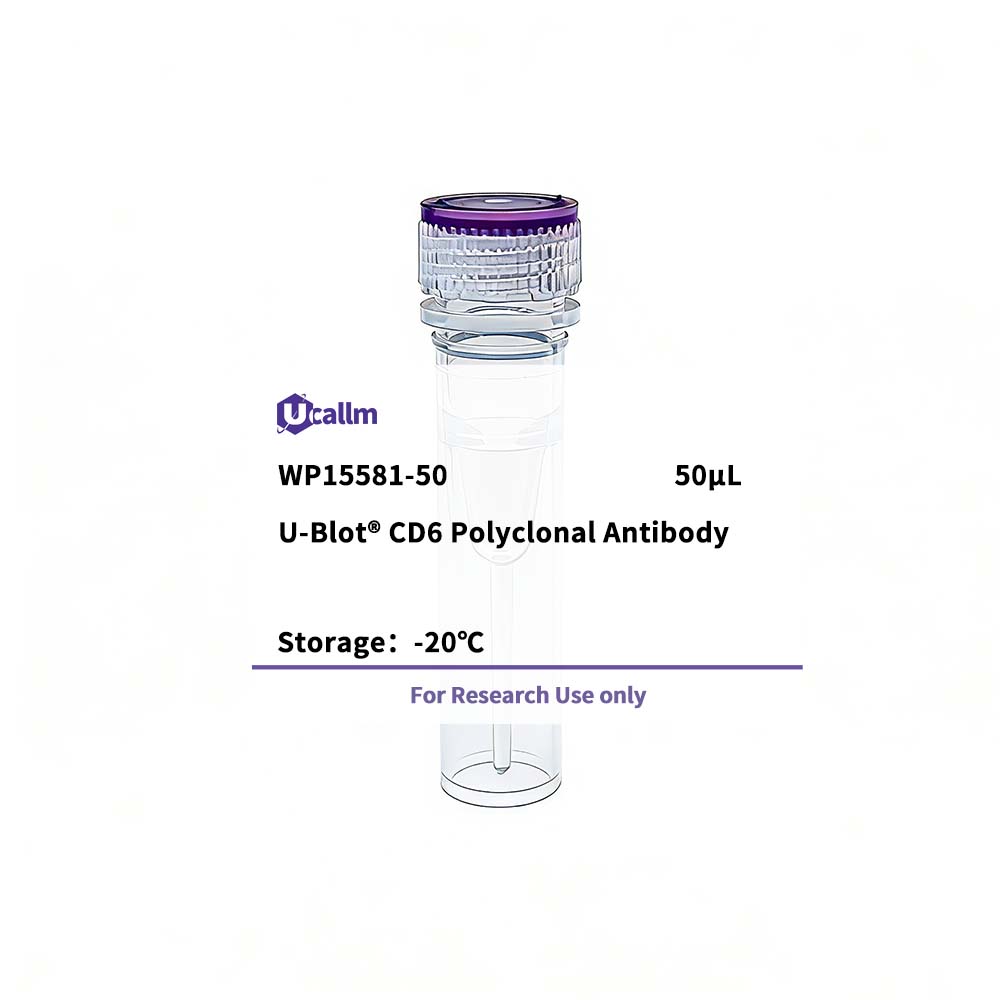
Ucallm_WP15581-50
Price range: $268.00 through $328.00
Product details
Background:
This gene encodes a protein found on the outer membrane of T-lymphocytes as well as some other immune cells. The encoded protein contains three scavenger receptor cysteine-rich (SRCR) domains and a binding site for an activated leukocyte cell adhesion molecule. The gene product is important for continuation of T cell activation. This gene may be associated with susceptibility to multiple sclerosis (PMID: 19525953, 21849685). Multiple transcript variants encoding different isoforms have been found for this gene. [provided by RefSeq, Dec 2011],
Specifications
| Size | 50μL/100μL |
| Target | CD6 |
| Reactivity | Human, Mouse |
| Applications | WB, IHC, IF, ELISA |
| MW(Calculated) | |
| MW(Observed) | 73kD |
| Host Species | Rabbit |
| Isotype | IgG |
| Conjugate/Modification | Unmodified |
| Recommended Dilution Ratio | WB 1:500-1:2000; IHC: 1:100-1:300; ELISA 1:10000; IF 1:50-200 / Note: For IHC, we suggest antigen retrieval with TE buffer pH 9.0 (Cat#WT1004) |
| Formulation | Liquid in PBS containing 50% glycerol, 0.5% BSA and 0.02% sodium azide. |
| Purification | The antibody was affinity-purified from rabbit antiserum by affinity-chromatography using epitope-specific immunogen. |
| Storage | -15°C to -25°C/1 year(Do not lower than -25°C) |
| Concentration | 1 mg/ml |
| Clonality | Polyclonal |
| Clone Number | |
| Immunogen | The antiserum was produced against synthesized peptide derived from the Internal region of human CD6. AA range:361-410 |
| Specificity | CD6 Polyclonal Antibody detects endogenous levels of CD6 protein. |
| Gene Name | CD6 |
| Protein Name | T-cell differentiation antigen CD6 |
| Other Name | CD6; / T-cell differentiation antigen CD6; / T12; / TP120; / CD6 |
| Species | Human |
| Gene ID | 923 |
| Uniprot | P30203, |
| Species.1 | Mouse |
| Gene ID.1 | |
| Uniprot.1 | Q61003 |
| Species.2 | |
| Gene ID.2 | |
| Uniprot.2 | |
| Cellular Localization | Cell membrane; Single-pass type I membrane protein . Detected at the immunological synapse, i.e, at the contact zone between antigen-presenting dendritic cells and T-cells (PubMed:15294938, PubMed:16352806). Colocalizes with the TCR/CD3 complex at the immunological synapse (PubMed:15294938). .; [Soluble CD6]: Secreted . The origins of the secreted form are not clear, but it might be created by proteolytic shedding of the ectodomain. . |
| Tissue Expression | Detected on thymocytes (PubMed:15294938). Detected on peripheral blood T-cells (PubMed:15048703, PubMed:16352806). Detected on natural killer (NK) cells (PubMed:16352806). Soluble CD6 is detected in blood serum (at protein level) (PubMed:17601777). Detected in spleen, thymus, appendix, lymph node and peripheral blood leukocytes (PubMed:9013954). Expressed by thymocytes, mature T-cells, a subset of B-cells known as B-1 cells, and by some cells in the brain. |
| Signaling_pathway | Environmental Information Processing >> Signaling molecules and interaction >> Cell adhesion molecules |
| Research Areas | >>Cell adhesion molecules |
| Function | Function:Involved in cell adhesion. Binds to CD166.,PTM:After T-cell activation, becomes hyperphosphorylated on Ser and Thr residues and phosphorylated on Tyr residues.,PTM:Contains intrachain disulfide bond(s).,similarity:Contains 3 SRCR domains.,tissue specificity:Expressed by thymocytes, mature T-cells, a subset of B-cells known as B-1 cells, and by some cells in the brain., |
Please login to post questions
Related products





