

CD69 Monoclonal Antibody
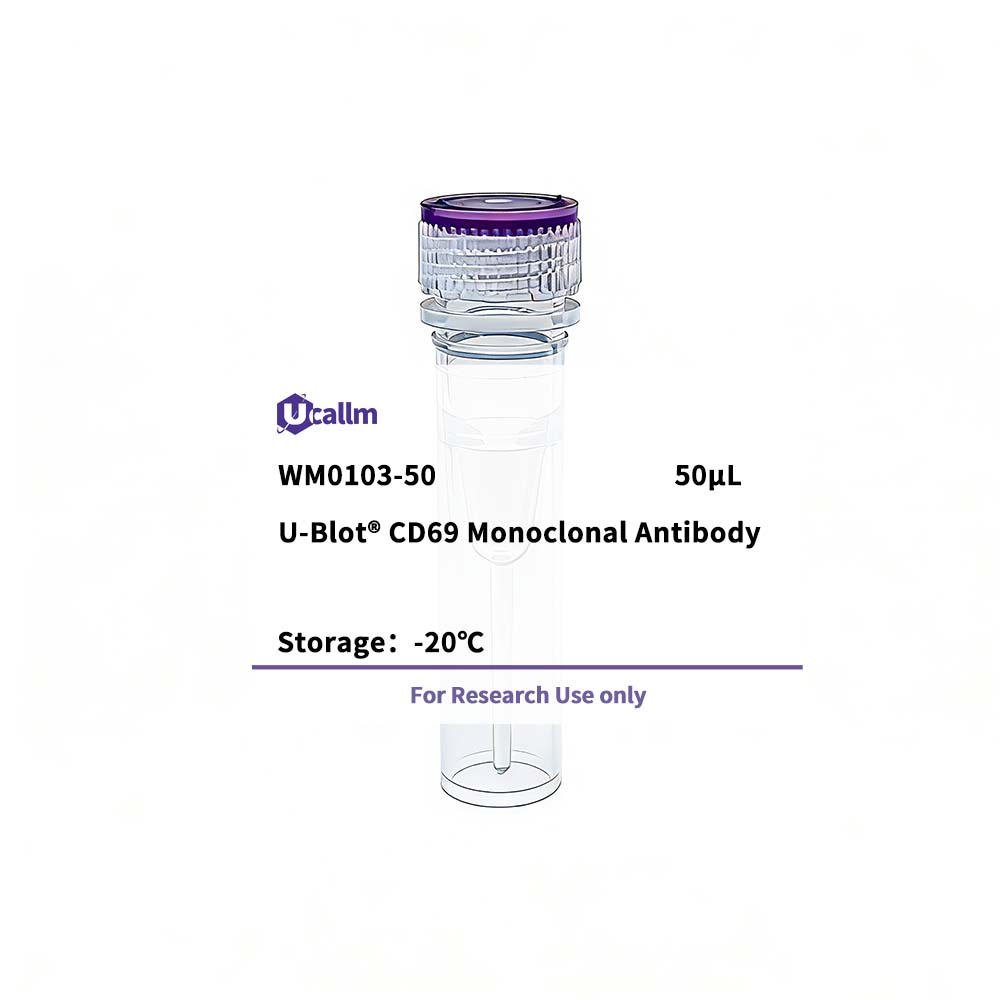
Ucallm_WM0103-50
Price range: $268.00 through $328.00
Product details
Background:
This gene encodes a member of the calcium dependent lectin superfamily of type II transmembrane receptors. Expression of the encoded protein is induced upon activation of T lymphocytes, and may play a role in proliferation. Furthermore, the protein may act to transmit signals in natural killer cells and platelets. [provided by RefSeq, Aug 2011],
Specifications
| Size | 50μL/100μL |
| Target | CD69 |
| Reactivity | Human |
| Applications | WB, IHC, IF, FC, ELISA |
| MW(Calculated) | 23kD |
| MW(Observed) | |
| Host Species | Mouse |
| Isotype | |
| Conjugate/Modification | Unmodified |
| Recommended Dilution Ratio | WB 1:500-1:2000; IHC 1:200-1:1000; Flow Cyt 1:200-1:400; ELISA 1:10000; IF 1:50-200 / Note: For IHC, we suggest antigen retrieval with TE buffer pH 9.0 (Cat#WT1004) |
| Formulation | Liquid in PBS containing 50% glycerol, 0.5% BSA and 0.02% sodium azide. |
| Purification | Affinity purification |
| Storage | -15°C to -25°C/1 year(Do not lower than -25°C) |
| Concentration | |
| Clonality | Monoclonal |
| Clone Number | 15H4 |
| Immunogen | Purified recombinant fragment of human CD69 expressed in E. Coli. |
| Specificity | CD69 Monoclonal Antibody detects endogenous levels of CD69 protein. |
| Gene Name | CD69 |
| Protein Name | Early activation antigen CD69 |
| Other Name | CD69; / CLEC2C; / Early activation antigen CD69; / Activation inducer molecule; / AIM; / BL-AC/P26; / C-type lectin domain family 2 member C; / EA1; / Early T-cell activation antigen p60; / GP32/28; / Leukocyte surface antigen Leu-23; / MLR-3; / CD antigen CD69 |
| Species | Human |
| Gene ID | 969 |
| Uniprot | Q07108, |
| Species.1 | Mouse |
| Gene ID.1 | |
| Uniprot.1 | P37217 |
| Species.2 | |
| Gene ID.2 | |
| Uniprot.2 | |
| Cellular Localization | Membrane; Single-pass type II membrane protein. |
| Tissue Expression | Expressed on the surface of activated T-cells, B-cells, natural killer cells, neutrophils, eosinophils, epidermal Langerhans cells and platelets. |
| Signaling_pathway | |
| Research Areas | |
| Function | developmental stage:Earliest inducible cell surface glycoprotein acquired during lymphoid activation.,Function:Involved in lymphocyte proliferation and functions as a signal transmitting receptor in lymphocytes, natural killer (NK) cells, and platelets.,induction:By antigens, mitogens or activators of PKC on the surface of T and B-lymphocytes. By interaction of IL-2 with the p75 IL-2R on the surface of NK cells.,online information:CD69,PTM:Constitutive Ser/Thr phosphorylation in both mature thymocytes and activated T-lymphocytes.,similarity:Contains 1 C-type lectin domain.,subunit:Homodimer; disulfide-linked.,tissue specificity:Expressed on the surface of activated T-cells, B-cells, natural killer cells, neutrophils, eosinophils, epidermal Langerhans cells and platelets., |
Please login to post questions
Related products





