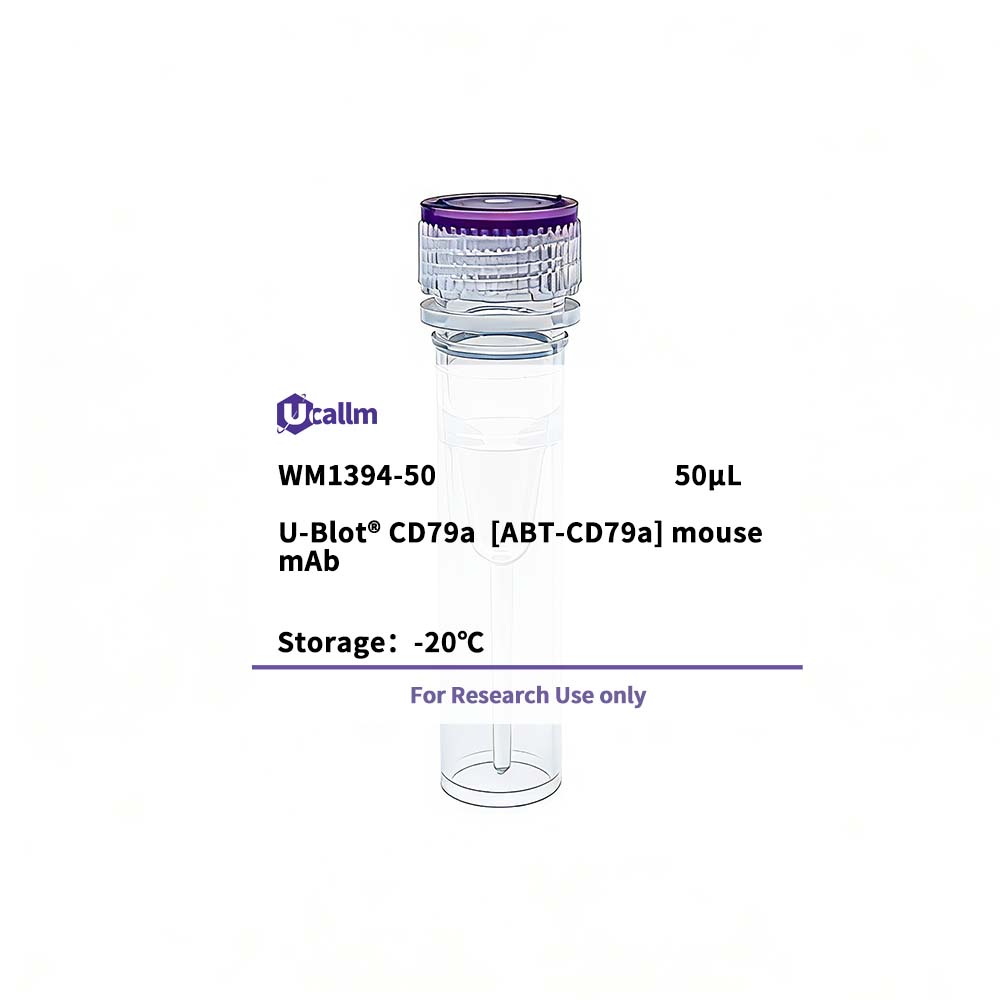
SKU: WM1394 Categories: ,

CD79a [ABT-CD79a] mouse mAb

Price range: $268.00 through $328.00

SKU: WM1394-50
Enter the quantity you would like, or drag the panel to find the quantity and price that best for you
Bulk QuoteAuthorize OEM & ODM

Product details

Background:
CD79a and CD79b form a heterodimer molecular complex. Together with the membrane surface immunoglobulin of B cells, they form the antigen recognition receptor of B cells, participate in the signal transduction of B cell activation, and can be a broad-spectrum marker of B cells. They can be labeled from the former B cells to mature plasma cells. Because the expression of CD79a decreased during terminal differentiation, the staining may be due to the cross reaction of CD79b. It is often used in combination with other antibodies for the diagnosis of B-cell lymphoma.

Specifications

Size50μL/100μL
TargetCD79A
ReactivityHuman, Rat
ApplicationsIHC, WB, IF, ELISA
MW(Calculated)25kD
MW(Observed)39kD
Host SpeciesMouse
IsotypeIgG2b,Kappa
Conjugate/ModificationUnmodified
Recommended Dilution RatioIHC 1:200-1000; WB 1:500-2000; IF 1:100-500; ELISA 1:1000-5000 / Note: For IHC, we suggest antigen retrieval with TE buffer pH 9.0 (Cat#WT1004)
FormulationPBS, 50% glycerol, 0.05% Proclin 300, 0.05%BSA
PurificationRecombinant Antibody expressed in animal component-free (ACF) media, purified via Protein G affinity chromatography.
Storage-15°C to -25°C/1 year(Do not lower than -25°C)
Concentration
ClonalityMonoclonal
Clone NumberRMM-CD79a
ImmunogenSynthesized peptide derived from human CD79A AA range: 100-226
SpecificityThe antibody can specifically recognize human CD79A protein.
Gene NameCD79A IGA MB1
Protein NameB-cell antigen receptor complex-associated protein alpha chain (Ig-alpha) (MB-1 membrane glycoprotein) (Membrane-bound immunoglobulin-associated protein) (Surface IgM-associated protein) (CD antigen CD79a)
Other NameB lymphocyte-specific MB1 protein; / B-cell antigen receptor complex-associated protein alpha chain; / CD 79a; / CD79a; / CD79a antigen; / immunoglobulin-associated alpha; / CD79A antigen; / CD79a molecule, immunoglobulin-associated alpha; / CD79A_HUMAN; / Ig alpha; / Ig-alpha; / IGA; / IgM-alpha; / Immunoglobulin-associated alpha; / Ly54; / MB-1 membrane glycoprotein; / MB1; / Membrane-bound immunoglobulin-associated protein; / Surface IgM-associated protein
SpeciesHuman
Gene ID973
UniprotP11912
Species.1
Gene ID.1
Uniprot.1
Species.2
Gene ID.2
Uniprot.2
Cellular LocalizationCytoplasmic, Membranous
Tissue ExpressionB-cells.
Signaling_pathwayOrganismal Systems >> Immune system >> B cell receptor signaling pathway;Human Diseases >> Immune disease >> Primary immunodeficiency
Research Areas>>B cell receptor signaling pathway; / >>Primary immunodeficiency
FunctionDisease:Defects in CD79A are a cause of non-Bruton type agammaglobulinemia [MIM:601495]. Agammaglobulinemia is an immunodeficiency disease which results in developmental defects in the maturation pathway of B-cells. Two different mutations, one at the splice donor site of intron 2 and the other at the splice acceptor site for exon 3, have been identified. Both mutations give rise to a truncated protein.,Function:Required in cooperation with CD79B for initiation of the signal transduction cascade activated by binding of antigen to the B-cell antigen receptor complex (BCR) which leads to internalization of the complex, trafficking to late endosomes and antigen presentation. Also required for BCR surface expression and for efficient differentiation of pro- and pre-B-cells. Stimulates SYK autophosphorylation and activation. Binds to BLNK, bringing BLNK into proximity with SYK and allowing SYK to phosphorylate BLNK. Also interacts with and increases activity of some Src-family tyrosine kinases. Represses BCR signaling during development of immature B cells.,online information:CD79A mutation db,PTM:Phosphorylated on tyrosine, serine and threonine residues upon B-cell activation. Phosphorylation of tyrosine residues by Src-family kinases is an early and essential feature of the BCR signaling cascade. The phosphorylated tyrosines serve as docking sites for SH2-domain containing kinases, leading to their activation which in turn leads to phosphorylation of downstream targets. Phosphorylation of serine and threonine residues may prevent subsequent tyrosine phosphorylation.,similarity:Contains 1 Ig-like C2-type (immunoglobulin-like) domain.,similarity:Contains 1 ITAM domain.,subcellular location:Following antigen binding, the BCR has been shown to translocate from detergent-soluble regions of the cell membrane to lipid rafts although signal transduction through the complex can also occur outside lipid rafts.,subunit:Heterodimer of alpha and beta chains; disulfide-linked. Part of the B-cell antigen receptor complex where the alpha/beta chain heterodimer is non-covalently associated with an antigen-specific membrane-bound surface immunoglobulin of two heavy chains and two light chains. Interacts through its phosphorylated ITAM domain with the SH2 domains of SYK which stimulates SYK autophosphorylation and activation. Also interacts, when phosphorylated on Tyr-210, with the SH2 domain of BLNK/SLP65, bringing BLNK into proximity with SYK and allowing SYK to phosphorylate BLNK which is necessary for trafficking of the BCR to late endosomes. Interacts with Src-family tyrosine kinases including FYN and LYN, increasing their activity.,tissue specificity:B-cells.,
Please login to post questions
Back to Top
Product has been added to your cart

