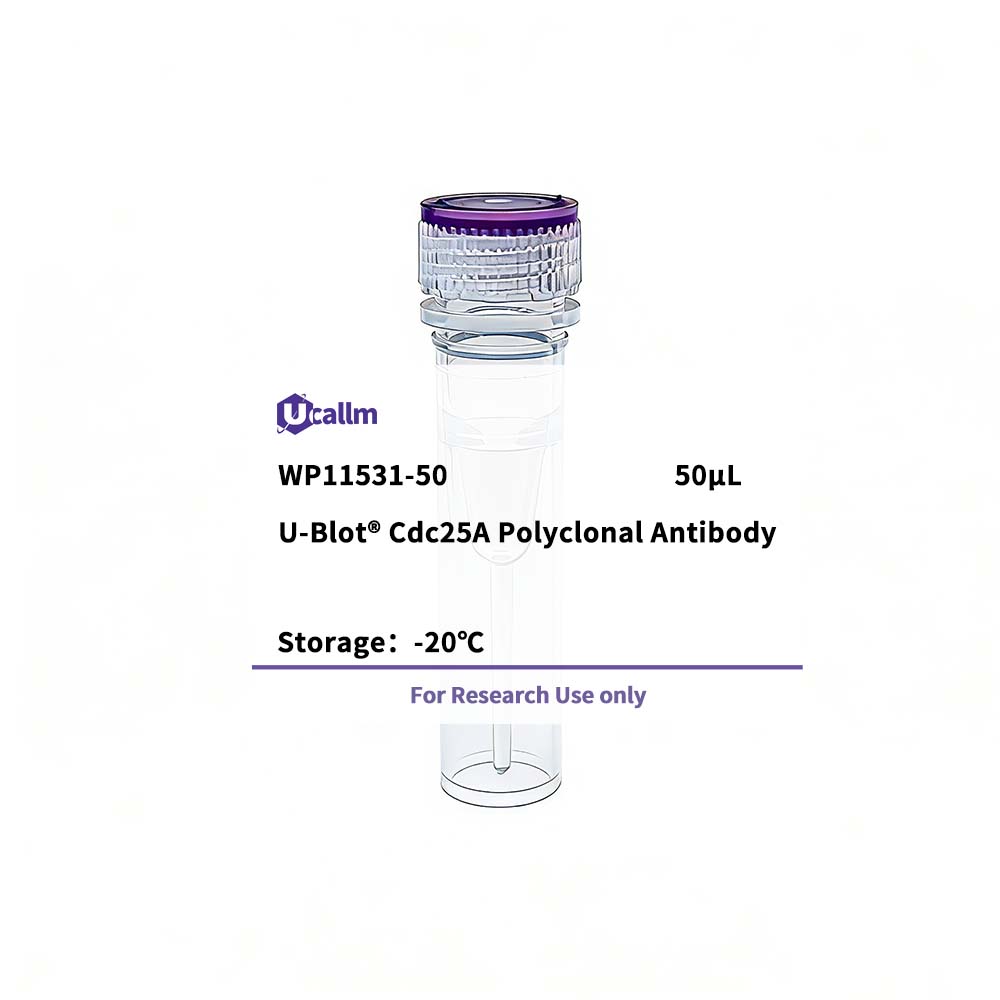
SKU: WP11531 Categories: ,

Cdc25A Polyclonal Antibody

Price range: $268.00 through $328.00

SKU: WP11531-100
Enter the quantity you would like, or drag the panel to find the quantity and price that best for you
Bulk QuoteAuthorize OEM & ODM

Product details

Background:

cell division cycle 25A(CDC25A) Homo sapiens CDC25A is a member of the CDC25 family of phosphatases. CDC25A is required for progression from G1 to the S phase of the cell cycle. It activates the cyclin-dependent kinase CDC2 by removing two phosphate groups. CDC25A is specifically degraded in response to DNA damage, which prevents cells with chromosomal abnormalities from progressing through cell division. CDC25A is an oncogene, although its exact role in oncogenesis has not been demonstrated. Two transcript variants encoding different isoforms have been found for this gene. [provided by RefSeq, Jul 2008],

Specifications

Size50μL/100μL
TargetCdc25A
ReactivityHuman, Mouse, Rat, Monkey
ApplicationsWB, IHC, IF, ELISA
MW(Calculated)
MW(Observed)60kD
Host SpeciesRabbit
IsotypeIgG
Conjugate/ModificationUnmodified
Recommended Dilution RatioWB 1:500-1:2000; IHC 1:100-1:300; IF 1:200-1:1000; ELISA 1:10000; Not yet tested in other applications. / Note: For IHC, we suggest antigen retrieval with TE buffer pH 9.0 (Cat#WT1004)
FormulationLiquid in PBS containing 50% glycerol, 0.5% BSA and 0.02% sodium azide.
PurificationThe antibody was affinity-purified from rabbit antiserum by affinity-chromatography using epitope-specific immunogen.
Storage-15°C to -25°C/1 year(Do not lower than -25°C)
Concentration1 mg/ml
ClonalityPolyclonal
Clone Number
ImmunogenThe antiserum was produced against synthesized peptide derived from human CDC25A. AA range:43-92
SpecificityCdc25A Polyclonal Antibody detects endogenous levels of Cdc25A protein.
Gene NameCDC25A
Protein NameM-phase inducer phosphatase 1
Other NameCDC25A; / M-phase inducer phosphatase 1; / Dual specificity phosphatase Cdc25A
SpeciesHuman
Gene ID993
UniprotP30304,
Species.1Mouse
Gene ID.1
Uniprot.1P48964,
Species.2Rat
Gene ID.2171102
Uniprot.2P48965
Cellular Localizationintracellular,nucleus,nucleoplasm,cytoplasm,cytosol,
Tissue ExpressionLymph,
Signaling_pathwayCellular Processes >> Cell growth and death >> Cell cycle;Cellular Processes >> Cell growth and death >> Cellular senescence;Human Diseases >> Cancer: overview >> MicroRNAs in cancer
Research Areas>>Cell cycle; / >>Cellular senescence; / >>Progesterone-mediated oocyte maturation; / >>MicroRNAs in cancer; / >>Chemical carcinogenesis - receptor activation
FunctionCatalytic activity:Protein tyrosine phosphate + H(2)O = protein tyrosine + phosphate.,Domain:The phosphodegron motif mediates interaction with specific F-box proteins when phosphorylated. Putative phosphorylation sites at Ser-79 and Ser-82 appear to be essential for this interaction.,enzyme regulation:Stimulated by B-type cyclins.,Function:Tyrosine protein phosphatase which functions as a dosage-dependent inducer of mitotic progression. Directly dephosphorylates CDC2 and stimulates its kinase activity. Also dephosphorylates CDK2 in complex with cyclin E, in vitro.,PTM:Phosphorylated by CHEK1 on Ser-76, Ser-124, Ser-178, Ser-279, Ser-293 and Thr-507 during checkpoint mediated cell cycle arrest. Also phosphorylated by CHEK2 on Ser-124, Ser-279, and Ser-293 during checkpoint mediated cell cycle arrest. Phosphorylation on Ser-178 and Thr-507 creates binding sites for YWHAE/14-3-3 epsilon which inhibits CDC25A. Phosphorylation on Ser-76, Ser-124, Ser-178, Ser-279 and Ser-293 may also promote ubiquitin-dependent proteolysis of CDC25A.,PTM:Ubiquitinated. Association with the F-box proteins BTRC and FBXW11 targets the protein for ubiquitination by CUL1 and proteolysis by the ubiquitin-dependent proteasome pathway.,similarity:Belongs to the MPI phosphatase family.,similarity:Contains 1 rhodanese domain.,subunit:Interacts with CCNB1/cyclin B1. Interacts with YWHAE/14-3-3 epsilon when phosphorylated. Interacts with CUL1 specifically when CUL1 is neddylated and active. Interacts with BTRC/BTRCP1 and FBXW11/BTRCP2. Interactions with CUL1, BTRC and FBXW11 are enhanced upon DNA damage.,
Please login to post questions
Back to Top
Product has been added to your cart
