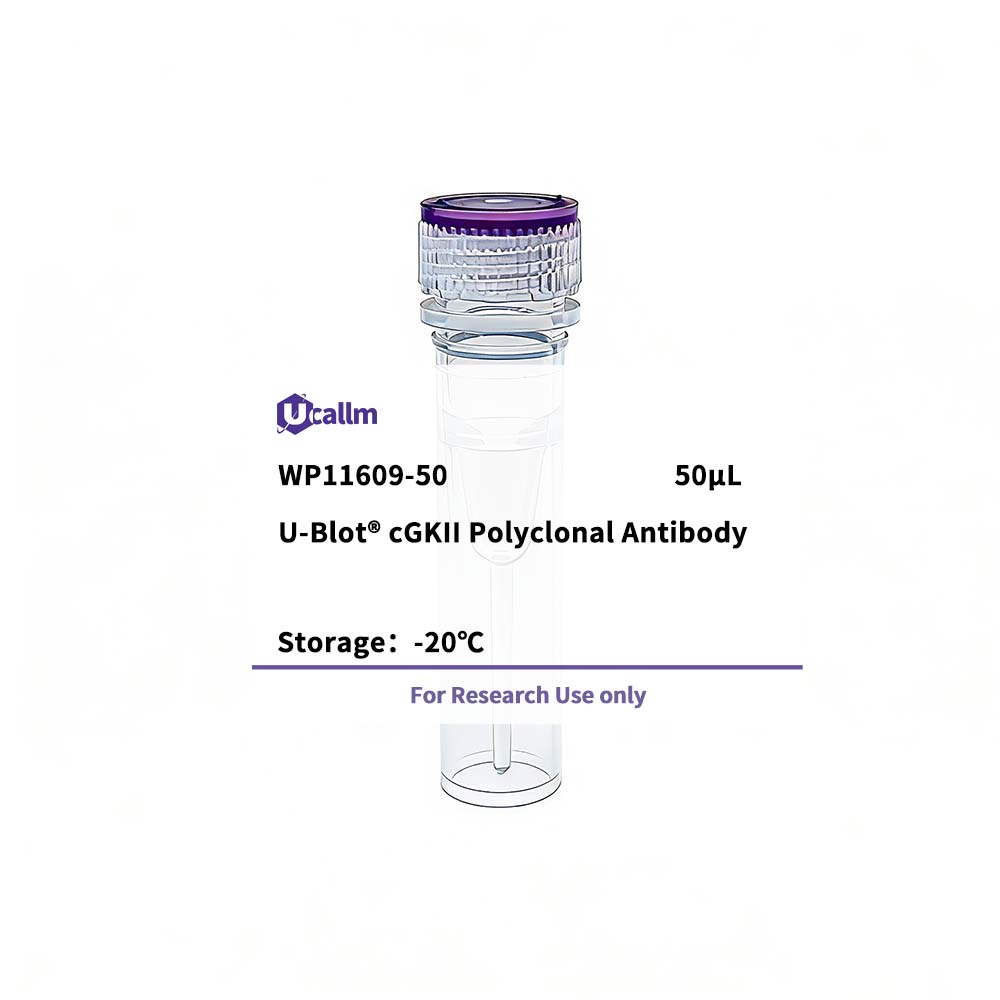
SKU: WP11609 Categories: ,

cGKII Polyclonal Antibody

Price range: $268.00 through $328.00

SKU: WP11609-100
Enter the quantity you would like, or drag the panel to find the quantity and price that best for you
Bulk QuoteAuthorize OEM & ODM

Product details

Background:

This gene encodes a protein that belongs to the serine/threonine protein kinase family of proteins. The encoded protein plays a role in the regulation of fluid balance in the intestine. A similar protein in mouse is thought to regulate differentiation and proliferation of cells in the colon. Alternate splicing results in multiple transcript variants. [provided by RefSeq, Sep 2013],

Specifications

Size50μL/100μL
TargetcGKII
ReactivityHuman, Mouse, Rat
ApplicationsWB, IHC, IF, ELISA
MW(Calculated)
MW(Observed)87kD
Host SpeciesRabbit
IsotypeIgG
Conjugate/ModificationUnmodified
Recommended Dilution RatioWB 1:500-1:2000; IHC 1:100-1:300; ELISA 1:20000; IF 1:50-200 / Note: For IHC, we suggest antigen retrieval with TE buffer pH 9.0 (Cat#WT1004)
FormulationLiquid in PBS containing 50% glycerol, 0.5% BSA and 0.02% sodium azide.
PurificationThe antibody was affinity-purified from rabbit antiserum by affinity-chromatography using epitope-specific immunogen.
Storage-15°C to -25°C/1 year(Do not lower than -25°C)
Concentration1 mg/ml
ClonalityPolyclonal
Clone Number
ImmunogenThe antiserum was produced against synthesized peptide derived from human CGK 2. AA range:391-440
SpecificitycGKII Polyclonal Antibody detects endogenous levels of cGKII protein.
Gene NamePRKG2
Protein NamecGMP-dependent protein kinase 2
Other NamePRKG2; / PRKGR2; / cGMP-dependent protein kinase 2; / cGK 2; / cGK2; / cGMP-dependent protein kinase II; / cGKII
SpeciesHuman
Gene ID5593
UniprotQ13237,
Species.1Mouse
Gene ID.1
Uniprot.1Q61410,
Species.2Rat
Gene ID.225523
Uniprot.2Q64595
Cellular LocalizationApical cell membrane; Lipid-anchor .
Tissue ExpressionHighly concentrated in brain, lung and intestinal mucosa.
Signaling_pathwayCellular Processes >> Cellular community - eukaryotes >> Gap junction;Organismal Systems >> Immune system >> Platelet activation;Environmental Information Processing >> Signal transduction >> cGMP-PKG signaling pathway
Research Areas>>cGMP-PKG signaling pathway; / >>Gap junction; / >>Platelet activation; / >>Circadian entrainment; / >>Thermogenesis; / >>Long-term depression; / >>Olfactory transduction; / >>Regulation of lipolysis in adipocytes; / >>Renin secretion; / >>Salivary secretion
FunctionCatalytic activity:ATP + a protein = ADP + a phosphoprotein.,enzyme regulation:Binding of cGMP results in enzyme activation.,similarity:Belongs to the protein kinase superfamily. AGC Ser/Thr protein kinase family. cGMP subfamily.,similarity:Contains 1 AGC-kinase C-terminal domain.,similarity:Contains 1 protein kinase domain.,similarity:Contains 2 cyclic nucleotide-binding domains.,tissue specificity:Highly concentrated in brain, lung and intestinal mucosa.,
Please login to post questions
Back to Top
Product has been added to your cart
