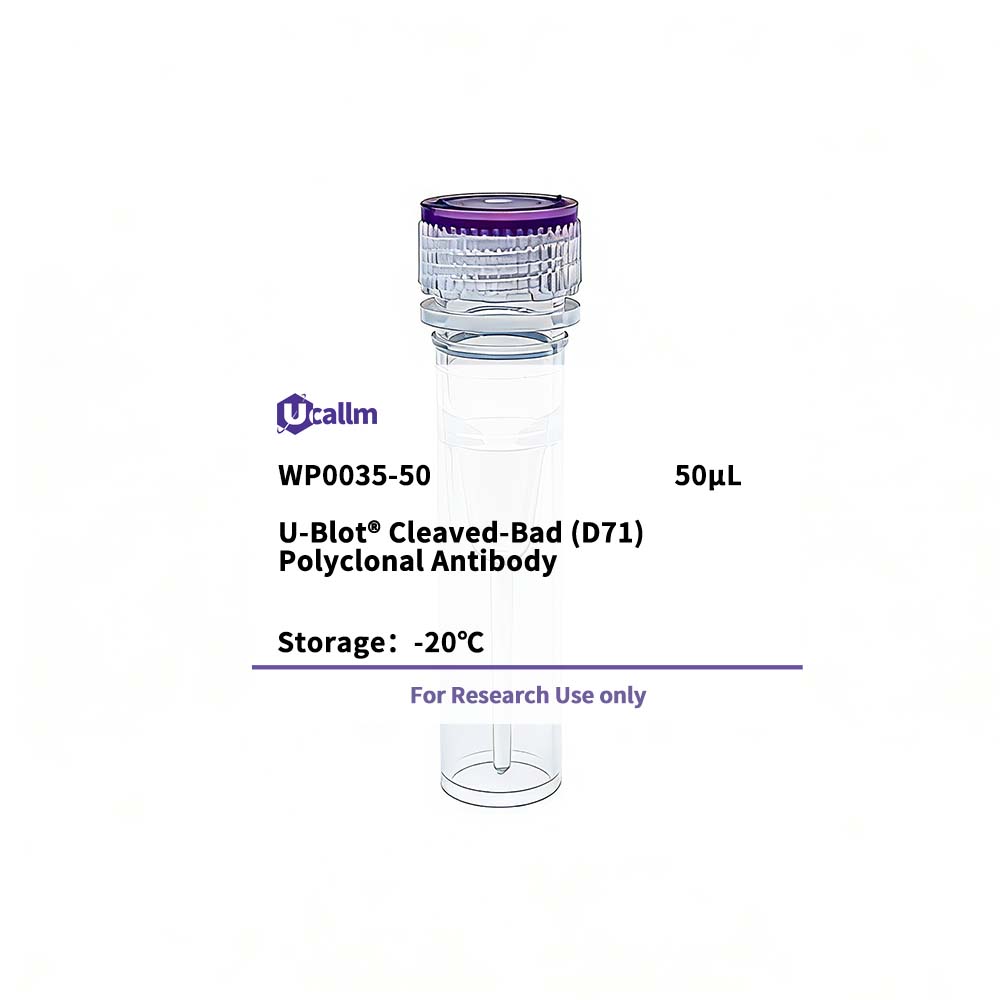
SKU: WP0035 Categories: ,

Cleaved-Bad (D71) Polyclonal Antibody

Price range: $268.00 through $328.00

SKU: WP0035-100
Enter the quantity you would like, or drag the panel to find the quantity and price that best for you
Bulk QuoteAuthorize OEM & ODM

Product details

Background:

BCL2 associated agonist of cell death encoded by BAD is a member of the BCL-2 family. BCL-2 family members are known to be regulators of programmed cell death. BCL2 associated agonist of cell death positively regulates cell apoptosis by forming heterodimers with BCL-xL and BCL-2, and reversing their death repressor activity. Proapoptotic activity of BCL2 associated agonist of cell death is regulated through its phosphorylation. Protein kinases AKT and MAP kinase, as well as protein phosphatase calcineurin were found to be involved in the regulation of BCL2 associated agonist of cell death. Alternative splicing of BAD results in two transcript variants which encode the same isoform.

Specifications

Size50μL/100μL
TargetBad
ReactivityMouse, Rat
ApplicationsWB, IHC, IF, ELISA
MW(Calculated)
MW(Observed)20kD
Host SpeciesRabbit
IsotypeIgG
Conjugate/ModificationUnmodified
Recommended Dilution RatioWB 1:500-1:2000; IHC 1:100-1:300; ELISA 1:20000; IF 1:50-200 / Note: For IHC, we suggest antigen retrieval with TE buffer pH 9.0 (Cat#WT1004)
FormulationLiquid in PBS containing 50% glycerol, 0.5% BSA and 0.02% sodium azide.
PurificationThe antibody was affinity-purified from rabbit antiserum by affinity-chromatography using epitope-specific immunogen.
Storage-15°C to -25°C/1 year(Do not lower than -25°C)
Concentration1 mg/ml
ClonalityPolyclonal
Clone Number
ImmunogenThe antiserum was produced against synthesized peptide derived from mouse BAD. AA range:21-70
SpecificityCleaved-Bad (D71) Polyclonal Antibody detects endogenous levels of fragment of activated Bad protein resulting from cleavage adjacent to D71.
Gene NameBAD
Protein NameBcl2 antagonist of cell death
Other NameBAD; / BBC6; / BCL2L8; / Bcl2 antagonist of cell death; / BAD; / Bcl-2-binding component 6; / Bcl-2-like protein 8; / Bcl2-L-8; / Bcl-XL/Bcl-2-associated death promoter
SpeciesHuman
Gene ID572
UniprotQ92934,
Species.1Mouse
Gene ID.112015
Uniprot.1Q61337,
Species.2Rat
Gene ID.264639
Uniprot.2O35147
Cellular Localization
Tissue Expression
Signaling_pathwayCellular Processes >> Transport and catabolism >> Autophagy - animal;Cellular Processes >> Cell growth and death >> Apoptosis;Cellular Processes >> Cellular community - eukaryotes >> Focal adhesion;Organismal Systems >> Immune system >> Chemokine signaling pathway;Organismal Systems >> Endocrine system >> Insulin signaling pathway;Organismal Systems >> Endocrine system >> Thyroid hormone signaling pathway;Organismal Systems >> Nervous system >> Neurotrophin signaling pathway;Human Diseases >> Cancer: overview >> Pathways in cancer;Human Diseases >> Cancer: specific types >> Colorectal cancer;Human Diseases >> Cancer: specific types >> Pancreatic cancer;Human Diseases >> Cancer: specific types >> Hepatocellular carcinoma;Human Diseases >> Cancer: specific types >> Acute myeloid leukemia;Human Diseases >> Cancer: specific types >> Chronic myeloid leukemia;Human Diseases >> Cancer: specific types >> Melanoma;Human Diseases >> Cancer: specific types >> Renal cell carcinoma;Human Diseases >> Cancer: specific types >> Prostate cancer;Human Diseases >> Cancer: specific types >> Endometrial cancer;Human Diseases >> Cancer: specific types >> Non-small cell lung cancer;Human Diseases >> Neurodegenerative disease >> Alzheimer disease;Human Diseases >> Neurodegenerative disease >> Amyotrophic lateral sclerosis;Human Diseases >> Neurodegenerative disease >> Prion disease;Human Diseases >> Neurodegenerative disease >> Pathways of neurodegeneration - multiple diseases;Environmental Information Processing >> Signal transduction >> ErbB signaling pathway;Environmental Information Processing >> Signal transduction >> Ras signaling pathway;Environmental Information Processing >> Signal transduction >> VEGF signaling pathway;Environmental Information Processing >> Signal transduction >> cAMP signaling pathway;Environmental Information Processing >> Signal transduction >> cGMP-PKG signaling pathway;Environmental Information Processing >> Signal transduction >> PI3K-Akt signaling pathway
Research Areas
Function
Please login to post questions
Back to Top
Product has been added to your cart
