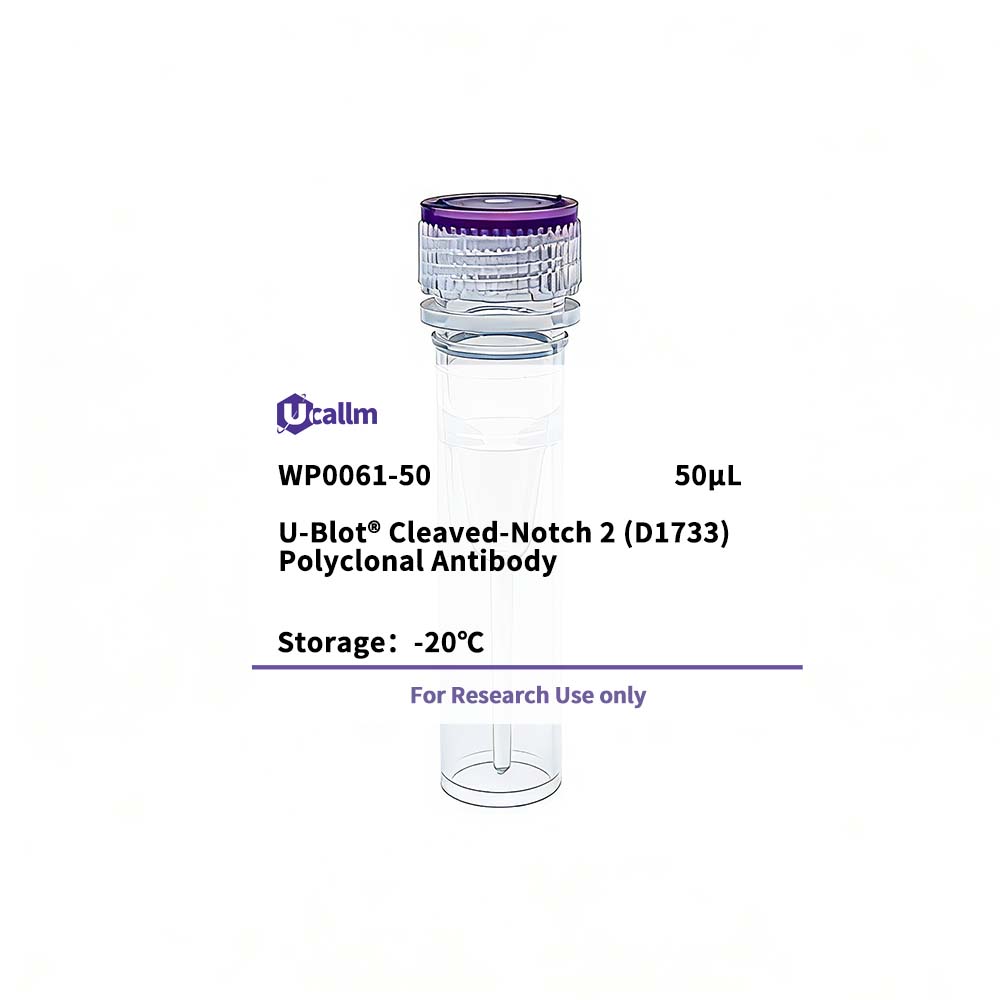
SKU: WP0061 Categories: ,

Cleaved-Notch 2 (D1733) Polyclonal Antibody

Price range: $268.00 through $328.00

SKU: WP0061-100
Enter the quantity you would like, or drag the panel to find the quantity and price that best for you
Bulk QuoteAuthorize OEM & ODM

Product details

Background:

notch 2(NOTCH2) Homo sapiens This gene encodes a member of the Notch family. Members of this Type 1 transmembrane protein family share structural characteristics including an extracellular domain consisting of multiple epidermal growth factor-like (EGF) repeats, and an intracellular domain consisting of multiple, different domain types. Notch family members play a role in a variety of developmental processes by controlling cell fate decisions. The Notch signaling network is an evolutionarily conserved intercellular signaling pathway which regulates interactions between physically adjacent cells. In Drosophilia, notch interaction with its cell-bound ligands (delta, serrate) establishes an intercellular signaling pathway that plays a key role in development. Homologues of the notch-ligands have also been identified in human, but precise interactions between these ligands and the human notch homologues remain to be determined. This protein is cle

Specifications

Size50μL/100μL
TargetNotch 2
ReactivityHuman, Mouse, Rat
ApplicationsIF, WB, IHC, ELISA
MW(Calculated)
MW(Observed)110kD(cleaved)
Host SpeciesRabbit
IsotypeIgG
Conjugate/ModificationUnmodified
Recommended Dilution RatioIF 1:50-200; WB 1:500-1:2000; IHC 1:100-1:300; ELISA 1:40000; Not yet tested in other applications; / Note: For IHC, we suggest antigen retrieval with TE buffer pH 9.0 (Cat#WT1004)
FormulationLiquid in PBS containing 50% glycerol, 0.5% BSA and 0.02% sodium azide.
PurificationThe antibody was affinity-purified from rabbit antiserum by affinity-chromatography using epitope-specific immunogen.
Storage-15°C to -25°C/1 year(Do not lower than -25°C)
Concentration1 mg/ml
ClonalityPolyclonal
Clone Number
ImmunogenThe antiserum was produced against synthesized peptide derived from human Notch 2. AA range:1684-1733
SpecificityCleaved-Notch 2 (D1733) Polyclonal Antibody detects endogenous levels of fragment of activated Notch 2 protein resulting from cleavage adjacent to D1733.
Gene NameNOTCH2
Protein NameNeurogenic locus notch homolog protein 2
Other NameNOTCH2; / Neurogenic locus notch homolog protein 2; / Notch 2; / hN2
SpeciesHuman
Gene ID4853
UniprotQ04721,
Species.1Mouse
Gene ID.118129
Uniprot.1O35516,
Species.2Rat
Gene ID.229492
Uniprot.2Q9QW30
Cellular Localization[Notch 2 extracellular truncation]: Cell membrane; Single-pass type I membrane protein .; [Notch 2 intracellular domain]: Nucleus . Cytoplasm . Following proteolytical processing NICD is translocated to the nucleus. Retained at the cytoplasm by TCIM (PubMed:25985737). .
Tissue ExpressionExpressed in the brain, heart, kidney, lung, skeletal muscle and liver. Ubiquitously expressed in the embryo.
Signaling_pathwayOrganismal Systems >> Immune system >> Th1 and Th2 cell differentiation;Organismal Systems >> Endocrine system >> Thyroid hormone signaling pathway;Human Diseases >> Cancer: overview >> Pathways in cancer;Human Diseases >> Cancer: overview >> MicroRNAs in cancer;Human Diseases >> Cancer: specific types >> Breast cancer;Environmental Information Processing >> Signal transduction >> Notch signaling pathway
Research Areas>>Endocrine resistance; / >>Notch signaling pathway; / >>Th1 and Th2 cell differentiation; / >>Thyroid hormone signaling pathway; / >>Human papillomavirus infection; / >>Pathways in cancer; / >>MicroRNAs in cancer; / >>Chemical carcinogenesis - receptor activation; / >>Breast cancer
FunctionDisease:Defects in NOTCH2 are the cause of Alagille syndrome type 2 (ALGS2) [MIM:610205]. Alagille syndrome is an autosomal dominant multisystem disorder defined clinically by hepatic bile duct paucity and cholestasis in association with cardiac, skeletal, and ophthalmologic manifestations. There are characteristic facial features and less frequent clinical involvement of the renal and vascular systems.,Function:Functions as a receptor for membrane-bound ligands Jagged1, Jagged2 and Delta1 to regulate cell-fate determination. Upon ligand activation through the released notch intracellular domain (NICD) it forms a transcriptional activator complex with RBP-J kappa and activates genes of the enhancer of split locus. Affects the implementation of differentiation, proliferation and apoptotic programs.,PTM:Phosphorylated.,PTM:Synthesized in the endoplasmic reticulum as an inactive form which is proteolytically cleaved by a furin-like convertase in the trans-Golgi network before it reaches the plasma membrane to yield an active, ligand-accessible form. Cleavage results in a C-terminal fragment N(TM) and a N-terminal fragment N(EC). Following ligand binding, it is cleaved by TNF-alpha converting enzyme (TACE) to yield a membrane-associated intermediate fragment called notch extracellular truncation (NEXT). This fragment is then cleaved by presenilin dependent gamma-secretase to release a notch-derived peptide containing the intracellular domain (NICD) from the membrane.,similarity:Belongs to the NOTCH family.,similarity:Contains 3 LNR (Lin/Notch) repeats.,similarity:Contains 35 EGF-like domains.,similarity:Contains 6 ANK repeats.,subcellular location:Following proteolytical processing NICD is translocated to the nucleus.,subunit:Heterodimer of a C-terminal fragment N(TM) and an N-terminal fragment N(EC) which are probably linked by disulfide bonds (By similarity). Interacts with MAML1, MAML2 and MAML3 which act as transcriptional coactivators for NOTCH2.,tissue specificity:Expressed in the brain, heart, kidney, lung, skeletal muscle and liver.,
Please login to post questions
Back to Top
Product has been added to your cart

