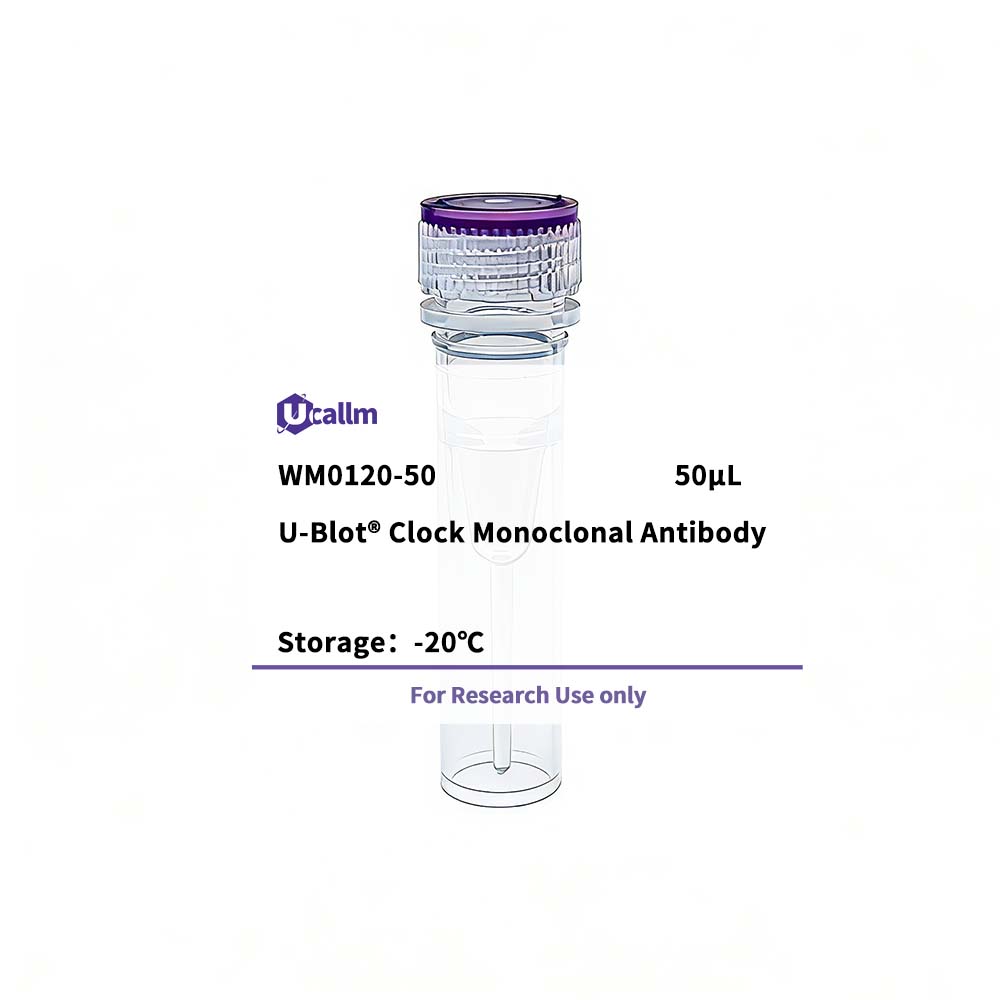
SKU: WM0120 Categories: ,

Clock Monoclonal Antibody

Price range: $268.00 through $328.00

SKU: WM0120-50
Enter the quantity you would like, or drag the panel to find the quantity and price that best for you
Bulk QuoteAuthorize OEM & ODM

Product details

Background:
The protein encoded by this gene plays a central role in the regulation of circadian rhythms. The protein encodes a transcription factor of the basic helix-loop-helix (bHLH) family and contains DNA binding histone acetyltransferase activity. The encoded protein forms a heterodimer with ARNTL (BMAL1) that binds E-box enhancer elements upstream of Period (PER1, PER2, PER3) and Cryptochrome (CRY1, CRY2) genes and activates transcription of these genes. PER and CRY proteins heterodimerize and repress their own transcription by interacting in a feedback loop with CLOCK/ARNTL complexes. Polymorphisms in this gene may be associated with behavioral changes in certain populations and with obesity and metabolic syndrome. Alternative splicing results in multiple transcript variants. [provided by RefSeq, Jan 2014],

Specifications

Size50μL/100μL
TargetClock
ReactivityHuman
ApplicationsWB, IF, ELISA
MW(Calculated)95kD
MW(Observed)
Host SpeciesMouse
Isotype
Conjugate/ModificationUnmodified
Recommended Dilution RatioWB 1:500-1:2000; IF 1:200-1:1000; ELISA 1:10000; Not yet tested in other applications.
FormulationLiquid in PBS containing 50% glycerol, 0.5% BSA and 0.02% sodium azide.
PurificationAffinity purification
Storage-15°C to -25°C/1 year(Do not lower than -25°C)
Concentration
ClonalityMonoclonal
Clone Number16C6
ImmunogenPurified recombinant fragment of human Clock expressed in E. Coli.
SpecificityClock Monoclonal Antibody detects endogenous levels of Clock protein.
Gene NameCLOCK
Protein NameCircadian locomoter output cycles protein kaput
Other NameCLOCK; / BHLHE8; / KIAA0334; / Circadian locomoter output cycles protein kaput; / hCLOCK; / Class E basic helix-loop-helix protein 8; / bHLHe8
SpeciesHuman
Gene ID9575
UniprotO15516,
Species.1Mouse
Gene ID.1
Uniprot.1O08785
Species.2
Gene ID.2
Uniprot.2
Cellular LocalizationNucleus . Cytoplasm . Cytoplasm, cytosol . Shuttling between the cytoplasm and the nucleus is under circadian regulation and is ARNTL/BMAL1-dependent. Phosphorylated form located in the nucleus while the nonphosphorylated form found only in the cytoplasm. Sequestered to the cytoplasm in the presence of ID2 (By similarity). Localizes to sites of DNA damage in a H2AX-independent manner. .
Tissue ExpressionHair follicles (at protein level). Expressed in all tissues examined including spleen, thymus, prostate, testis, ovary, small intestine, colon, leukocytes, heart, brain, placenta, lung, liver, skeletal muscle, kidney and pancreas. Highest levels in testis and skeletal muscle. Low levels in thymus, lung and liver. Expressed in all brain regions with highest levels in cerebellum. Highly expressed in the suprachiasmatic nucleus (SCN).
Signaling_pathwayOrganismal Systems >> Nervous system >> Dopaminergic synapse;Organismal Systems >> Environmental adaptation >> Circadian rhythm
Research Areas>>Circadian rhythm; / >>Dopaminergic synapse
FunctionCatalytic activity:Acetyl-CoA + histone = CoA + acetylhistone.,Function:ARNTL/2-CLOCK heterodimers activate E-box element (3'-CACGTG-5') transcription of a number of proteins of the circadian clock. Activates transcription of PER1 and PER2. This transcription is inhibited in a feedback loop by PER and CRY proteins. Has intrinsic histone acetyltransferase activity and this enzymatic function contributes to chromatin-remodeling events implicated in circadian control of gene expression (By similarity). Acetylates primarily histones H3 and H4 (By similarity). Acetylates also a non-histone substrate: ARNTL.,miscellaneous:CLOCK-ARNTL double mutations within the PAS domains result in syngernistic desensitization to high levels of CRY on repression of CLOCK-ARNTL transcriptional activity of PER1 and disrupt circadian rhythmicity.,PTM:Phosphorylation is dependent on CLOCK-ARNTL heterodimer formation.,similarity:Contains 1 basic helix-loop-helix (bHLH) domain.,similarity:Contains 1 PAC (PAS-associated C-terminal) domain.,similarity:Contains 2 PAS (PER-ARNT-SIM) domains.,subcellular location:Shuffling between the cytoplasm and the nucleus is under circadian regulation and is ARNTL-dependent. Phosphorylated form located in the nucleus.,subunit:Component of the circadian clock oscillator which includes the CRY proteins, CLOCK or NPAS2, ARNTL or ARNTL2, CSNK1D and/or CSNK1E, TIMELESS and the PER proteins. Efficient DNA binding requires dimerization with another bHLH protein. Heterodimerization with ARNTL is required for E-box-dependent transactivation, for CLOCK nuclear translocation and degradation, and, for phosphorylation of both CLOCK and ARNTL. Interaction with PER and CRY proteins requires translocation to the nucleus. Interaction of the CLOCK-ARNTL heterodimer with PER or CRY inhibits transcription activation. Binds weakly ARNTL and ARNTL2 to form heterodimers which bind poorly to the E-box motif.,tissue specificity:Expressed in all tissues examined including spleen, thymus, prostate, testis, ovary, small intestine, colon, leukocytes, heart, brain, placenta, lung, liver, skeletal muscle, kidney and pancreas. Highest levels in testis and skeletal muscle. Low levels in thymus, lung and liver. Expressed in all brain regions with highest levels in cerebellum. Highly expressed in the suprachiasmatic nucleus (SCN).,
Please login to post questions
Back to Top
Product has been added to your cart

