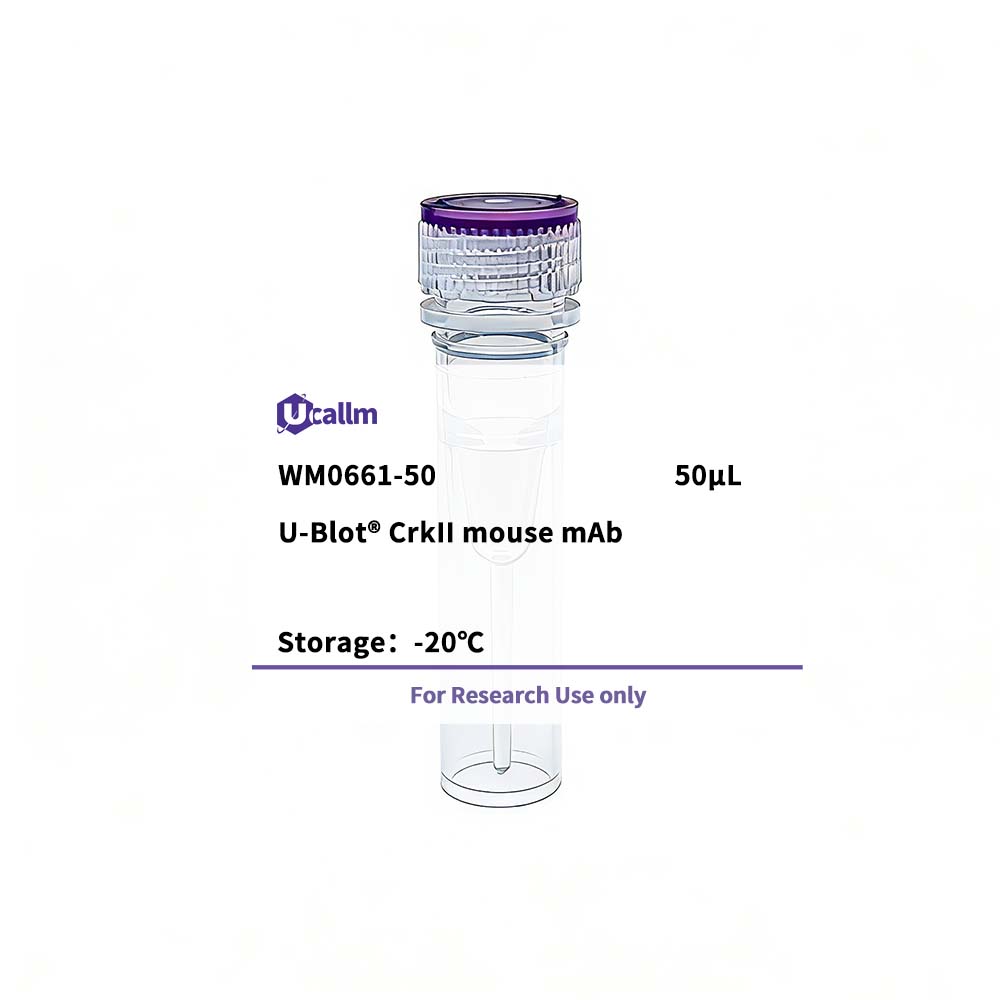
SKU: WM0661 Categories: ,

CrkII mouse mAb

Price range: $268.00 through $328.00

SKU: WM0661-50
Enter the quantity you would like, or drag the panel to find the quantity and price that best for you
Bulk QuoteAuthorize OEM & ODM

Product details

Background:
This gene encodes a member of an adapter protein family that binds to several tyrosine-phosphorylated proteins. The product of this gene has several SH2 and SH3 domains (src-homology domains) and is involved in several signaling pathways, recruiting cytoplasmic proteins in the vicinity of tyrosine kinase through SH2-phosphotyrosine interaction. The N-terminal SH2 domain of this protein functions as a positive regulator of transformation whereas the C-terminal SH3 domain functions as a negative regulator of transformation. Two alternative transcripts encoding different isoforms with distinct biological activity have been described. [provided by RefSeq, Jul 2008],


Specifications

Size50μL/100μL
TargetCrk II
ReactivityHuman
ApplicationsWB
MW(Calculated)
MW(Observed)34kD
Host SpeciesMouse
Isotype
Conjugate/ModificationUnmodified
Recommended Dilution RatioWB 1:1000
FormulationLiquid in PBS containing 50% glycerol, 0.5% BSA and 0.02% sodium azide.
PurificationThe antibody was affinity-purified from mouse ascites by affinity-chromatography using epitope-specific immunogen.
Storage-15°C to -25°C/1 year(Do not lower than -25°C)
Concentration
ClonalityMonoclonal
Clone Number5B10
ImmunogenPurified recombinant human CrkII protein fragments expressed in E.coli.
SpecificityThis antibody detects endogenous levels of CrkII and does not cross-react with related proteins.
Gene Namecrk
Protein Name
Other NameAdapter molecule crk; / Avian sarcoma virus CT10; / v crk; / oncogene homolog; / CRK; / CRK isoform 2; / CRK isoform II; / CRK_HUMAN; / CRKII; / FLJ38130; / OTTHUMP00000115366; / OTTHUMP00000198330; / p38; / Proto oncogene C crk; / Proto-oncogene C-crk; / v crk avian sarcoma virus CT10 oncogene homolog; / v crk sarcoma virus CT10 oncogene homolog; / v crk sarcoma virus CT10 oncogene homolog; / avian; / .
SpeciesHuman
Gene ID1398
UniprotP46108,
Species.1Mouse
Gene ID.112928
Uniprot.1Q64010
Species.2
Gene ID.2
Uniprot.2
Cellular LocalizationCytoplasm . Cell membrane . Translocated to the plasma membrane upon cell adhesion. .
Tissue ExpressionEmbryonic lung,Epithelium,Eye,Lung,Placenta,
Signaling_pathwayCellular Processes >> Cellular community - eukaryotes >> Focal adhesion;Cellular Processes >> Cell motility >> Regulation of actin cytoskeleton;Organismal Systems >> Immune system >> Fc gamma R-mediated phagocytosis;Organismal Systems >> Immune system >> Chemokine signaling pathway;Organismal Systems >> Endocrine system >> Insulin signaling pathway;Organismal Systems >> Endocrine system >> Growth hormone synthesis, secretion and action;Organismal Systems >> Nervous system >> Neurotrophin signaling pathway;Human Diseases >> Cancer: overview >> Pathways in cancer;Human Diseases >> Cancer: overview >> MicroRNAs in cancer;Human Diseases >> Cancer: specific types >> Chronic myeloid leukemia;Human Diseases >> Cancer: specific types >> Renal cell carcinoma;Environmental Information Processing >> Signal transduction >> MAPK signaling pathway;Environmental Information Processing >> Signal transduction >> ErbB signaling pathway;Environmental Information Processing >> Signal transduction >> Rap1 signaling pathway
Research Areas>>MAPK signaling pathway; / >>ErbB signaling pathway; / >>Rap1 signaling pathway; / >>Chemokine signaling pathway; / >>Focal adhesion; / >>Fc gamma R-mediated phagocytosis; / >>Neurotrophin signaling pathway; / >>Regulation of actin cytoskeleton; / >>Insulin signaling pathway; / >>Growth hormone synthesis, secretion and action; / >>Bacterial invasion of epithelial cells; / >>Shigellosis; / >>Yersinia infection; / >>Human cytomegalovirus infection; / >>Human immunodeficiency virus 1 infection; / >>Pathways in cancer; / >>MicroRNAs in cancer; / >>Renal cell carcinoma; / >>Chronic myeloid leukemia
FunctionDomain:The C-terminal SH3 domain function as a negative modulator for transformation and the N-terminal SH3 domain appears to function as a positive regulator for transformation.,Domain:The SH2 domain mediates interaction with SHB.,Function:The Crk-I and Crk-II forms differ in their biological activities. Crk-II has less transforming activity than Crk-I. Crk-II mediates attachment-induced MAPK8 activation, membrane ruffling and cell motility in a Rac-dependent manner. Involved in phagocytosis of apoptotic cells and cell motility via its interaction with DOCK1 and DOCK4.,PTM:Phosphorylated on Tyr-221 upon cell adhesion. Results in the negative regulation of the association with SH2- and SH3-binding partners, possibly by the formation of an intramolecular interaction of phosphorylated Tyr-221 with the SH2 domain. This leads finally to the down-regulation of the Crk signaling pathway.,PTM:Phosphorylation of Crk-II (40 kDa) gives rise to a 42 kDa form.,similarity:Contains 1 SH2 domain.,similarity:Contains 1 SH3 domain.,similarity:Contains 2 SH3 domains.,subcellular location:Translocated to the plasma membrane upon cell adhesion.,subunit:Interacts with ABL1, C3G, SOS, MAP4K1, MAPK8 and DOCK3 via its first SH3 domain. Interacts with BCAR1, CBL, CBLB, PXN, IRS4 and GAB1 via its SH2 domain upon stimulus-induced tyrosine phosphorylation. Interacts with several tyrosine-phosphorylated growth factor receptors such as EGFR, PDGFR and INSR via its SH2 domain (By similarity). Interacts with DOCK1 and DOCK4. Interacts with SHB.,
Please login to post questions
Back to Top
Product has been added to your cart
