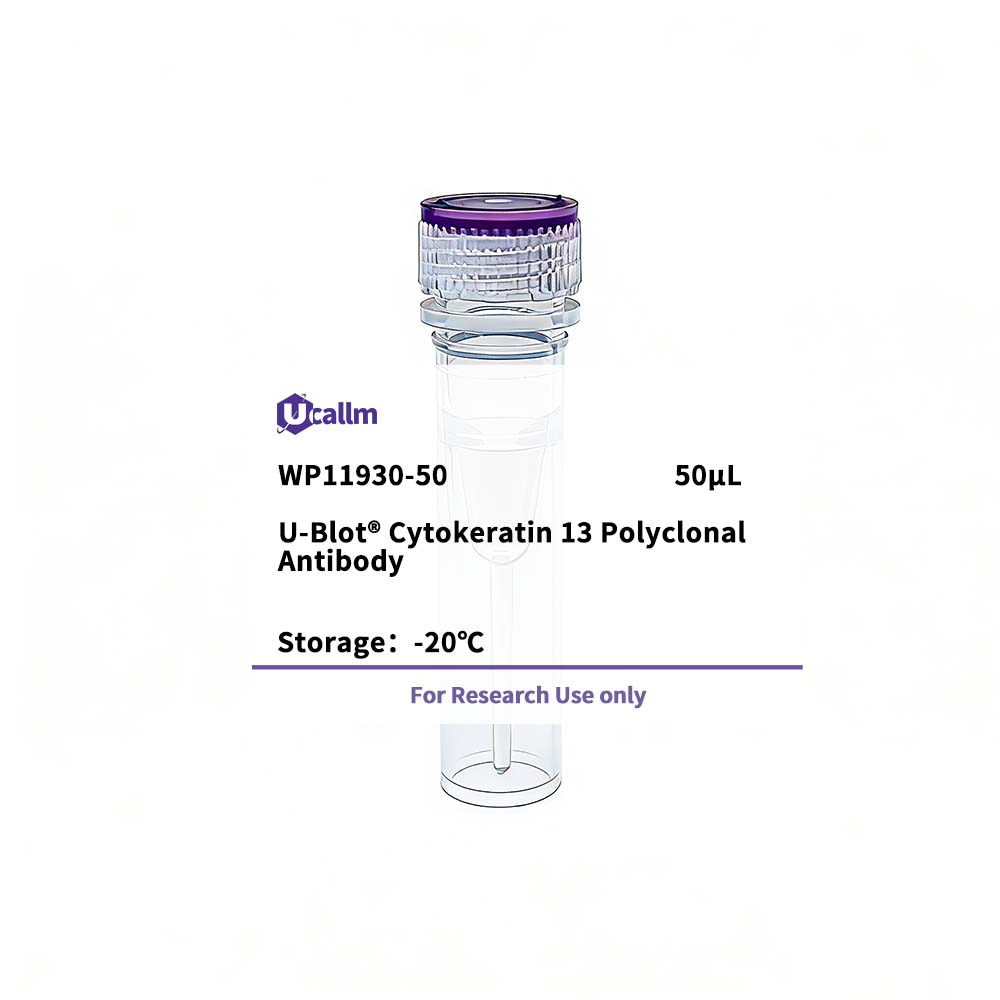
SKU: WP11930 Categories: ,

Cytokeratin 13 Polyclonal Antibody

Price range: $268.00 through $328.00

SKU: WP11930-100
Enter the quantity you would like, or drag the panel to find the quantity and price that best for you
Bulk QuoteAuthorize OEM & ODM

Product details

Background:

The protein encoded by this gene is a member of the keratin gene family. The keratins are intermediate filament proteins responsible for the structural integrity of epithelial cells and are subdivided into cytokeratins and hair keratins. Most of the type I cytokeratins consist of acidic proteins which are arranged in pairs of heterotypic keratin chains. This type I cytokeratin is paired with keratin 4 and expressed in the suprabasal layers of non-cornified stratified epithelia. Mutations in this gene and keratin 4 have been associated with the autosomal dominant disorder White Sponge Nevus. The type I cytokeratins are clustered in a region of chromosome 17q21.2. Alternative splicing of this gene results in multiple transcript variants; however, not all variants have been described. [provided by RefSeq, Jul 2008],

Specifications

Size50μL/100μL
TargetCytokeratin 13
ReactivityHuman, Mouse, Rat
ApplicationsWB, IHC, IF, ELISA
MW(Calculated)
MW(Observed)52kD
Host SpeciesRabbit
IsotypeIgG
Conjugate/ModificationUnmodified
Recommended Dilution RatioWB 1:500-1:2000; IHC 1:100-1:300; ELISA 1:5000; IF 1:50-200 / Note: For IHC, we suggest antigen retrieval with TE buffer pH 9.0 (Cat#WT1004)
FormulationLiquid in PBS containing 50% glycerol, 0.5% BSA and 0.02% sodium azide.
PurificationThe antibody was affinity-purified from rabbit antiserum by affinity-chromatography using epitope-specific immunogen.
Storage-15°C to -25°C/1 year(Do not lower than -25°C)
Concentration1 mg/ml
ClonalityPolyclonal
Clone Number
ImmunogenThe antiserum was produced against synthesized peptide derived from human Cytokeratin 13. AA range:233-282
SpecificityCytokeratin 13 Polyclonal Antibody detects endogenous levels of Cytokeratin 13 protein.
Gene NameKRT13
Protein NameKeratin type I cytoskeletal 13
Other NameKRT13; / Keratin; / type I cytoskeletal 13; / Cytokeratin-13; / CK-13; / Keratin-13; / K13
SpeciesHuman
Gene ID3860
UniprotP13646,
Species.1Mouse
Gene ID.116663
Uniprot.1P08730,
Species.2Rat
Gene ID.2287699
Uniprot.2Q6IFV4
Cellular Localizationnucleus,intermediate filament,keratin filament,intermediate filament cytoskeleton,extracellular exosome,
Tissue ExpressionExpressed in some epidermal sweat gland ducts (at protein level) and in exocervix, esophagus and placenta.
Signaling_pathwayOrganismal Systems >> Endocrine system >> Estrogen signaling pathway
Research Areas>>Estrogen signaling pathway; / >>Staphylococcus aureus infection
FunctionDisease:Defects in KRT13 are a cause of white sponge nevus of cannon (WSN) [MIM:193900]. WSN is a rare autosomal dominant disorder which predominantly affects non-cornified stratified squamous epithelia. Clinically, it is characterized by the presence of soft, white, and spongy plaques in the oral mucosa. The characteristic histopathologic features are epithelial thickening, parakeratosis, and vacuolization of the suprabasal layer of oral epithelial keratinocytes. Less frequently the mucous membranes of the nose, esophagus, genitalia and rectum are involved.,miscellaneous:There are two types of cytoskeletal and microfibrillar keratin: I (acidic; 40-55 kDa) and II (neutral to basic; 56-70 kDa).,online information:Keratin-13 entry,PTM:O-glycosylated; glycans consist of single N-acetylglucosamine residues.,similarity:Belongs to the intermediate filament family.,subunit:Heterotetramer of two type I and two type II keratins. keratin-13 is generally associated with keratin-4.,tissue specificity:Expressed in some epidermal sweat gland ducts (at protein level) and in exocervix, esophagus and placenta.,
Please login to post questions
Back to Top
Product has been added to your cart


