

Cytokeratin 14 [PT1674] mouse mAb
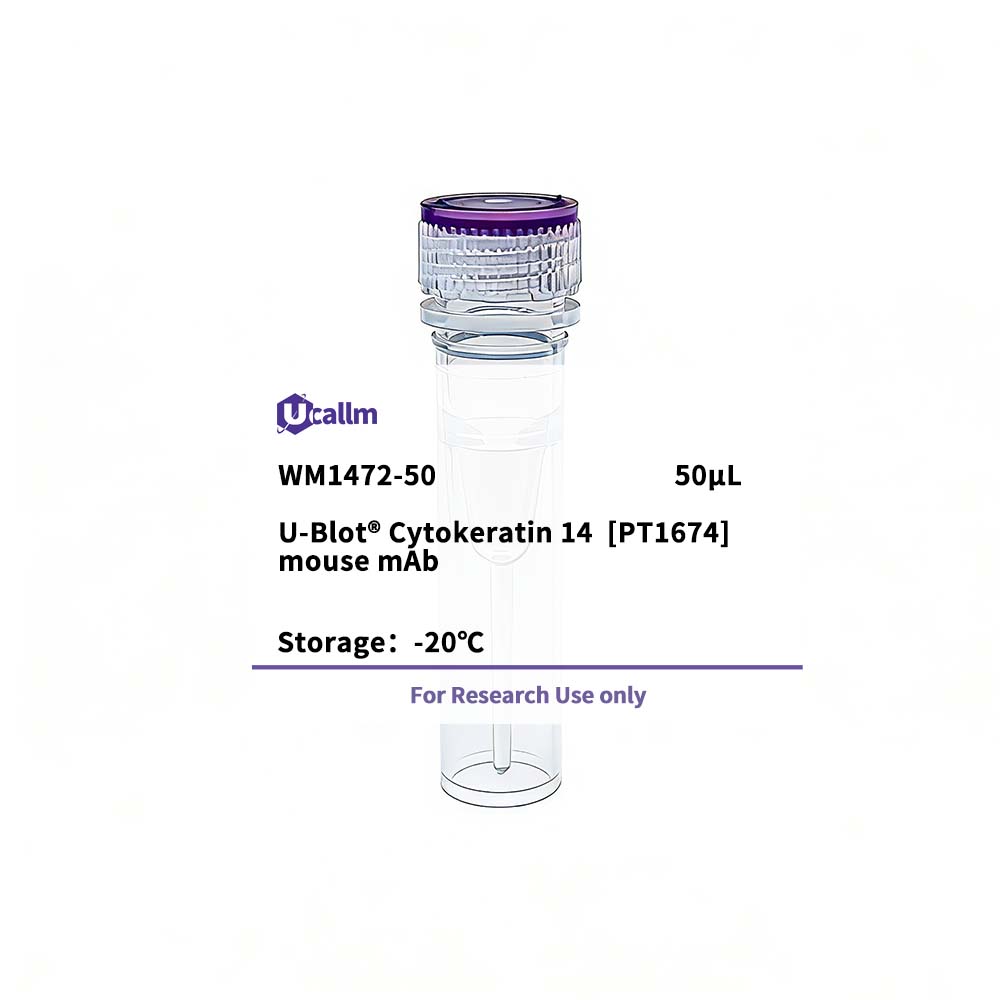
Ucallm_WM1472-50
Price range: $268.00 through $328.00
Product details
Background:
CK14 is a member of the Type I family of cytokeratins with a molecular weight of 50 kDa, which is expressed in the basal cells of myoepithelium and keratinized squamous epithelium. It is mainly used for the difference between stratified squamous epithelium and monolayer epithelium and the diagnosis of squamous cell carcinoma. Eosinophilic tumors at multiple anatomical sites express CK14, which can be used to distinguish from adenocarcinoma, invasive ductal carcinoma of salivary gland and intraductal carcinoma.
Specifications
| Size | 50μL/100μL |
| Target | Cytokeratin 14 |
| Reactivity | Human, Mouse, Rat |
| Applications | IHC, WB, IF, ELISA |
| MW(Calculated) | 52kD |
| MW(Observed) | 53kD |
| Host Species | Mouse |
| Isotype | IgG1,Kappa |
| Conjugate/Modification | Unmodified |
| Recommended Dilution Ratio | IHC 1:200-1000; WB 1:500-2000; IF 1:100-500; ELISA 1:1000-5000 / Note: For IHC, we suggest antigen retrieval with TE buffer pH 9.0 (Cat#WT1004) |
| Formulation | PBS, 50% glycerol, 0.05% Proclin 300, 0.05%BSA |
| Purification | Recombinant Antibody expressed in animal component-free (ACF) media, purified via Protein G affinity chromatography. |
| Storage | -15°C to -25°C/1 year(Do not lower than -25°C) |
| Concentration | |
| Clonality | Monoclonal |
| Clone Number | RMM1674 |
| Immunogen | Synthesized peptide derived from human Cytokeratin 14 AA range: 400-472 |
| Specificity | The antibody can specifically recognize human CK14 protein. In immunohistochemistry on formalin-fixed, paraffin-embedded tissue sections, the antibody specifically labels the basal cell of squamous epithelial cells and glandular epithelia, myoepithelium and mesothelial cells. |
| Gene Name | KRT14 |
| Protein Name | Keratin, type I cytoskeletal 14 (Cytokeratin-14) (CK-14) (Keratin-14) (K14) |
| Other Name | CK 14; / CK-14; / ck14; / Cytokeratin 14; / CytokeRatin-14; / CytokeRatin14; / Dowling Meara; / EBS3; / EBS4; / Epidermolysis bullosa simplex; / K14; / K1C14_HUMAN; / KeRatin 14; / epidermolysis bullosa simplex, Dowling-Meara, Koebner; / KeRatin 14; / KeRatin; / KeRatin type I cytoskeletal 14; / KeRatin, type I cytoskeletal 14; / KeRatin-14; / KeRatin14; / Koebner; / Krt 14; / Krt14; / NFJ; / OTTHUMP00000164624; / type I cytoskeletal 14 |
| Species | Human |
| Gene ID | 3861 |
| Uniprot | P02533 |
| Species.1 | |
| Gene ID.1 | |
| Uniprot.1 | |
| Species.2 | |
| Gene ID.2 | |
| Uniprot.2 | |
| Cellular Localization | Cytoplasmic, Membranous |
| Tissue Expression | Expressed in the corneal epithelium (at protein level) (PubMed:26758872). Detected in the basal layer, lowered within the more apically located layers specifically in the stratum spinosum, stratum granulosum but is not detected in stratum corneum. Strongly expressed in the outer root sheath of anagen follicles but not in the germinative matrix, inner root sheath or hair (PubMed:9457912). Found in keratinocytes surrounding the club hair during telogen (PubMed:9457912). |
| Signaling_pathway | Organismal Systems >> Endocrine system >> Estrogen signaling pathway |
| Research Areas | >>Estrogen signaling pathway; / >>Staphylococcus aureus infection |
| Function | Disease:Defects in KRT14 are a cause of epidermolysis bullosa simplex Dowling-Meara type (DM-EBS) [MIM:131760]. DM-EBS is a severe form of intraepidermal epidermolysis bullosa characterized by generalized herpetiform blistering, milia formation, dystrophic nails, and mucous membrane involvement.,Disease:Defects in KRT14 are a cause of epidermolysis bullosa simplex Koebner type (K-EBS) [MIM:131900]. K-EBS is a form of intraepidermal epidermolysis bullosa characterized by generalized skin blistering. The phenotype is not fundamentally distinct from the Dowling-Meara type, althought it is less severe.,Disease:Defects in KRT14 are a cause of epidermolysis bullosa simplex Weber-Cockayne type (WC-EBS) [MIM:131800]. WC-EBS is a form of intraepidermal epidermolysis bullosa characterized by blistering limited to palmar and plantar areas of the skin.,Disease:Defects in KRT14 are the cause of dermatopathia pigmentosa reticularis (DPR) [MIM:125595]. DPR is a rare ectodermal dysplasia characterized by lifelong persistant reticulate hyperpigmentation, noncicatricial alopecia, and nail dystrophy.,Disease:Defects in KRT14 are the cause of epidermolysis bullosa simplex autosomal recessive (AREBS) [MIM:601001]. AREBS is an intraepidermal epidermolysis bullosa characterized by localized blistering on the dorsal, lateral and plantar surfaces of the feet.,Disease:Defects in KRT14 are the cause of Naegeli-Franceschetti-Jadassohn syndrome (NFJS) [MIM:161000]; also known as Naegeli syndrome. NFJS is a rare autosomal dominant form of ectodermal dysplasia. The cardinal features are absence of dermatoglyphics (fingerprints), reticular cutaneous hyperpigmentation (starting at about the age of 2 years without a preceding inflammatory stage), palmoplantar keratoderma, hypohidrosis with diminished sweat gland function and discomfort provoked by heat, nail dystrophy, and tooth enamel defects.,Function:The nonhelical tail domain is involved in promoting KRT5-KRT14 filaments to self-organize into large bundles and enhances the mechanical properties involved in resilience of keratin intermediate filaments in vitro.,miscellaneous:There are two types of cytoskeletal and microfibrillar keratin: I (acidic; 40-55 kDa) and II (neutral to basic; 56-70 kDa).,similarity:Belongs to the intermediate filament family.,subcellular location:Expressed in both as a filamentous pattern.,subunit:Heterotetramer of two type I and two type II keratins. keratin-14 associates with keratin-5. Interacts with TRADD and with keratin filaments. Associates with other type I keratins.,tissue specificity:Detected in the basal layer, lowered within the more apically located layers specifically in the stratum spinosum, stratum granulosum but is not detected in stratum corneum. Strongly expressed in the outer root sheath of anagen follicles but not in the germinative matrix, inner root sheath or hair. Found in keratinocytes surrounding the club hair during telogen., |
Please login to post questions
Related products





