SKU: WM0679 Categories: ,

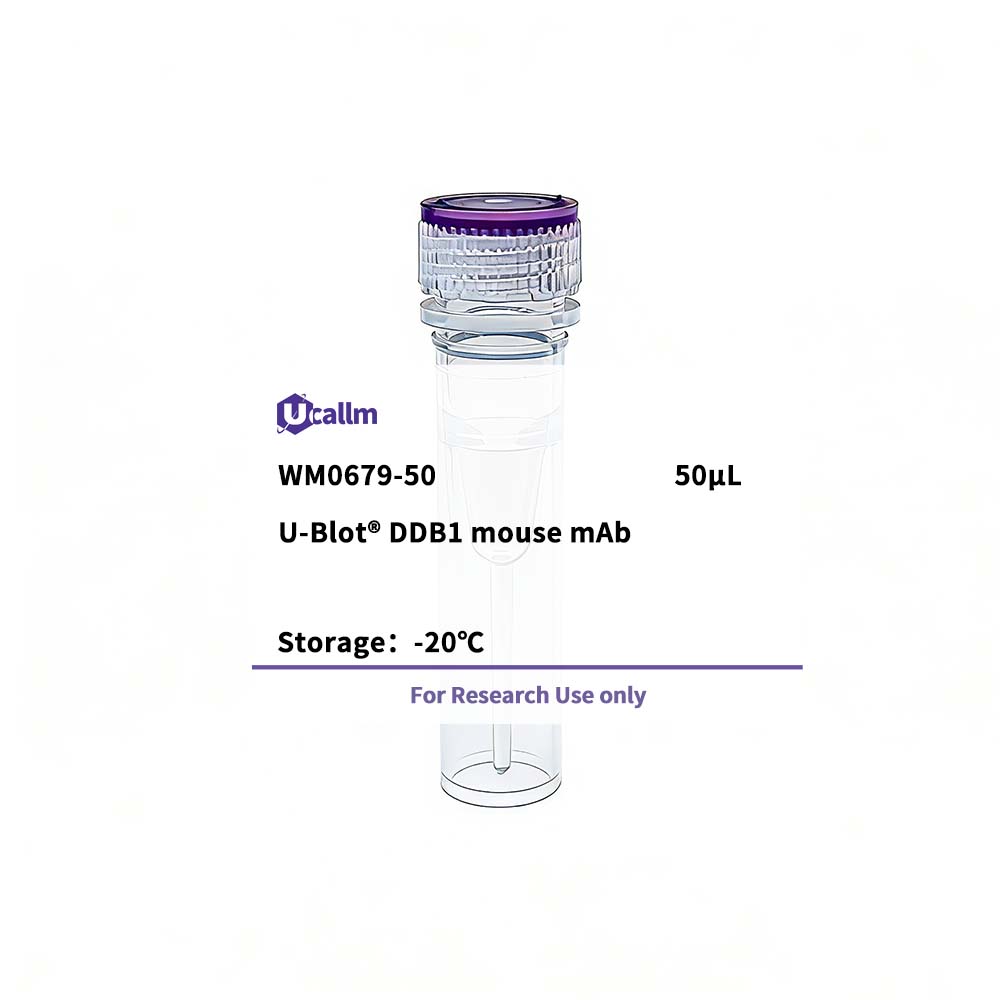
DDB1 mouse mAb

Price range: $268.00 through $328.00

SKU: WM0679-50
Enter the quantity you would like, or drag the panel to find the quantity and price that best for you
Bulk QuoteAuthorize OEM & ODM

Product details

Background:
The protein encoded by this gene is the large subunit (p127) of the heterodimeric DNA damage-binding (DDB) complex while another protein (p48) forms the small subunit. This protein complex functions in nucleotide-excision repair and binds to DNA following UV damage. Defective activity of this complex causes the repair defect in patients with xeroderma pigmentosum complementation group E (XPE) – an autosomal recessive disorder characterized by photosensitivity and early onset of carcinomas. However, it remains for mutation analysis to demonstrate whether the defect in XPE patients is in this gene or the gene encoding the small subunit. In addition, Best vitelliform mascular dystrophy is mapped to the same region as this gene on 11q, but no sequence alternations of this gene are demonstrated in Best disease patients. The protein encoded by this gene also functions as an adaptor molecul

Specifications

Size50μL/100μL
TargetDDB1
ReactivityHuman, Mouse, Rat, Monkey
ApplicationsWB
MW(Calculated)
MW(Observed)127kD
Host SpeciesMouse
Isotype
Conjugate/ModificationUnmodified
Recommended Dilution RatioWB 1:1000
FormulationLiquid in PBS containing 50% glycerol, 0.5% BSA and 0.02% sodium azide.
PurificationThe antibody was affinity-purified from mouse ascites by affinity-chromatography using epitope-specific immunogen.
Storage-15°C to -25°C/1 year(Do not lower than -25°C)
Concentration
ClonalityMonoclonal
Clone Number5G7
ImmunogenPurified recombinant human DDB1 protein fragments expressed in E.coli.
SpecificityThis antibody detects endogenous levels of DDB1 and does not cross-react with related proteins.
Gene Nameddb1
Protein Name
Other NameDamage specific DNA binding protein 1; / Damage-specific DNA-binding protein 1; / DDB 1; / DDB p127 subunit; / Ddb1; / DDB1_HUMAN; / DDBa; / DNA damage binding protein 1; / DNA damage-binding protein 1; / DNA damage-binding protein a; / HBV X-associated protein 1; / UV damaged DNA binding factor; / UV damaged DNA binding protein 1; / UV DDB 1; / UV DDB1; / UV-damaged DNA-binding factor; / UV-damaged DNA-binding protein 1; / UV-DDB 1; / UV-DDB1; / X associated protein 1; / XAP 1; / XAP-1; / XAP1; / Xeroderma pigmentosum group E complementing protein; / Xeroderma pigmentosum group E-complementing protein; / XPCE; / XPE; / XPE BF; / XPE binding factor; / XPE-BF; / XPE-binding factor.
SpeciesHuman
Gene ID1642
UniprotQ16531,
Species.1Mouse
Gene ID.1
Uniprot.1Q3U1J4
Species.2
Gene ID.2
Uniprot.2
Cellular LocalizationCytoplasm . Nucleus . Primarily cytoplasmic (PubMed:10777491, PubMed:11673459). Translocates to the nucleus following UV irradiation and subsequently accumulates at sites of DNA damage (PubMed:10777491, PubMed:11673459). .
Tissue ExpressionBrain,Epidermis,Fetal lung,Peripheral blood,Placenta,Skin,
Signaling_pathway
Research Areas>>Nucleotide excision repair; / >>Ubiquitin mediated proteolysis; / >>Hepatitis B; / >>Human immunodeficiency virus 1 infection; / >>Viral carcinogenesis
FunctionFunction:Required for DNA repair. Binds to DDB2 to form the UV-damaged DNA-binding protein complex (the UV-DDB complex). The UV-DDB complex may recognize UV-induced DNA damage and recruit proteins of the nucleotide excision repair pathway (the NER pathway) to initiate DNA repair. The UV-DDB complex preferentially binds to cyclobutane pyrimidine dimers (CPD), 6-4 photoproducts (6-4 PP), apurinic sites and short mismatches. Also appears to function as a component of numerous distinct DCX (DDB1-CUL4-X-box) E3 ubiquitin-protein ligase complexes which mediate the ubiquitination and subsequent proteasomal degradation of target proteins. The functional specificity of the DCX E3 ubiquitin-protein ligase complex is determined by the variable substrate recognition component recruited by DDB1. DCX(DDB2) (also known as DDB1-CUL4-ROC1, CUL4-DDB-ROC1 and CUL4-DDB-RBX1) may ubiquitinate histone H2A, histone H3 and histone H4 at sites of UV-induced DNA damage. The ubiquitination of histones may facilitate their removal from the nucleosome and promote subsequent DNA repair. DCX(DDB2) also ubiquitinates XPC, which may enhance DNA-binding by XPC and promote NER. DCX(DTL) plays a role in PCNA-dependent polyubiquitination of CDT1 and MDM2-dependent ubiquitination of TP53 in response to radiation-induced DNA damage and during DNA replication. DCX(ERCC8) (the CSA complex) plays a role in transcription-coupled repair (TCR). May also play a role in ubiquitination of CDKN1B/p27kip when associated with CUL4 and SKP2.,pathway:Protein modification; protein ubiquitination.,PTM:Ubiquitinated by CUL4A. Subsequently degraded by ubiquitin-dependent proteolysis.,similarity:Belongs to the DDB1 family.,subcellular location:Primarily cytoplasmic. Translocates to the nucleus following UV irradiation and subsequently accumulates at sites of DNA damage.,subunit:Component of the UV-DDB complex which includes DDB1 and DDB2. The UV-DDB complex interacts with monoubiquitinated histone H2A and binds to XPC via the DDB2 subunit. Component of numerous DCX (DDB1-CUL4-X-box) E3 ubiquitin-protein ligase complexes which consist of a core of DDB1, CUL4A or CUL4B and RBX1. DDB1 may recruit specific substrate targeting subunits to the DCX complex. These substrate targeting subunits are generally known as DCAF (DDB1- and CUL4-associated factor) or CDW (CUL4-DDB1-associated WD40-repeat) proteins. Interacts with AMBRA1, ATG16L1, BTRC, C2ORF37, C4ORF30, DCAF15, DDA1, DET1, DTL, ERCC8, FBXW5, FBXW8, GRWD1, IQWD1, KATNB1, NLE1, NUP43, PAFAH1B1, PHIP, PWP1, RBBP4, RBBP5, RBBP7, RFWD2, SNRNP40, VPRBP, WDR5, WDR5B, WDR12, WDR21A, WDR22, WDR23, WDR26, WDR32, WDR39, WDR40A, WDR42, WDR42A, WDR53, WDR59, WDR61, WDR68, WSB1, WSB2 and WDTC1. DCX complexes may associate with the COP9 signalosome, and this inhibits the E3 ubiquitin-protein ligase activity of the complex. Interacts with NF2, TSC1 and TSC2. Interacts with Simian virus 5 protein V and the HBV X protein. Interaction with SV5 protein V may prevent the recruitment of DCAF proteins to DCX complexes.,
Please login to post questions
Back to Top
Product has been added to your cart

