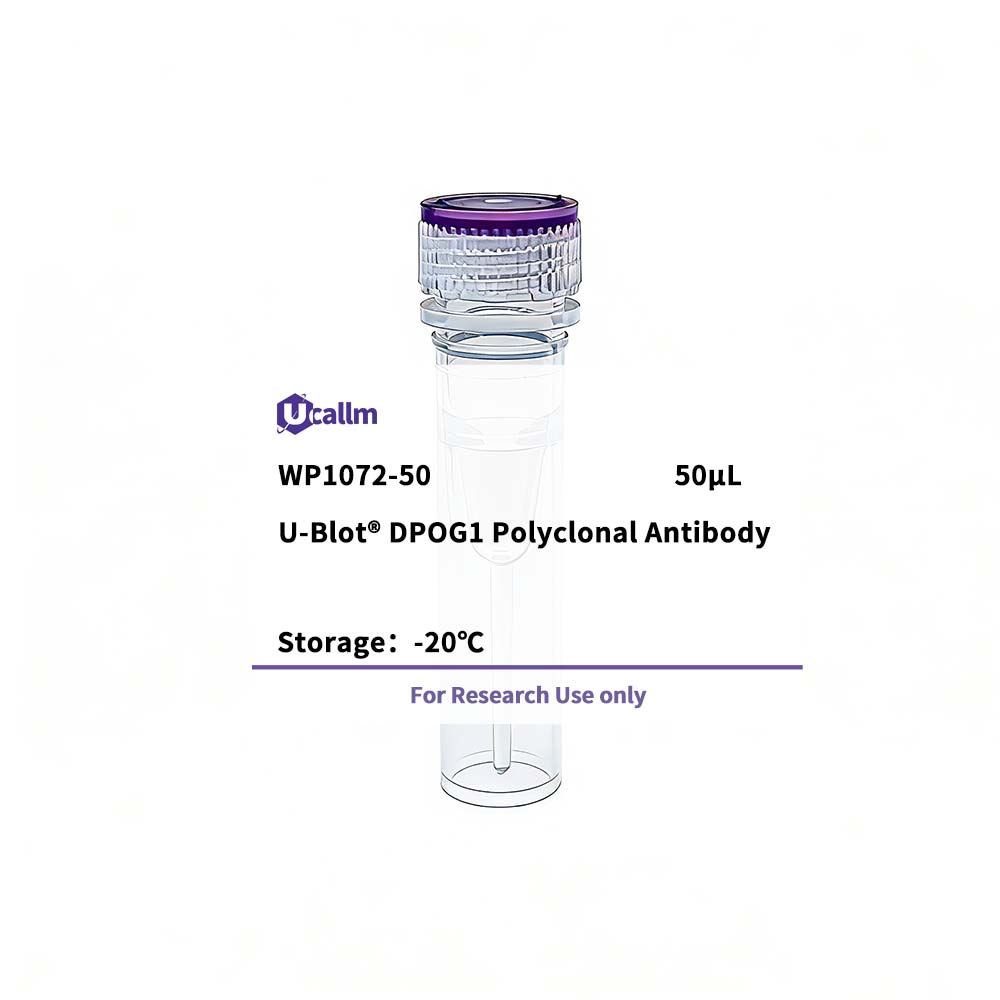
SKU: WP1072 Categories: ,

DPOG1 Polyclonal Antibody

Price range: $268.00 through $328.00

SKU: WP1072-100
Enter the quantity you would like, or drag the panel to find the quantity and price that best for you
Bulk QuoteAuthorize OEM & ODM

Product details

Background:

Mitochondrial DNA polymerase is heterotrimeric, consisting of a homodimer of accessory subunits plus a catalytic subunit. The protein encoded by this gene is the catalytic subunit of mitochondrial DNA polymerase. The encoded protein contains a polyglutamine tract near its N-terminus that may be polymorphic. Defects in this gene are a cause of progressive external ophthalmoplegia with mitochondrial DNA deletions 1 (PEOA1), sensory ataxic neuropathy dysarthria and ophthalmoparesis (SANDO), Alpers-Huttenlocher syndrome (AHS), and mitochondrial neurogastrointestinal encephalopathy syndrome (MNGIE). Two transcript variants encoding the same protein have been found for this gene. [provided by RefSeq, Jul 2008],

Specifications

Size50μL/100μL
TargetDPOG1
ReactivityHuman, Mouse, Rat
ApplicationsWB, ELISA
MW(Calculated)
MW(Observed)136kD
Host SpeciesRabbit
IsotypeIgG
Conjugate/ModificationUnmodified
Recommended Dilution RatioWB 1:500-2000; ELISA 1:5000-20000
FormulationLiquid in PBS containing 50% glycerol,0.5% BSA and 0.02% sodium azide.
PurificationThe antibody was affinity-purified from rabbit antiserum by affinity-chromatography using epitope-specific immunogen.
Storage-15°C to -25°C/1 year(Do not lower than -25°C)
Concentration1 mg/ml
ClonalityPolyclonal
Clone Number
ImmunogenSynthesized peptide derived from part region of human protein
SpecificityDPOG1 Polyclonal Antibody detects endogenous levels of protein.
Gene NamePOLG MDP1 POLG1 POLGA
Protein NameDNA polymerase subunit gamma-1 (Mitochondrial DNA polymerase catalytic subunit) (PolG-alpha)
Other Name
SpeciesHuman
Gene ID5428
UniprotP54098,
Species.1Mouse
Gene ID.1
Uniprot.1P54099,
Species.2Rat
Gene ID.2
Uniprot.2Q9QYV8
Cellular LocalizationMitochondrion . Mitochondrion matrix, mitochondrion nucleoid .
Tissue ExpressionBrain,Lymph,Testis,
Signaling_pathway
Research Areas
FunctionCatalytic activity:Deoxynucleoside triphosphate + DNA(n) = diphosphate + DNA(n+1).,cofactor:Magnesium.,Disease:Defects in POLG are a cause of Alpers-Huttenlocher syndrome (AHS) [MIM:203700]; also called Alpers diffuse degeneration of cerebral gray matter with hepatic cirrhosis. AHS is an autosomal recessive hepatocerebral syndrome. The typical course of AHS includes severe developmental delay, intractable seizures, liver failure, and death in childhood. Refractory seizures, cortical blindness, progressive liver dysfunction, and acute liver failure after exposure to valproic acid are considered diagnostic features. The neuropathological hallmarks of AHS are neuronal loss, spongiform degeneration, and astrocytosis of the visual cortex. Liver biopsy results show steatosis, often progressing to cirrhosis.,Disease:Defects in POLG are a cause of mitochondrial neurogastrointestinal encephalopathy syndrome (MNGIE) [MIM:603041]. MNGIE is an autosomal recessive disorder associated with PEO and multiple deletions of mitochondrial DNA in skeletal muscle. MNGIE is a multisystem disorder clinically characterized by onset between the second and fifth decades of life, ptosis, progressive external ophthalmoplegia, gastrointestinal dysmotility (often pseudoobstruction), diffuse leukoencephalopathy, thin body habitus, peripheral neuropathy and myopathy.,Disease:Defects in POLG are a cause of progressive external ophthalmoplegia with mitochondrial DNA deletions autosomal recessive (PEOB) [MIM:258450]. PEOB is a severe form of progressive external ophthalmoplegia. It is clinically more heterogeneous than the autosomal dominant forms. can be more severe.,Disease:Defects in POLG are a cause of sensory ataxic neuropathy dysarthria and ophthalmoparesis (SANDO) [MIM:607459]. SANDO is a clinically heterogeneous systemic disorder with variable features resulting from mitochondrial dysfunction. It shares phenotypic characteristics with autosomal recessive progressive external ophthalmoplegia and mitochondrial neurogastrointestinal encephalopathy syndrome. The clinical triad of symptoms consists of sensory ataxic, neuropathy, dysarthria, and ophthalmoparesis.,Disease:Defects in POLG are the cause of progressive external ophthalmoplegia with mitochondrial DNA deletions autosomal dominant type 1 (PEOA1) [MIM:157640]. Progressive external ophthalmoplegia is characterized by progressive weakness of ocular muscles and levator muscle of the upper eyelid. In a minority of cases, it is associated with skeletal myopathy, which predominantly involves axial or proximal muscles and which causes abnormal fatigability and even permanent muscle weakness. Ragged-red fibers and atrophy are found on muscle biopsy. A large proportion of chronic ophthalmoplegias are associated with other symptoms, leading to a multisystemic pattern of this disease. Additional symptoms are variable, and may include cataracts, hearing loss, sensory axonal neuropathy, ataxia, depression, hypogonadism, and parkinsonism.,Function:Involved in the replication of mitochondrial DNA.,polymorphism:The poly-Gln region seems to be polymorphic.,similarity:Belongs to the DNA polymerase type-A family.,subunit:Heterotrimer composed of a catalytic subunit and an homodimer of accessory subunits.,
Please login to post questions
Back to Top
Product has been added to your cart
