


DPYL1 Polyclonal Antibody
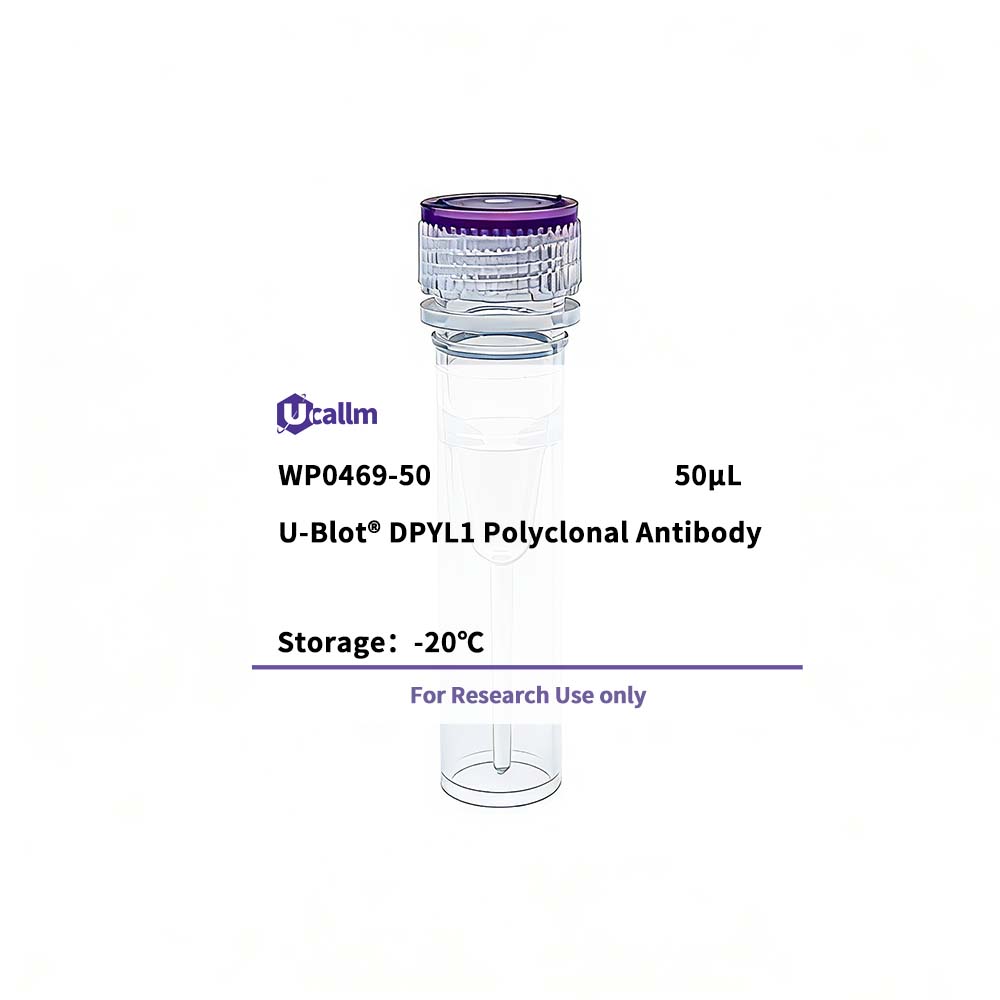
Ucallm_WP0469-50
Price range: $268.00 through $328.00
Product details
Background:
This gene encodes a member of a family of cytosolic phosphoproteins expressed exclusively in the nervous system. The encoded protein is thought to be a part of the semaphorin signal transduction pathway implicated in semaphorin-induced growth cone collapse during neural development. Alternative splicing results in multiple transcript variants. [provided by RefSeq, Jul 2008],
Specifications
| Size | 50μL/100μL |
| Target | CRMP1 |
| Reactivity | Human, Mouse, Rat |
| Applications | WB, ELISA |
| MW(Calculated) | |
| MW(Observed) | 62kD |
| Host Species | Rabbit |
| Isotype | IgG |
| Conjugate/Modification | Unmodified |
| Recommended Dilution Ratio | WB 1:500-2000; ELISA 1:5000-20000 |
| Formulation | Liquid in PBS containing 50% glycerol,0.5% BSA and 0.02% sodium azide. |
| Purification | The antibody was affinity-purified from rabbit antiserum by affinity-chromatography using epitope-specific immunogen. |
| Storage | -15°C to -25°C/1 year(Do not lower than -25°C) |
| Concentration | 1 mg/ml |
| Clonality | Polyclonal |
| Clone Number | |
| Immunogen | Synthesized peptide derived from human protein . at AA range: 440-520 |
| Specificity | DPYL1 Polyclonal Antibody detects endogenous levels of protein. |
| Gene Name | CRMP1 DPYSL1 ULIP3 |
| Protein Name | Dihydropyrimidinase-related protein 1 |
| Other Name | DPYL1; / Dihydropyrimidinase-related protein 1; / DRP-1; / Collapsin response mediator protein 1; / CRMP-1; / Unc-33-like phosphoprotein 3; / ULIP-3 |
| Species | Human |
| Gene ID | 1400 |
| Uniprot | Q14194, |
| Species.1 | Mouse |
| Gene ID.1 | 12933 |
| Uniprot.1 | P97427, |
| Species.2 | Rat |
| Gene ID.2 | 25415 |
| Uniprot.2 | Q62950 |
| Cellular Localization | Cytoplasm . Cytoplasm, cytoskeleton, microtubule organizing center, centrosome . Cytoplasm, cytoskeleton, spindle . Cell projection, growth cone . Cytoplasm, cytoskeleton . Perikaryon . Associated with centrosomes and the mitotic spindle during metaphase (PubMed:11562390). Colocalizes with FLNA and tubulin in the central region of DRG neuron growth cone (By similarity). Following SEMA3A stimulation of DRG neurons, colocalizes with F-actin (By similarity). . |
| Tissue Expression | Brain. |
| Signaling_pathway | |
| Research Areas | |
| Function | Function:Necessary for signaling by class 3 semaphorins and subsequent remodeling of the cytoskeleton. Plays a role in axon guidance, invasive growth and cell migration.,similarity:Belongs to the DHOase family. Hydantoinase/dihydropyrimidinase subfamily.,subcellular location:Associated with centrosomes and the mitotic spindle during metaphase.,subunit:Homotetramer, and heterotetramer with DPYSL2, DPYSL3, DPYSL4 or DPYSL5. Interacts with PLXNA1.,tissue specificity:Brain., |
Please login to post questions
Related products





