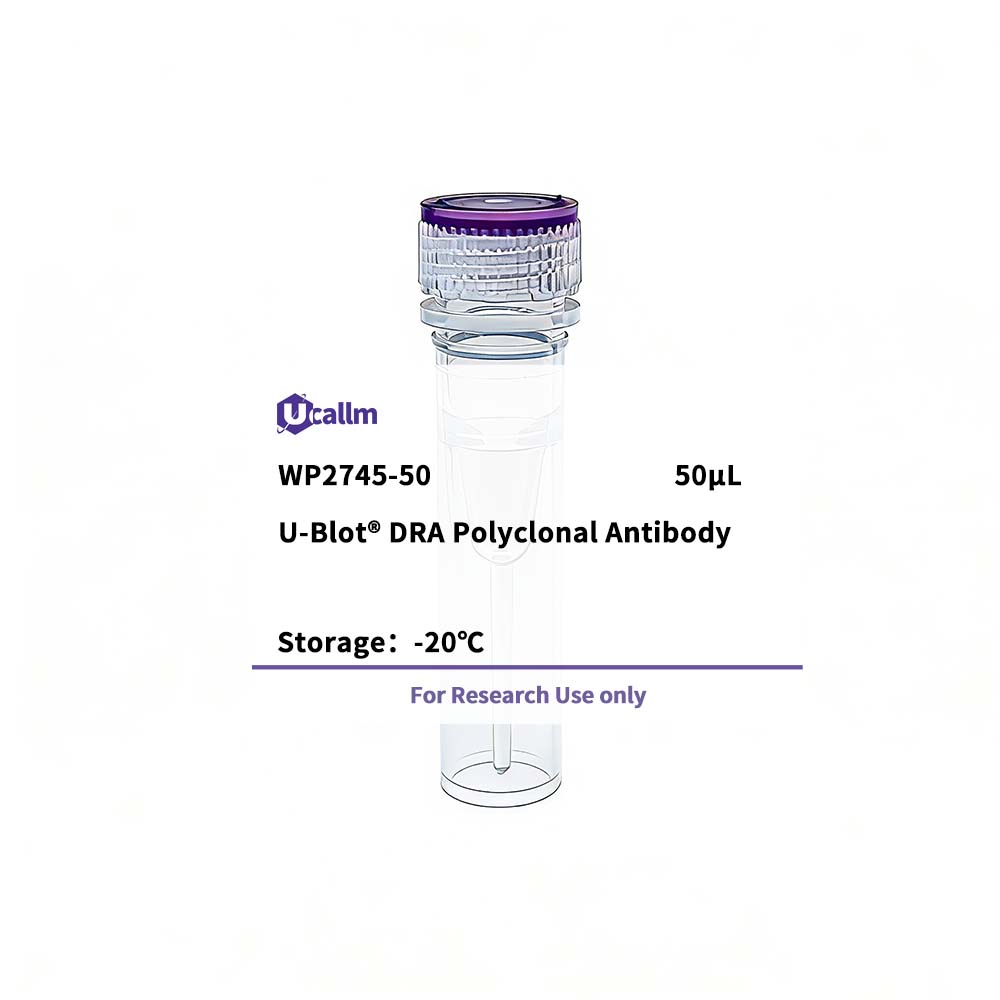
SKU: WP2745 Categories: ,

DRA Polyclonal Antibody

Price range: $268.00 through $328.00

SKU: WP2745-100
Enter the quantity you would like, or drag the panel to find the quantity and price that best for you
Bulk QuoteAuthorize OEM & ODM

Product details

Background:

HLA-DRA is one of the HLA class II alpha chain paralogues. This class II molecule is a heterodimer consisting of an alpha and a beta chain, both anchored in the membrane. It plays a central role in the immune system by presenting peptides derived from extracellular proteins. Class II molecules are expressed in antigen presenting cells (APC: B lymphocytes, dendritic cells, macrophages). The alpha chain is approximately 33-35 kDa and its gene contains 5 exons. Exon 1 encodes the leader peptide, exons 2 and 3 encode the two extracellular domains, and exon 4 encodes the transmembrane domain and the cytoplasmic tail. DRA does not have polymorphisms in the peptide binding part and acts as the sole alpha chain for DRB1, DRB3, DRB4 and DRB5. [provided by RefSeq, Jul 2008],


Specifications

Size50μL/100μL
TargetHLA-DRA
ReactivityHuman
ApplicationsWB, ELISA
MW(Calculated)
MW(Observed)27kD
Host SpeciesRabbit
IsotypeIgG
Conjugate/ModificationUnmodified
Recommended Dilution RatioWB 1:500-2000; ELISA 1:5000-20000
FormulationLiquid in PBS containing 50% glycerol,0.5% BSA and 0.02% sodium azide.
PurificationThe antibody was affinity-purified from rabbit antiserum by affinity-chromatography using epitope-specific immunogen.
Storage-15°C to -25°C/1 year(Do not lower than -25°C)
Concentration1 mg/ml
ClonalityPolyclonal
Clone Number
ImmunogenSynthesized peptide derived from human protein . at AA range: 100-180
SpecificityDRA Polyclonal Antibody detects endogenous levels of protein.
Gene NameHLA-DRA HLA-DRA1
Protein NameHLA class II histocompatibility antigen, DR alpha chain (MHC class II antigen DRA)
Other Name
SpeciesHuman
Gene ID3122
UniprotP01903
Species.1
Gene ID.1
Uniprot.1
Species.2
Gene ID.2
Uniprot.2
Cellular LocalizationCell membrane; Single-pass type I membrane protein . Endoplasmic reticulum membrane; Single-pass type I membrane protein . Early endosome membrane; Single-pass type I membrane protein . Late endosome membrane; Single-pass type I membrane protein . Lysosome membrane; Single-pass type I membrane protein . Autolysosome membrane; Single-pass type I membrane protein. The MHCII complex transits through a number of intracellular compartments in the endocytic pathway until it reaches the cell membrane for antigen presentation (PubMed:9075930, PubMed:18305173). Component of immunological synapses at the interface between T cell and APC (PubMed:15322540, PubMed:29884618). .
Tissue ExpressionExpressed in professional APCs: macrophages, dendritic cells and B cells (at protein level) (PubMed:31495665, PubMed:15322540, PubMed:23783831). Expressed in thymic epithelial cells (at protein level) (PubMed:23783831).
Signaling_pathwayCellular Processes >> Transport and catabolism >> Phagosome;Organismal Systems >> Immune system >> Hematopoietic cell lineage;Organismal Systems >> Immune system >> Antigen processing and presentation;Organismal Systems >> Immune system >> Th1 and Th2 cell differentiation;Organismal Systems >> Immune system >> Th17 cell differentiation;Organismal Systems >> Immune system >> Intestinal immune network for IgA production;Human Diseases >> Immune disease >> Asthma;Human Diseases >> Immune disease >> Systemic lupus erythematosus;Human Diseases >> Immune disease >> Rheumatoid arthritis;Human Diseases >> Immune disease >> Autoimmune thyroid disease;Human Diseases >> Immune disease >> Inflammatory bowel disease;Human Diseases >> Immune disease >> Allograft rejection;Human Diseases >> Immune disease >> Graft-versus-host disease;Environmental Information Processing >> Signaling molecules and interaction >> Cell adhesion molecules
Research Areas>>Phagosome; / >>Cell adhesion molecules; / >>Antigen processing and presentation; / >>Hematopoietic cell lineage; / >>Th1 and Th2 cell differentiation; / >>Th17 cell differentiation; / >>Intestinal immune network for IgA production; / >>Type I diabetes mellitus; / >>Leishmaniasis; / >>Toxoplasmosis; / >>Staphylococcus aureus infection; / >>Tuberculosis; / >>Influenza A; / >>Human T-cell leukemia virus 1 infection; / >>Herpes simplex virus 1 infection; / >>Epstein-Barr virus infection; / >>Asthma; / >>Autoimmune thyroid disease; / >>Inflammatory bowel disease; / >>Systemic lupus erythematosus; / >>Rheumatoid arthritis; / >>Allograft rejection; / >>Graft-versus-host disease; / >>Viral myocarditis
FunctionDisease:Genetic variations in HLA-DRA are associated with susceptibility to hepatitis B virus infection (HBV infection) [MIM:610424]. Approximately one third of all cases of cirrhosis and half of all cases of hepatocellular carcinoma can be attributed to chronic HBV infection. HBV infection may result in subclinical or asymptomatic infection, acute self-limited hepatitis, or fulminant hepatitis requiring liver transplantation.,polymorphism:The following alleles of DRA are known: DRA*0101 and DRA*0102. The sequence shown is that of DRA*0101.,similarity:Belongs to the MHC class II family.,similarity:Contains 1 Ig-like C1-type (immunoglobulin-like) domain.,subunit:Heterodimer of an alpha chain and a beta chain.,
Please login to post questions
Back to Top
Product has been added to your cart
