SKU: WR4544 Categories: ,

U-Blot® Dystrophin Rabbit mAb

Price range: $268.00 through $328.00

SKU: WR4544-50
Enter the quantity you would like, or drag the panel to find the quantity and price that best for you
Bulk QuoteAuthorize OEM & ODM

Product details

Background:dystrophin(DMD) Homo sapiens The dystrophin gene is the largest gene found in nature, measuring 2.4 Mb. The gene was identified through a positional cloning approach, targeted at the isolation of the gene responsible for Duchenne (DMD) and Becker (BMD) Muscular Dystrophies. DMD is a recessive, fatal, X-linked disorder occurring at a frequency of about 1 in 3,500 new-born males. BMD is a milder allelic form. In general, DMD patients carry mutations which cause premature translation termination (nonsense or frame shift mutations), while in BMD patients dystrophin is reduced either in molecular weight (derived from in-frame deletions) or in expression level. The dystrophin gene is highly complex, containing at least eight independent, tissue-specific promoters and two polyA-addition sites. Furthermore, dystrophin RNA is differentially spliced, producing a range of different transcripts, encoding a large set of protein isoforms. Dystrophin (as enc


Specifications

Size50μL/100μL
TargetDMD
ReactivityHuman, Mouse, Rat
ApplicationsWB, IHC, IF, ELISA
MW(Calculated)427kD
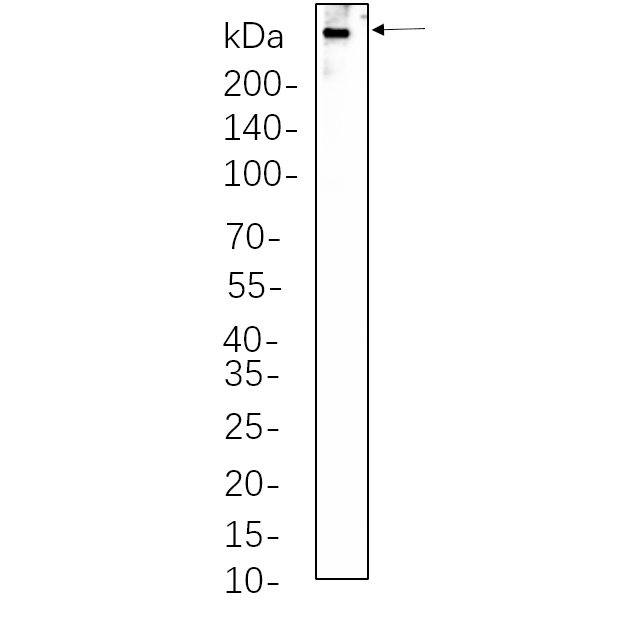
MW(Observed)427kD
Host SpeciesRabbit
IsotypeIgG,Kappa
Conjugate/ModificationUnmodified
Recommended Dilution RatioIHC 1:200-1:1000; WB 1:500-1:2000; IF 1:200-1:1000; ELISA 1:5000-1:20000; / Note: For IHC, we suggest antigen retrieval with TE buffer pH 9.0 (Cat#WT1004)
FormulationPBS, 50% glycerol, 0.05% Proclin 300, 0.05%BSA
PurificationRecombinant Antibody expressed in animal component-free (ACF) media, purified via Protein A affinity chromatography.
Storage-15°C to -25°C/1 year(Do not lower than -25°C)
Concentration
ClonalityMonoclonal
Clone NumberRM0821R
ImmunogenThe specific immunogen used to produce this antibody is proprietary information.
SpecificityEndogenous
Gene NameDMD
Protein NameDystrophin
Other Name
SpeciesHuman
Gene ID1756
UniprotP11532,
Species.1Mouse
Gene ID.1
Uniprot.1P11531,
Species.2Rat
Gene ID.2
Uniprot.2P11530
Cellular LocalizationCell membrane, sarcolemma; Peripheral membrane protein; Cytoplasmic side . Cytoplasm, cytoskeleton . Cell junction, synapse, postsynaptic cell membrane . In muscle cells, sarcolemma localization requires the presence of ANK2, while localization to costameres requires the presence of ANK3. Localizes to neuromuscular junctions (NMJs). In adult muscle, NMJ localization depends upon ANK2 presence, but not in newborn animals. .
Tissue ExpressionExpressed in muscle fibers accumulating in the costameres of myoplasm at the sarcolemma. Expressed in brain, muscle, kidney, lung and testis. Most tissues contain transcripts of multiple isoforms. Isoform 15: Only isoform to be detected in heart and liver and is also expressed in brain, testis and hepatoma cells.
Signaling_pathway
Research Areas>>Hypertrophic cardiomyopathy; / >>Arrhythmogenic right ventricular cardiomyopathy; / >>Dilated cardiomyopathy; / >>Viral myocarditis
FunctionAlternative products:Additional isoforms seem to exist,Disease:Defects in DMD are a cause of cardiomyopathy dilated X-linked type 3B (CMD3B) [MIM:302045]; also known as X-linked dilated cardiomyopathy (XLCM). Dilated cardiomyopathy is a disorder characterized by ventricular dilation and impaired systolic function, resulting in congestive heart failure and arrhythmia. Patients are at risk of premature death.,Disease:Defects in DMD are the cause of Becker muscular dystrophy (BMD) [MIM:300376]. BMD resembles DMD in hereditary and clinical features but is later in onset and more benign.,Disease:Defects in DMD are the cause of Duchenne muscular dystrophy (DMD) [MIM:310200]. DMD is the most common form of muscular dystrophy; a sex-linked recessive disorder. It typically presents in boys aged 3 to 7 year as proximal muscle weakness causing waddling gait, toe-walking, lordosis, frequent falls, and difficulty in standing up and climbing up stairs. The pelvic girdle is affected first, then the shoulder girdle. Progression is steady and most patients are confined to a wheelchair by age of 10 or 12. Flexion contractures and scoliosis ultimately occur. About 50% of patients have a lower IQ than their genetic expectations would suggest. There is no treatment.,Function:May play a role in anchoring the cytoskeleton to the plasma membrane.,miscellaneous:The DMD gene is the largest known gene in humans. It is 2.4 million base-pairs in size, comprises 79 exons and takes over 16 hours to be transcribed and cotranscriptionally spliced.,online information:Dystrophin entry,online information:Dystrophin Mutation Database,online information:The Singapore human mutation and polymorphism database,similarity:Contains 1 WW domain.,similarity:Contains 1 ZZ-type zinc finger.,similarity:Contains 2 CH (calponin-homology) domains.,similarity:Contains 22 spectrin repeats.,subunit:Interacts with the syntrophins SNTA1, SNTB1, SNTB2, SNTG1 and SNTG2. Interacts with KRT19. Interacts with SYNM.,tissue specificity:Expressed in muscle fibers accumulating in the costameres of myoplasm at the sarcolemma. Expressed in brain, muscle, kidney, lung and testis. Isoform 5 is expressed in heart, brain, liver, testis and hepatoma cells. Most tissues contain transcripts of multiple isoforms, however only isoform 5 is detected in heart and liver.,
Please login to post questions

Back to Top
Product has been added to your cart
