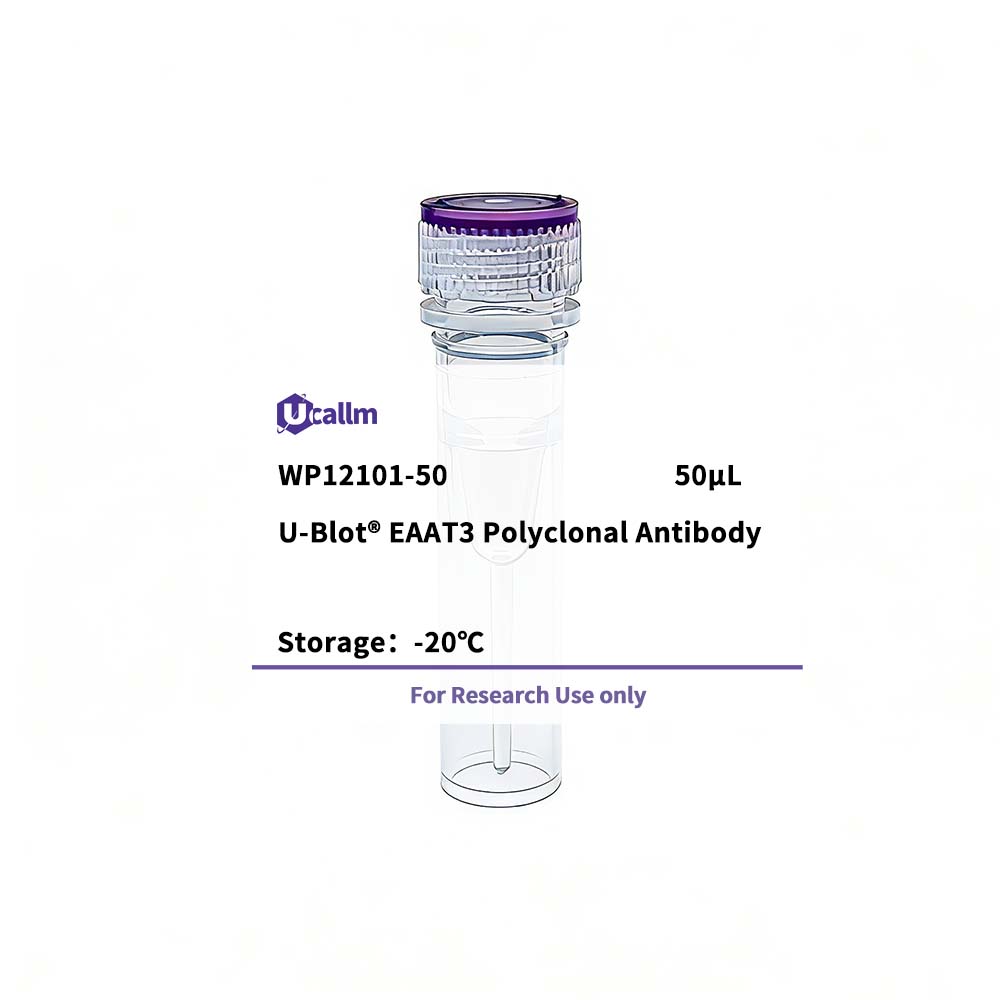
SKU: WP12101 Categories: ,

EAAT3 Polyclonal Antibody

Price range: $268.00 through $328.00

SKU: WP12101-100
Enter the quantity you would like, or drag the panel to find the quantity and price that best for you
Bulk QuoteAuthorize OEM & ODM

Product details

Background:

This gene encodes a member of the high-affinity glutamate transporters that play an essential role in transporting glutamate across plasma membranes. In brain, these transporters are crucial in terminating the postsynaptic action of the neurotransmitter glutamate, and in maintaining extracellular glutamate concentrations below neurotoxic levels. This transporter also transports aspartate, and mutations in this gene are thought to cause dicarboxylicamino aciduria, also known as glutamate-aspartate transport defect. [provided by RefSeq, Mar 2010],

Specifications

Size50μL/100μL
TargetEAAT3
ReactivityHuman, Mouse, Rat
ApplicationsWB, ELISA
MW(Calculated)
MW(Observed)57kD
Host SpeciesRabbit
IsotypeIgG
Conjugate/ModificationUnmodified
Recommended Dilution RatioWB 1:500-1:2000; ELISA 1:10000; Not yet tested in other applications.
FormulationLiquid in PBS containing 50% glycerol, 0.5% BSA and 0.02% sodium azide.
PurificationThe antibody was affinity-purified from rabbit antiserum by affinity-chromatography using epitope-specific immunogen.
Storage-15°C to -25°C/1 year(Do not lower than -25°C)
Concentration1 mg/ml
ClonalityPolyclonal
Clone Number
ImmunogenThe antiserum was produced against synthesized peptide derived from human EAAT3. AA range:122-171
SpecificityEAAT3 Polyclonal Antibody detects endogenous levels of EAAT3 protein.
Gene NameSLC1A1
Protein NameExcitatory amino acid transporter 3
Other NameSLC1A1; / EAAC1; / EAAT3; / Excitatory amino acid transporter 3; / Excitatory amino-acid carrier 1; / Neuronal and epithelial glutamate transporter; / Sodium-dependent glutamate/aspartate transporter 3; / Solute carrier family 1 member 1
SpeciesHuman
Gene ID6505
UniprotP43005,
Species.1Mouse
Gene ID.120510
Uniprot.1P51906,
Species.2Rat
Gene ID.225550
Uniprot.2P51907
Cellular LocalizationCell membrane; Multi-pass membrane protein . Apical cell membrane; Multi-pass membrane protein . Cell junction, synapse, synaptosome . Early endosome membrane . Late endosome membrane . Recycling endosome membrane .
Tissue ExpressionExpressed in all tissues tested including liver, muscle, testis, ovary, retinoblastoma cell line, neurons and brain (in which there was dense expression in substantia nigra, red nucleus, hippocampus and in cerebral cortical layers).
Signaling_pathwayOrganismal Systems >> Nervous system >> Glutamatergic synapse;Organismal Systems >> Nervous system >> Synaptic vesicle cycle
Research Areas>>Synaptic vesicle cycle; / >>Glutamatergic synapse; / >>Protein digestion and absorption
FunctionDisease:Defects in SLC1A1 may be a cause of dicarboxylicamino aciduria [MIM:222730]; also known as glutamate-aspartate transport defect. This is as defect in renal and probably intestinal transport of glutamic and aspartic acids and is associated with moderate hyperprolinemia.,Function:Transports L-glutamate and also L- and D-aspartate. Essential for terminating the postsynaptic action of glutamate by rapidly removing released glutamate from the synaptic cleft. Acts as a symport by cotransporting sodium. Negatively regulated by ARL6IP5.,PTM:Glycosylated.,similarity:Belongs to the sodium:dicarboxylate (SDF) symporter (TC 2.A.23) family.,subunit:Interacts with ARL6IP5/PRAF3.,tissue specificity:Expressed in all tissues tested including liver, muscle, testis, ovary, retinoblastoma cell line, neurons and brain (in which there was dense expression in substantia nigra, red nucleus, hippocampus and in cerebral cortical layers).,
Please login to post questions
Back to Top
Product has been added to your cart


