SKU: WP12103 Categories: ,

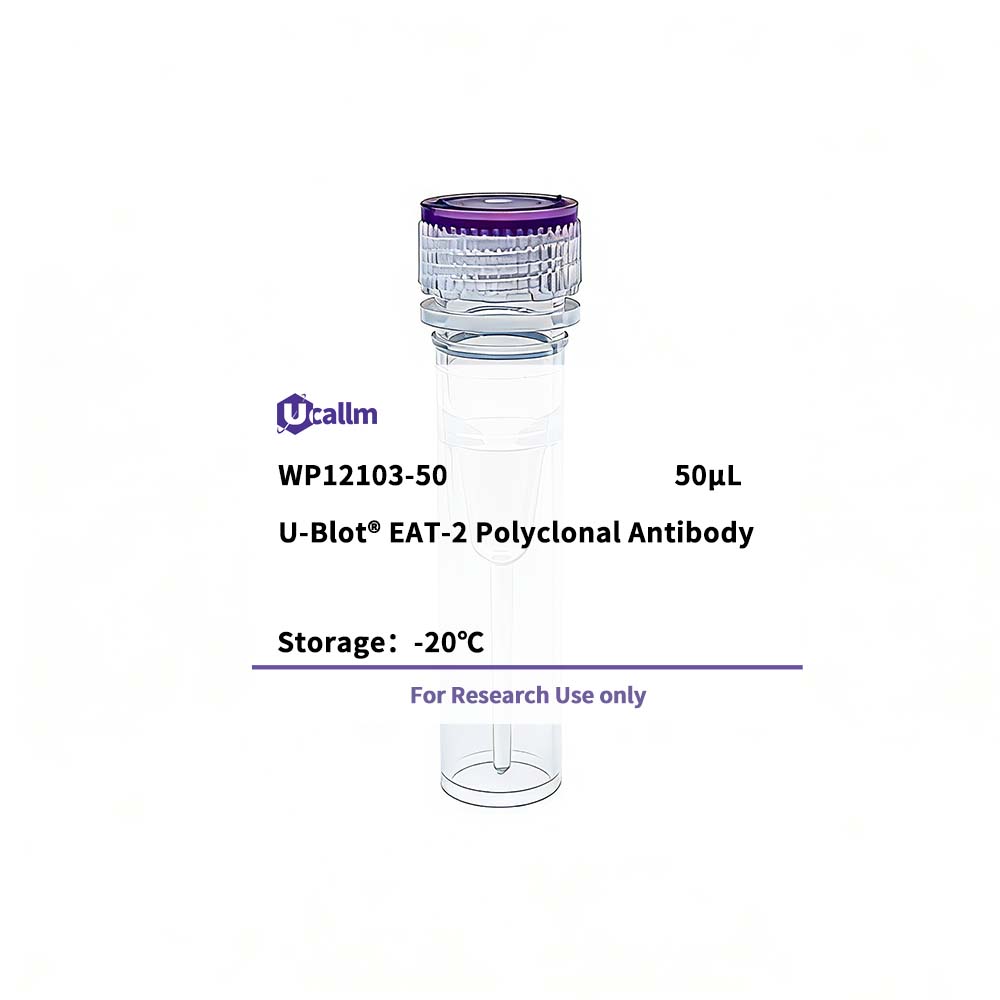
EAT-2 Polyclonal Antibody

Price range: $268.00 through $328.00

SKU: WP12103-100
Enter the quantity you would like, or drag the panel to find the quantity and price that best for you
Bulk QuoteAuthorize OEM & ODM

Product details

Background:

By binding phosphotyrosines through its free SRC (MIM 190090) homology-2 (SH2) domain, EAT2 regulates signal transduction through receptors expressed on the surface of antigen-presenting cells (Morra et al., 2001 [PubMed 11689425]).[supplied by OMIM, Mar 2008],


Specifications

Size50μL/100μL
TargetEAT-2
ReactivityHuman, Mouse
ApplicationsIHC, IF, ELISA
MW(Calculated)15kD
MW(Observed)
Host SpeciesRabbit
IsotypeIgG
Conjugate/ModificationUnmodified
Recommended Dilution RatioIHC 1:100-1:300; ELISA 1:40000; IF 1:50-200 / Note: For IHC, we suggest antigen retrieval with TE buffer pH 9.0 (Cat#WT1004)
FormulationLiquid in PBS containing 50% glycerol, 0.5% BSA and 0.02% sodium azide.
PurificationThe antibody was affinity-purified from rabbit antiserum by affinity-chromatography using epitope-specific immunogen.
Storage-15°C to -25°C/1 year(Do not lower than -25°C)
Concentration1 mg/ml
ClonalityPolyclonal
Clone Number
ImmunogenThe antiserum was produced against synthesized peptide derived from human SH2D1B. AA range:71-120
SpecificityEAT-2 Polyclonal Antibody detects endogenous levels of EAT-2 protein.
Gene NameSH2D1B
Protein NameSH2 domain-containing protein 1B
Other NameSH2D1B; / EAT2; / SH2 domain-containing protein 1B; / EWS/FLI1-activated transcript 2; / EAT-2
SpeciesHuman
Gene ID117157
UniprotO14796,
Species.1Mouse
Gene ID.1
Uniprot.1O35324
Species.2
Gene ID.2
Uniprot.2
Cellular Localizationintracellular,cytosol,
Tissue ExpressionLeukocyte,Lung,Spleen,
Signaling_pathwayOrganismal Systems >> Immune system >> Natural killer cell mediated cytotoxicity
Research Areas>>Natural killer cell mediated cytotoxicity
FunctionFunction:Plays a role in controlling signal transduction through at least four receptors, CD84, CD150, CD229 and CD244, expressed on the surface of professional antigen-presenting cells.,similarity:Contains 1 SH2 domain.,subunit:Binds to the phosphorylated receptors CD84, CD150, CD229 and CD244. Does not bind to non-phosphorylated CD150.,
Please login to post questions
Back to Top
Product has been added to your cart

