SKU: WR4477 Categories: ,

U-Blot® Endoplasmin Rabbit mAb

Price range: $268.00 through $328.00

SKU: WR4477-50
Enter the quantity you would like, or drag the panel to find the quantity and price that best for you
Bulk QuoteAuthorize OEM & ODM

Product details

Background:This gene encodes a member of a family of adenosine triphosphate(ATP)-metabolizing molecular chaperones with roles in stabilizing and folding other proteins. The encoded protein is localized to melanosomes and the endoplasmic reticulum. Expression of this protein is associated with a variety of pathogenic states, including tumor formation. There is a microRNA gene located within the 5' exon of this gene. There are pseudogenes for this gene on chromosomes 1 and 15. [provided by RefSeq, Aug 2012],

Specifications

Size50μL/100μL
TargetEndoplasmin
ReactivityHuman, Mouse, Rat
ApplicationsWB, IHC, IF, IP, ELISA
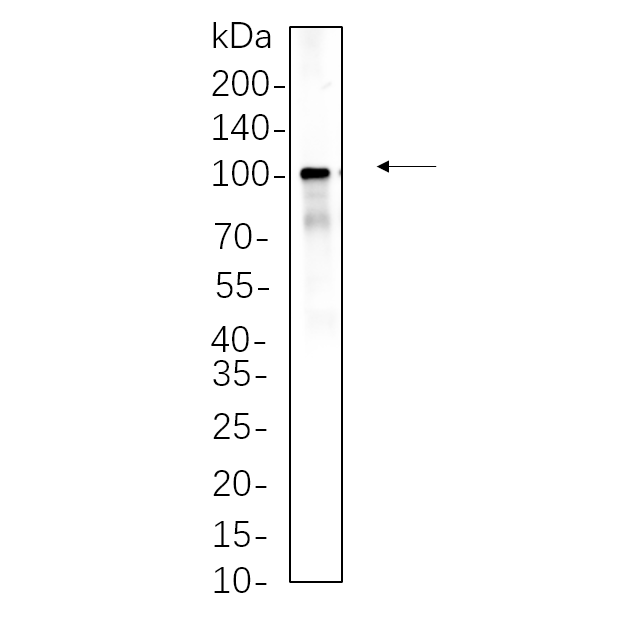
MW(Calculated)93kD
MW(Observed)100kD
Host SpeciesRabbit
IsotypeIgG,Kappa
Conjugate/ModificationUnmodified
Recommended Dilution RatioIHC 1:1000-1:5000; WB 1:2000-1:10000; IF 1:200-1:1000; ELISA 1:5000-1:20000; IP 1:50-1:200; / Note: For IHC, we suggest antigen retrieval with TE buffer pH 9.0 (Cat#WT1004)
FormulationPBS, 50% glycerol, 0.05% Proclin 300, 0.05%BSA
PurificationRecombinant Antibody expressed in animal component-free (ACF) media, purified via Protein A affinity chromatography.
Storage-15°C to -25°C/1 year(Do not lower than -25°C)
Concentration
ClonalityMonoclonal
Clone NumberRM0698R
ImmunogenThe specific immunogen used to produce this antibody is proprietary information.
SpecificityEndogenous
Gene NameHSP90B1
Protein NameEndoplasmin
Other NameHSP90B1; / GRP94; / TRA1; / Endoplasmin; / 94 kDa glucose-regulated protein; / GRP-94; / Heat shock protein 90 kDa beta member 1; / Tumor rejection antigen 1; / gp96 homolog
SpeciesHuman
Gene ID7184
UniprotP14625,
Species.1Mouse
Gene ID.122027
Uniprot.1P08113
Species.2
Gene ID.2
Uniprot.2
Cellular LocalizationEndoplasmic reticulum
Tissue ExpressionBlood,Brain,Liver,Lung,Platelet,Skin,
Signaling_pathwayOrganismal Systems >> Immune system >> IL-17 signaling pathway;Organismal Systems >> Endocrine system >> Estrogen signaling pathway;Human Diseases >> Cancer: overview >> Pathways in cancer;Human Diseases >> Cancer: specific types >> Prostate cancer;Environmental Information Processing >> Signal transduction >> PI3K-Akt signaling pathway;Genetic Information Processing >> Folding, sorting and degradation >> Protein processing in endoplasmic reticulum
Research Areas>>Protein processing in endoplasmic reticulum; / >>PI3K-Akt signaling pathway; / >>IL-17 signaling pathway; / >>Estrogen signaling pathway; / >>Thyroid hormone synthesis; / >>Salmonella infection; / >>Pathways in cancer; / >>Chemical carcinogenesis - receptor activation; / >>Prostate cancer; / >>Lipid and atherosclerosis; / >>Fluid shear stress and atherosclerosis
FunctionFunction:Molecular chaperone that functions in the processing and transport of secreted proteins. Has ATPase activity.,PTM:Phosphorylated.,similarity:Belongs to the heat shock protein 90 family.,subcellular location:Identified by mass spectrometry in melanosome fractions from stage I to stage IV.,subunit:Homodimer; disulfide-linked. Component of an EIF2 complex at least composed of CUGBP1, CALR, CALR3, EIF2S1, EIF2S2, HSP90B1 and HSPA5 (By similarity). Part a large chaperone multiprotein complex comprising CABP1, DNAJB11, HSP90B1, HSPA5, HYOU, PDIA2, PDIA4, PPIB, SDF2L1, UGT1A1 and very small amounts of ERP29, but not, or at very low levels, CALR nor CANX.,
Please login to post questions

Back to Top
Product has been added to your cart
