SKU: WM0175 Categories: ,

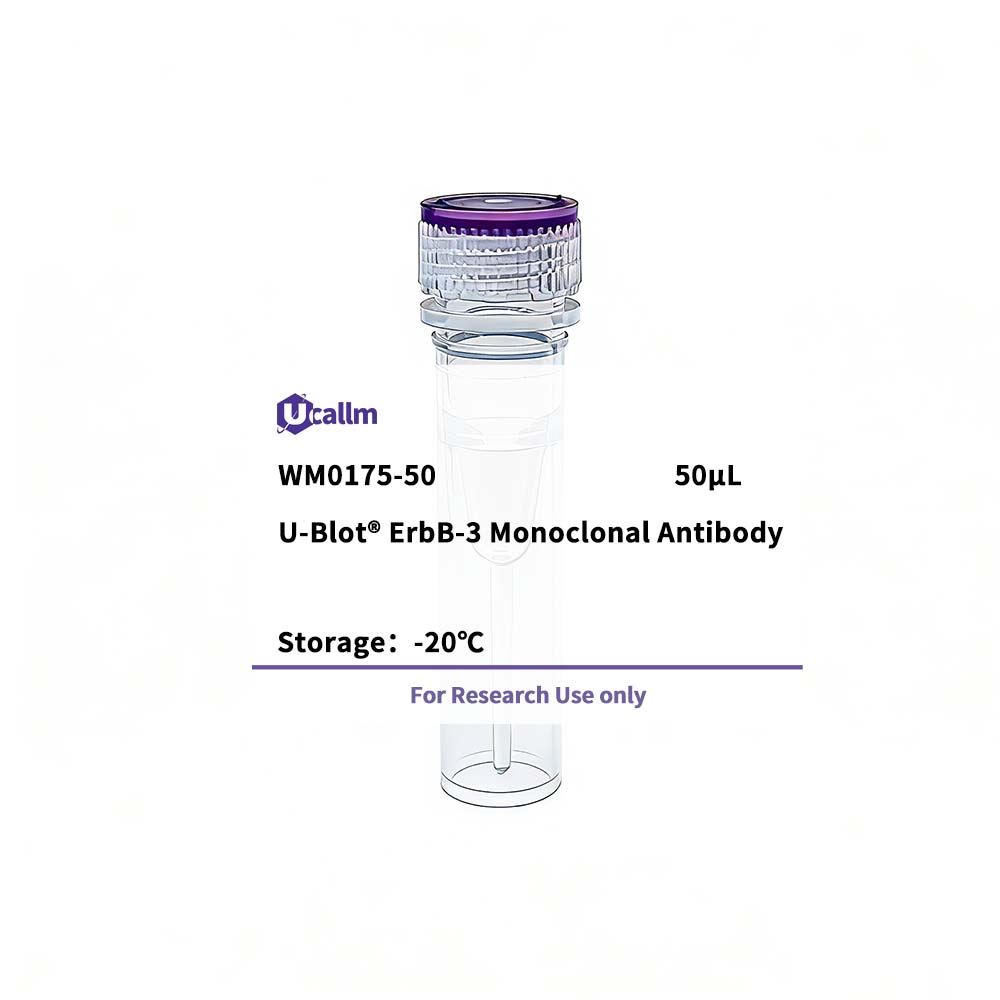
ErbB-3 Monoclonal Antibody

Price range: $268.00 through $328.00

SKU: WM0175-50
Enter the quantity you would like, or drag the panel to find the quantity and price that best for you
Bulk QuoteAuthorize OEM & ODM

Product details

Background:
This gene encodes a member of the epidermal growth factor receptor (EGFR) family of receptor tyrosine kinases. This membrane-bound protein has a neuregulin binding domain but not an active kinase domain. It therefore can bind this ligand but not convey the signal into the cell through protein phosphorylation. However, it does form heterodimers with other EGF receptor family members which do have kinase activity. Heterodimerization leads to the activation of pathways which lead to cell proliferation or differentiation. Amplification of this gene and/or overexpression of its protein have been reported in numerous cancers, including prostate, bladder, and breast tumors. Alternate transcriptional splice variants encoding different isoforms have been characterized. One isoform lacks the intermembrane region and is secreted outside the cell. This form acts to modulate the activity of the m


Specifications

Size50μL/100μL
TargetErbB-3/her2
ReactivityHuman
ApplicationsWB, IHC, IF, ELISA
MW(Calculated)148kD
MW(Observed)
Host SpeciesMouse
Isotype
Conjugate/ModificationUnmodified
Recommended Dilution RatioWB 1:500-1:2000; IHC 1:200-1:1000; ELISA 1:10000; IF 1:50-200 / Note: For IHC, we suggest antigen retrieval with TE buffer pH 9.0 (Cat#WT1004)
FormulationLiquid in PBS containing 50% glycerol, 0.5% BSA and 0.02% sodium azide.
PurificationAffinity purification
Storage-15°C to -25°C/1 year(Do not lower than -25°C)
Concentration
ClonalityMonoclonal
Clone Number9A3
ImmunogenPurified recombinant fragment of ErbB-3 (aa1175-1275) expressed in E. Coli.
SpecificityErbB-3 Monoclonal Antibody detects endogenous levels of ErbB-3 protein.
Gene NameERBB3
Protein NameReceptor tyrosine-protein kinase erbB-3
Other NameERBB3; / HER3; / Receptor tyrosine-protein kinase erbB-3; / Proto-oncogene-like protein c-ErbB-3; / Tyrosine kinase-type cell surface receptor HER3
SpeciesHuman
Gene ID2065
UniprotP21860,
Species.1Mouse
Gene ID.1
Uniprot.1Q61526
Species.2
Gene ID.2
Uniprot.2
Cellular Localization[Isoform 1]: Cell membrane; Single-pass type I membrane protein.; [Isoform 2]: Secreted.
Tissue ExpressionEpithelial tissues and brain.
Signaling_pathwayHuman Diseases >> Cancer: overview >> MicroRNAs in cancer;Environmental Information Processing >> Signal transduction >> MAPK signaling pathway;Environmental Information Processing >> Signal transduction >> ErbB signaling pathway;Environmental Information Processing >> Signal transduction >> Calcium signaling pathway;Environmental Information Processing >> Signal transduction >> PI3K-Akt signaling pathway
Research Areas>>EGFR tyrosine kinase inhibitor resistance; / >>MAPK signaling pathway; / >>ErbB signaling pathway; / >>Calcium signaling pathway; / >>PI3K-Akt signaling pathway; / >>Proteoglycans in cancer; / >>MicroRNAs in cancer
FunctionCatalytic activity:ATP + a [protein]-L-tyrosine = ADP + a [protein]-L-tyrosine phosphate.,Disease:Defects in ERBB3 are the cause of lethal congenital contracture syndrome type 2 (LCCS2) [MIM:607598]; also called Israeli Bedouin multiple contracture syndrome type A. LCCS2 is an autosomal recessive neurogenic form of a neonatally lethal arthrogryposis that is associated with atrophy of the anterior horn of the spinal cord. The LCCS2 syndrome is characterized by multiple joint contractures, anterior horn atrophy in the spinal cord, and a unique feature of a markedly distended urinary bladder. The phenotype suggests a spinal cord neuropathic etiology.,Disease:Overexpressed in a subset of human mammary tumors.,Domain:The cytoplasmic part of the receptor may interact with the SH2 or SH3 domains of many signal-transducing proteins.,Function:Binds and is activated by neuregulins and NTAK.,PTM:Ligand-binding increases phosphorylation on tyrosine residues and promotes its association with the p85 subunit of phosphatidylinositol 3-kinase.,similarity:Belongs to the protein kinase superfamily. Tyr protein kinase family. EGF receptor subfamily.,similarity:Contains 1 protein kinase domain.,subunit:Heterodimer with each of the other ERBB receptors (Potential). Interacts with CSPG5, PA2G4 and MUC1.,tissue specificity:Epithelial tissues and brain.,
Please login to post questions
Back to Top
Product has been added to your cart