SKU: WP1137 Categories: ,

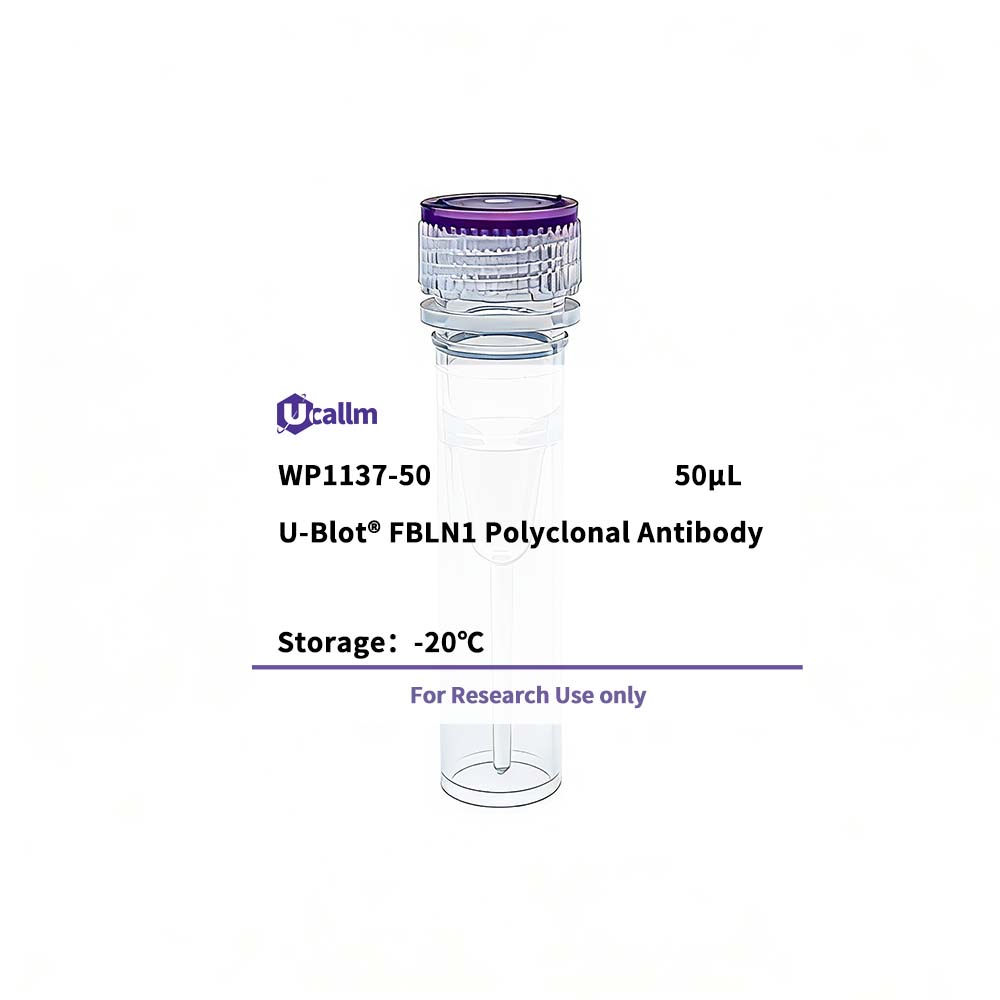
FBLN1 Polyclonal Antibody

Price range: $268.00 through $328.00

SKU: WP1137-100
Enter the quantity you would like, or drag the panel to find the quantity and price that best for you
Bulk QuoteAuthorize OEM & ODM

Product details

Background:

Fibulin 1 is a secreted glycoprotein that becomes incorporated into a fibrillar extracellular matrix. Calcium-binding is apparently required to mediate its binding to laminin and nidogen. It mediates platelet adhesion via binding fibrinogen. Four splice variants which differ in the 3' end have been identified. Each variant encodes a different isoform, but no functional distinctions have been identified among the four variants. [provided by RefSeq, Jul 2008],

Specifications

Size50μL/100μL
TargetFBLN1
ReactivityHuman, Mouse
ApplicationsWB, ELISA
MW(Calculated)
MW(Observed)77kD
Host SpeciesRabbit
IsotypeIgG
Conjugate/ModificationUnmodified
Recommended Dilution RatioWB 1:500-2000; ELISA 1:5000-20000
FormulationLiquid in PBS containing 50% glycerol,0.5% BSA and 0.02% sodium azide.
PurificationThe antibody was affinity-purified from rabbit antiserum by affinity-chromatography using epitope-specific immunogen.
Storage-15°C to -25°C/1 year(Do not lower than -25°C)
Concentration1 mg/ml
ClonalityPolyclonal
Clone Number
ImmunogenSynthesized peptide derived from part region of human protein
SpecificityFBLN1 Polyclonal Antibody detects endogenous levels of protein.
Gene NameFBLN1 PP213
Protein NameFibulin-1 (FIBL-1)
Other Name
SpeciesHuman
Gene ID2192
UniprotP23142,
Species.1Mouse
Gene ID.1
Uniprot.1Q08879
Species.2
Gene ID.2
Uniprot.2
Cellular LocalizationSecreted, extracellular space, extracellular matrix.
Tissue ExpressionIsoform A and isoform B are only expressed in placenta. Isoform C and isoform D are expressed in a variety of tissues and cultured cells.
Signaling_pathway
Research Areas
Functiondevelopmental stage:Widely expressed during embryonic development. Prominent in the matrix of the leptomeningeal anlage, in basement membranes of the neuroepithelium and the perineurium of peripheral nerves. In embryos of gestational week (gw) 4, staining was observed in the early mesenchymal bone anlagen. In gw 6.5 and 8, all perichondrial structures showed expression but the chondrocytes themselves showed no staining. In gw 10, expression is prominent in the interterritorial matrix surrounding the hypertrophic chondrocytes.,Disease:A chromosomal aberration involving FBLN1 is found in a complex type of synpolydactyly, also referred to as 3/3-prime/4 synpolydactyly associated with metacarpal and metatarsal synostoses [MIM:608180]. Reciprocal translocation t(12; 22)(p11.2; q13.3) with C12orf2. Fibroblasts derived from a patient with synpolydactyly displayed alterations in the level of isoform D splice variant incorporated into the ECM and secreted into the conditioned culture medium. By contrast, the expression of isoform C was not perturbed in the patient's fibroblasts. Furthermore, no aberrant polypeptides were detected in extracts of cultured patient's fibroblasts. The translocation t(12; 22) may result in haploinsufficiency of the isoform D splice variant, which could lead to the observed limb malformation.,Disease:Elevated expression and altered processing of FBLN1 protein is associated with human breast cancer.,Function:Incorporated into fibronectin-containing matrix fibers. May play a role in cell adhesion and migration along protein fibers within the extracellular matrix (ECM). Could be important for certain developmental processes and contribute to the supramolecular organization of ECM architecture, in particular to those of basement membranes. Has been implicated in a role in cellular transformation and tumor invasion, it appears to be a tumor suppressor. May play a role in haemostasis and thrombosis owing to its ability to bind fibrinogen and incorporate into clots. Could play a significant role in modulating the neurotrophic activities of APP, particularly soluble APP.,induction:Expression increased by estrogen in ovarian cancer cells.,similarity:Belongs to the fibulin family.,similarity:Contains 3 anaphylatoxin-like domains.,similarity:Contains 9 EGF-like domains.,subunit:Homomultimerizes and interacts with various extracellular matrix components such as FN1, LAMA1, LAMA2, NID, ACAN, CSPG2 and type IV collagen. Interacts also with APP, NOV, FGB and HPV type 16, HPV type 18, HPV type 31 and BPV type 1 E6 proteins. Interacts with FBLN7.,tissue specificity:Isoform A and isoform B are only expressed in placenta, whereas isoform C and isoform D are expressed in a variety of tissues and cultured cells.,
Please login to post questions
Back to Top
Product has been added to your cart
