

FBP1 rabbit pAb
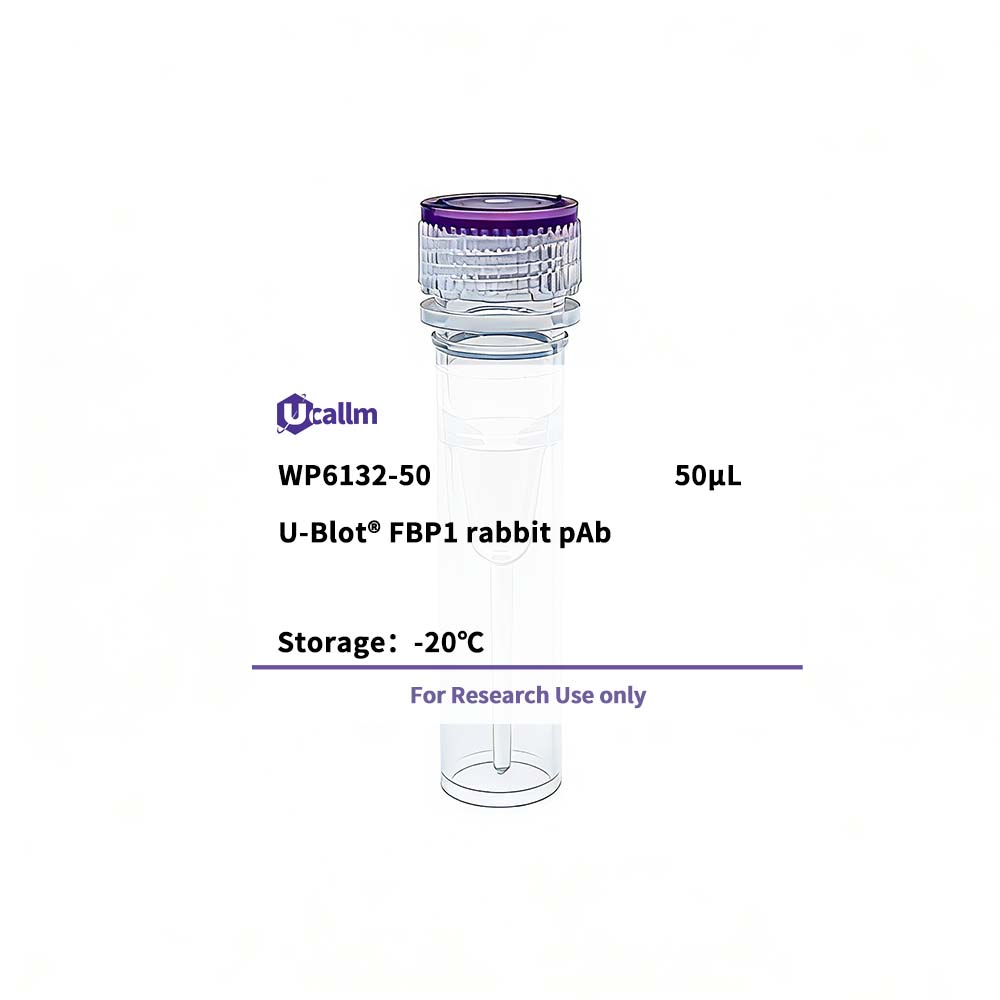
Ucallm_WP6132-50
Price range: $268.00 through $328.00
Product details
Background:
Specifications
| Size | 50μL/100μL |
| Target | FBP1 |
| Reactivity | Human, Mouse, Rat |
| Applications | WB |
| MW(Calculated) | 37kD |
| MW(Observed) | |
| Host Species | Rabbit |
| Isotype | IgG |
| Conjugate/Modification | Unmodified |
| Recommended Dilution Ratio | WB 1:500-2000 |
| Formulation | Liquid in PBS containing 50% glycerol, 0.5% BSA and 0.02% sodium azide. |
| Purification | The antibody was affinity-purified from rabbit antiserum by affinity-chromatography using epitope-specific immunogen. |
| Storage | -15°C to -25°C/1 year(Do not lower than -25°C) |
| Concentration | 1 mg/ml |
| Clonality | Polyclonal |
| Clone Number | |
| Immunogen | Synthesized peptide derived from human FBP1 |
| Specificity | This antibody detects endogenous levels of FBP1 at Human, Mouse,Rat |
| Gene Name | FBP1 FBP |
| Protein Name | Fructose-1,6-bisphosphatase 1 (FBPase 1) (D-fructose-1,6-bisphosphate 1-phosphohydrolase 1) |
| Other Name | |
| Species | Human |
| Gene ID | 2203 |
| Uniprot | P09467, |
| Species.1 | Mouse |
| Gene ID.1 | 14121 |
| Uniprot.1 | Q9QXD6, |
| Species.2 | Rat |
| Gene ID.2 | 24362 |
| Uniprot.2 | P19112 |
| Cellular Localization | |
| Tissue Expression | Expressed in pancreatic islets. |
| Signaling_pathway | Organismal Systems >> Endocrine system >> Insulin signaling pathway;Organismal Systems >> Endocrine system >> Glucagon signaling pathway;Environmental Information Processing >> Signal transduction >> AMPK signaling pathway |
| Research Areas | |
| Function | Catalyzes the hydrolysis of fructose 1,6-bisphosphate to fructose 6-phosphate in the presence of divalent cations, acting as a rate-limiting enzyme in gluconeogenesis. Plays a role in regulating glucose sensing and insulin secretion of pancreatic beta-cells. Appears to modulate glycerol gluconeogenesis in liver. Important regulator of appetite and adiposity; increased expression of the protein in liver after nutrient excess increases circulating satiety hormones and reduces appetite-stimulating neuropeptides and thus seems to provide a feedback mechanism to limit weight gain. |
Please login to post questions
Related products





