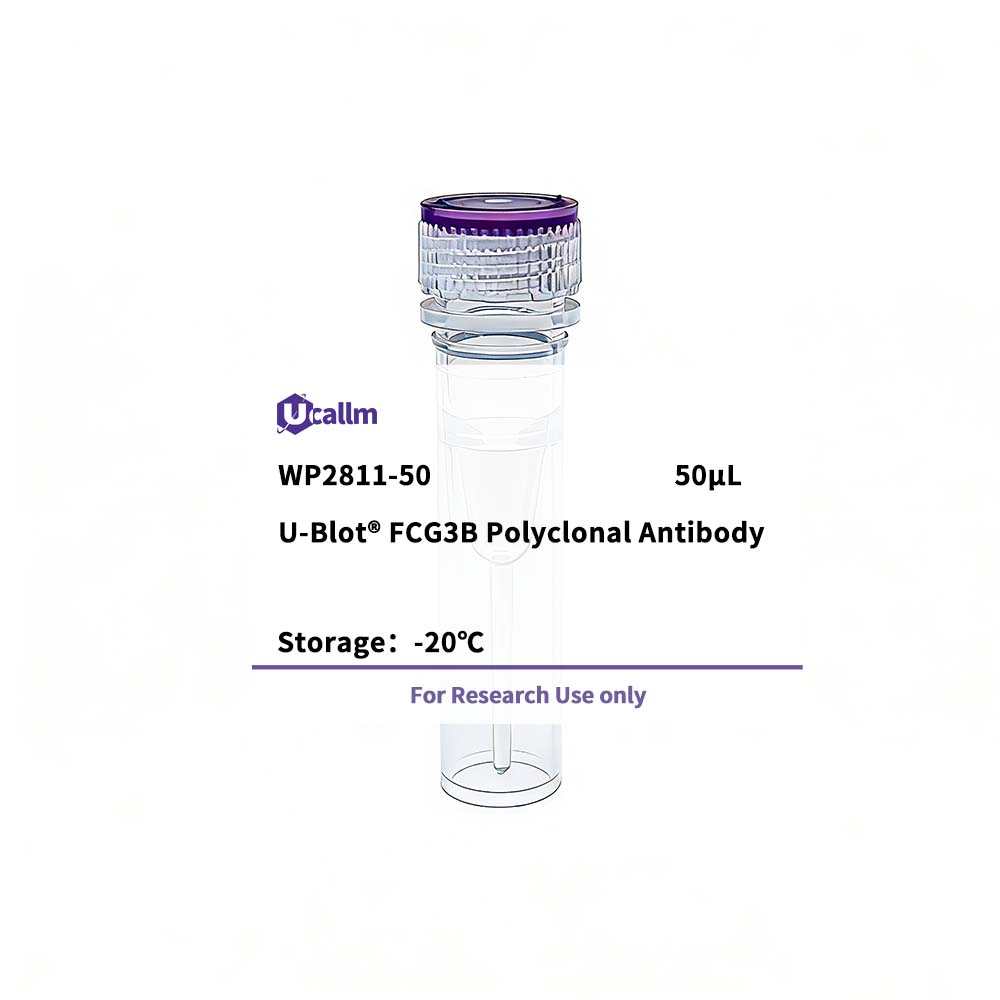
SKU: WP2811 Categories: ,

FCG3B Polyclonal Antibody

Price range: $268.00 through $328.00

SKU: WP2811-100
Enter the quantity you would like, or drag the panel to find the quantity and price that best for you
Bulk QuoteAuthorize OEM & ODM

Product details

Background:

The protein encoded by this gene is a low affinity receptor for the Fc region of gamma immunoglobulins (IgG). The encoded protein acts as a monomer and can bind either monomeric or aggregated IgG. This gene may function to capture immune complexes in the peripheral circulation. Several transcript variants encoding different isoforms have been found for this gene. A highly-similar gene encoding a related protein is also found on chromosome 1. [provided by RefSeq, Aug 2012],

Specifications

Size50μL/100μL
TargetFCG3B
ReactivityHuman
ApplicationsWB, ELISA
MW(Calculated)
MW(Observed)25kD
Host SpeciesRabbit
IsotypeIgG
Conjugate/ModificationUnmodified
Recommended Dilution RatioWB 1:500-2000; ELISA 1:5000-20000
FormulationLiquid in PBS containing 50% glycerol,0.5% BSA and 0.02% sodium azide.
PurificationThe antibody was affinity-purified from rabbit antiserum by affinity-chromatography using epitope-specific immunogen.
Storage-15°C to -25°C/1 year(Do not lower than -25°C)
Concentration1 mg/ml
ClonalityPolyclonal
Clone Number
ImmunogenSynthesized peptide derived from human protein . at AA range: 90-170
SpecificityFCG3B Polyclonal Antibody detects endogenous levels of protein.
Gene NameFCGR3B CD16B FCG3 FCGR3 IGFR3
Protein NameLow affinity immunoglobulin gamma Fc region receptor III-B (Fc-gamma RIII-beta) (Fc-gamma RIII) (Fc-gamma RIIIb) (FcRIII) (FcRIIIb) (FcR-10) (IgG Fc receptor III-1) (CD antigen CD16b)
Other Name
SpeciesHuman
Gene ID2215
UniprotO75015
Species.1
Gene ID.1
Uniprot.1
Species.2
Gene ID.2
Uniprot.2
Cellular LocalizationCell membrane; Lipid-anchor, GPI-anchor . Secreted. Secreted after cleavage.
Tissue ExpressionExpressed specifically by polymorphonuclear leukocytes (neutrophils). Also expressed by stimulated eosinophils.
Signaling_pathwayCellular Processes >> Transport and catabolism >> Phagosome;Organismal Systems >> Immune system >> Neutrophil extracellular trap formation;Organismal Systems >> Immune system >> Natural killer cell mediated cytotoxicity;Organismal Systems >> Immune system >> Fc gamma R-mediated phagocytosis;Organismal Systems >> Development and regeneration >> Osteoclast differentiation;Human Diseases >> Immune disease >> Systemic lupus erythematosus
Research Areas>>Phagosome; / >>Osteoclast differentiation; / >>Neutrophil extracellular trap formation; / >>Natural killer cell mediated cytotoxicity; / >>Fc gamma R-mediated phagocytosis; / >>Leishmaniasis; / >>Staphylococcus aureus infection; / >>Tuberculosis; / >>Systemic lupus erythematosus
FunctionDisease:The more active FCGR3B*01 allele has been associated with severe renal disease in certain systemic vasculitides.,Function:Receptor for the Fc region of immunoglobulins gamma. Low affinity receptor. Binds complexed or aggregated IgG and also monomeric IgG. Contrary to III-A, is not capable to mediate antibody-dependent cytotoxicity and phagocytosis. May serve as a trap for immune complexes in the peripheral circulation which does not activate neutrophils.,miscellaneous:Encoded by one of two nearly indentical genes: FCGR3A and FCGR3B (Shown here) which are expressed in a tissue-specific manner. The Phe-203 in FCGR3A determines the transmembrane domains whereas the Ser-203 in FCGR3B determines the GPI-anchoring.,polymorphism:There are three allelic forms of FCGR3B: FCGR3B*01 (NA-1), FCGR3B*02 (HNA-1b, NA-2) (shown here) and SH. FCGR3B*01 and FCGR3B*02 are detectable with antibodies against the biallelic neutrophil-specific antigen system NA.,PTM:Glycosylated. Glycosylation plays an inhibitory role in the interaction with IgG3.,PTM:The soluble form is produced by a proteolytic cleavage.,similarity:Contains 2 Ig-like C2-type (immunoglobulin-like) domains.,subcellular location:Secreted after cleavage.,subunit:Monomer. Interacts with INPP5D/SHIP1.,tissue specificity:Expressed specifically by polymorphonuclear leukocytes (neutrophils). Also expressed by stimulated eosinophils.,
Please login to post questions
Back to Top
Product has been added to your cart

