


FEM1A rabbit pAb
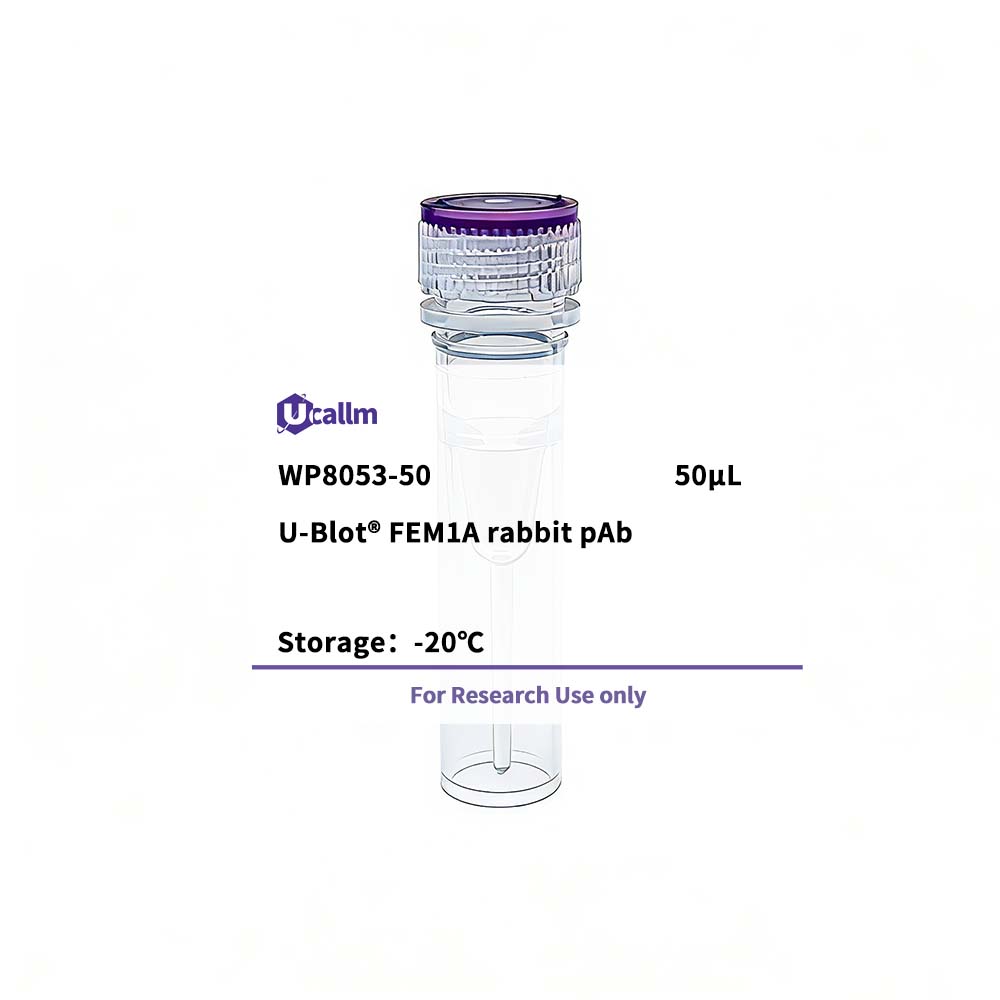
Ucallm_WP8053-50
Price range: $268.00 through $328.00
Product details
Background:
Specifications
| Size | 50μL/100μL |
| Target | FEM1A |
| Reactivity | Human, Rat |
| Applications | WB |
| MW(Calculated) | 74kD |
| MW(Observed) | |
| Host Species | Rabbit |
| Isotype | IgG |
| Conjugate/Modification | Unmodified |
| Recommended Dilution Ratio | WB 1:500-2000 |
| Formulation | Liquid in PBS containing 50% glycerol, 0.5% BSA and 0.02% sodium azide. |
| Purification | The antibody was affinity-purified from rabbit antiserum by affinity-chromatography using epitope-specific immunogen. |
| Storage | -15°C to -25°C/1 year(Do not lower than -25°C) |
| Concentration | 1 mg/ml |
| Clonality | Polyclonal |
| Clone Number | |
| Immunogen | Synthesized peptide derived from human FEM1A |
| Specificity | This antibody detects endogenous levels of FEM1A at Human,Rat |
| Gene Name | FEM1A EPRAP |
| Protein Name | Protein fem-1 homolog A (FEM1a) (FEM1-alpha) (Prostaglandin E receptor 4-associated protein) |
| Other Name | |
| Species | Human |
| Gene ID | 55527 |
| Uniprot | Q9BSK4, |
| Species.1 | |
| Gene ID.1 | |
| Uniprot.1 | |
| Species.2 | Rat |
| Gene ID.2 | 316131 |
| Uniprot.2 | Q4V890 |
| Cellular Localization | Mitochondrion . Cytoplasm . |
| Tissue Expression | Present in macrophages derived from peripheral blood monocytes. Also present in atheromata (at protein level). |
| Signaling_pathway | |
| Research Areas | |
| Function | Substrate-recognition component of a Cul2-RING (CRL2) E3 ubiquitin-protein ligase complex of the DesCEND (destruction via C-end degrons) pathway, which recognizes a C-degron located at the extreme C terminus of target proteins, leading to their ubiquitination and degradation . The C-degron recognized by the DesCEND pathway is usually a motif of less than ten residues and can be present in full-length proteins, truncated proteins or proteolytically cleaved forms . The CRL2(FEM1A) complex specifically recognizes proteins with an arginine at the C-terminus: recognizes and binds proteins ending with -Lys/Arg-Xaa-Arg and -Lys/Arg-Xaa-Xaa-Arg C-degrons, such as SIL1 or OR51B2, leading to their ubiquitination and degradation . Promotes ubiquitination and degradation of SLBP . Involved in PGE2-EP4-mediated inhibition of inflammation of macrophages via interaction with NFKB1 and PTGER4 (By similarity). Promotes inflammation in brain microglia through MAP2K4/MKK4-mediated signaling (By similarity). |
Please login to post questions
Related products





