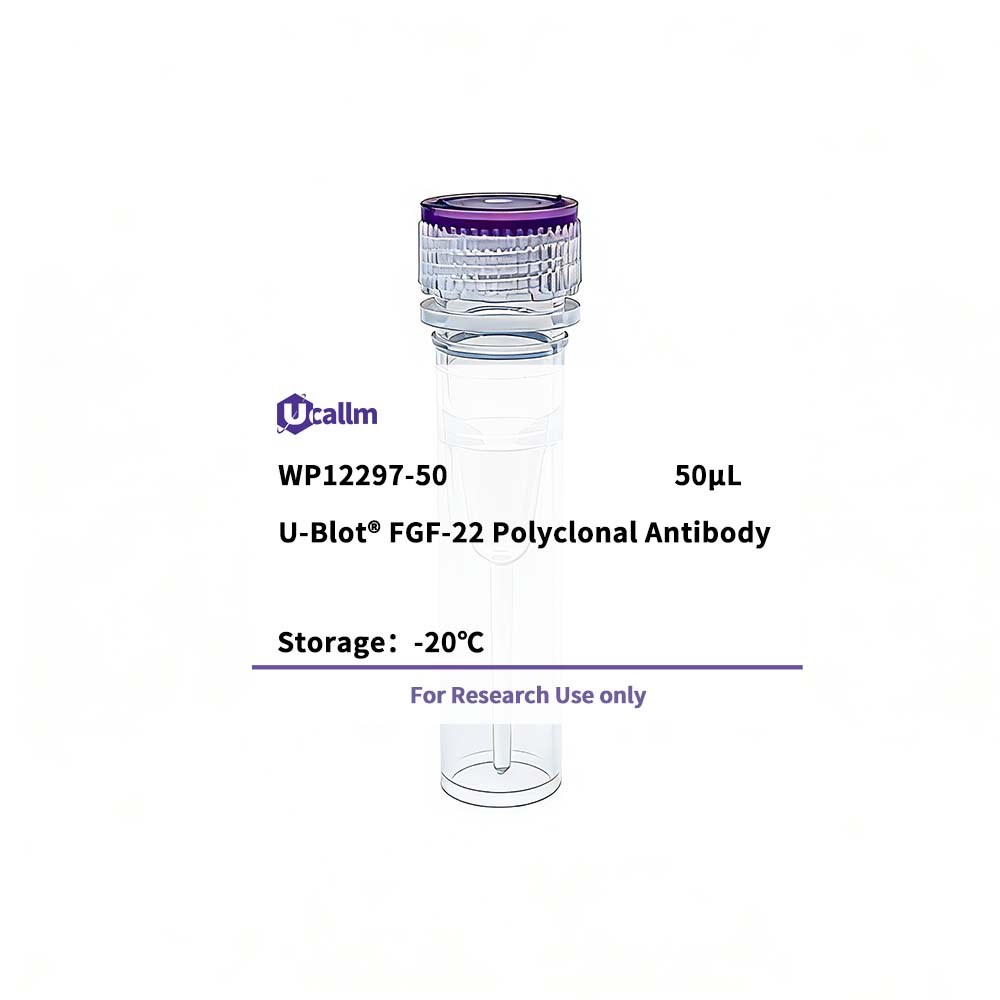
SKU: WP12297 Categories: ,

FGF-22 Polyclonal Antibody

Price range: $268.00 through $328.00

SKU: WP12297-100
Enter the quantity you would like, or drag the panel to find the quantity and price that best for you
Bulk QuoteAuthorize OEM & ODM

Product details

Background:

The protein encoded by this gene is a member of the fibroblast growth factor (FGF) family. FGF family members possess broad mitogenic and cell survival activities and are involved in a variety of biological processes including embryonic development, cell growth, morphogenesis, tissue repair, tumor growth and invasion. The mouse homolog of this gene was found to be preferentially expressed in the inner root sheath of the hair follicle, which suggested a role in hair development. Alternative splicing results in multiple transcript variants. [provided by RefSeq, Jul 2014],


Specifications

Size50μL/100μL
TargetFGF-22
ReactivityHuman, Mouse, Rat
ApplicationsWB, IHC, IF, ELISA
MW(Calculated)
MW(Observed)20kD
Host SpeciesRabbit
IsotypeIgG
Conjugate/ModificationUnmodified
Recommended Dilution RatioWB 1:500-1:2000; IHC 1:100-1:300; IF 1:200-1:1000; ELISA 1:40000; Not yet tested in other applications. / Note: For IHC, we suggest antigen retrieval with TE buffer pH 9.0 (Cat#WT1004)
FormulationLiquid in PBS containing 50% glycerol, 0.5% BSA and 0.02% sodium azide.
PurificationThe antibody was affinity-purified from rabbit antiserum by affinity-chromatography using epitope-specific immunogen.
Storage-15°C to -25°C/1 year(Do not lower than -25°C)
Concentration1 mg/ml
ClonalityPolyclonal
Clone Number
ImmunogenThe antiserum was produced against synthesized peptide derived from human FGF22. AA range:71-120
SpecificityFGF-22 Polyclonal Antibody detects endogenous levels of FGF-22 protein.
Gene NameFGF22
Protein NameFibroblast growth factor 22
Other NameFGF22; / Fibroblast growth factor 22; / FGF-22
SpeciesHuman
Gene ID27006
UniprotQ9HCT0,
Species.1Mouse
Gene ID.167112
Uniprot.1Q9ESS2
Species.2
Gene ID.2
Uniprot.2
Cellular LocalizationSecreted .
Tissue ExpressionPlacenta,
Signaling_pathwayCellular Processes >> Cell motility >> Regulation of actin cytoskeleton;Human Diseases >> Cancer: overview >> Pathways in cancer;Human Diseases >> Cancer: specific types >> Gastric cancer;Human Diseases >> Cancer: specific types >> Melanoma;Human Diseases >> Cancer: specific types >> Breast cancer;Environmental Information Processing >> Signal transduction >> MAPK signaling pathway;Environmental Information Processing >> Signal transduction >> Ras signaling pathway;Environmental Information Processing >> Signal transduction >> Rap1 signaling pathway;Environmental Information Processing >> Signal transduction >> Calcium signaling pathway;Environmental Information Processing >> Signal transduction >> PI3K-Akt signaling pathway
Research Areas>>MAPK signaling pathway; / >>Ras signaling pathway; / >>Rap1 signaling pathway; / >>Calcium signaling pathway; / >>PI3K-Akt signaling pathway; / >>Regulation of actin cytoskeleton; / >>Pathways in cancer; / >>Chemical carcinogenesis - receptor activation; / >>Melanoma; / >>Breast cancer; / >>Gastric cancer
FunctionFunction:May be involved in hair development.,similarity:Belongs to the heparin-binding growth factors family.,subunit:Interacts with FGFBP1.,
Please login to post questions
Back to Top
Product has been added to your cart
