SKU: WM0189 Categories: ,

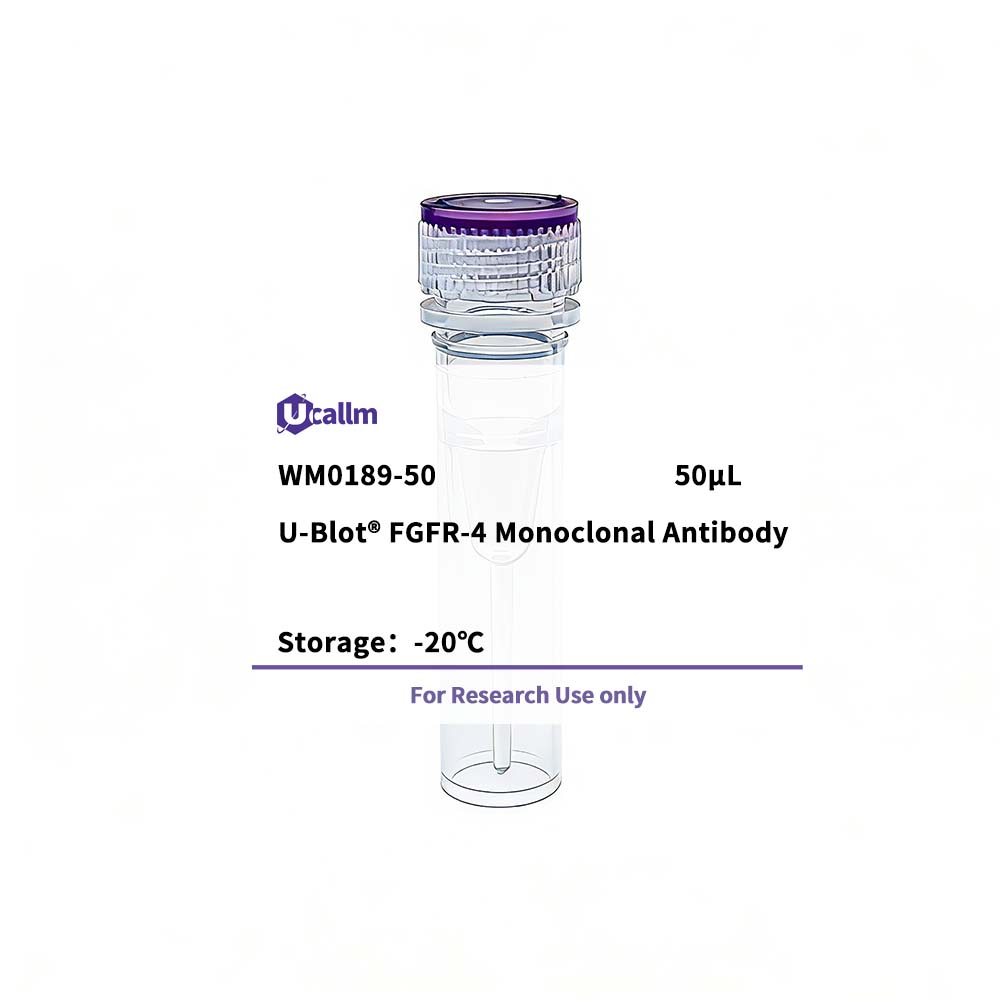
FGFR-4 Monoclonal Antibody

Price range: $268.00 through $328.00

SKU: WM0189-50
Enter the quantity you would like, or drag the panel to find the quantity and price that best for you
Bulk QuoteAuthorize OEM & ODM

Product details

Background:
The protein encoded by this gene is a member of the fibroblast growth factor receptor family, where amino acid sequence is highly conserved between members and throughout evolution. FGFR family members differ from one another in their ligand affinities and tissue distribution. A full-length representative protein would consist of an extracellular region, composed of three immunoglobulin-like domains, a single hydrophobic membrane-spanning segment and a cytoplasmic tyrosine kinase domain. The extracellular portion of the protein interacts with fibroblast growth factors, setting in motion a cascade of downstream signals, ultimately influencing mitogenesis and differentiation. The genomic organization of this gene, compared to members 1-3, encompasses 18 exons rather than 19 or 20. Although alternative splicing has been observed, there is no evidence that the C-terminal half of the IgII

Specifications

Size50μL/100μL
TargetFGFR-4
ReactivityHuman
ApplicationsWB, IF, ELISA
MW(Calculated)88kD
MW(Observed)
Host SpeciesMouse
Isotype
Conjugate/ModificationUnmodified
Recommended Dilution RatioWB 1:500-1:2000; IF 1:200-1:1000; ELISA 1:10000; Not yet tested in other applications.
FormulationLiquid in PBS containing 50% glycerol, 0.5% BSA and 0.02% sodium azide.
PurificationAffinity purification
Storage-15°C to -25°C/1 year(Do not lower than -25°C)
Concentration
ClonalityMonoclonal
Clone Number15E9
ImmunogenPurified recombinant extracellular fragment of human FGFR-4 fused with hIgGFc tag expressed in HEK293 cell line.
SpecificityFGFR-4 Monoclonal Antibody detects endogenous levels of FGFR-4 protein.
Gene NameFGFR4
Protein NameFibroblast growth factor receptor 4
Other NameFGFR4; / JTK2; / TKF; / Fibroblast growth factor receptor 4; / FGFR-4; / CD antigen CD334
SpeciesHuman
Gene ID2264
UniprotP22455,
Species.1Mouse
Gene ID.1
Uniprot.1Q03142
Species.2
Gene ID.2
Uniprot.2
Cellular LocalizationCell membrane; Single-pass type I membrane protein. Endosome. Endoplasmic reticulum. Internalized from the cell membrane to recycling endosomes, and from there back to the cell membrane.; [Isoform 2]: Secreted.; [Isoform 3]: Cytoplasm .
Tissue ExpressionExpressed in gastrointestinal epithelial cells, pancreas, and gastric and pancreatic cancer cell lines.
Signaling_pathwayCellular Processes >> Cellular community - eukaryotes >> Signaling pathways regulating pluripotency of stem cells;Cellular Processes >> Cell motility >> Regulation of actin cytoskeleton;Human Diseases >> Cancer: overview >> Pathways in cancer;Environmental Information Processing >> Signal transduction >> MAPK signaling pathway;Environmental Information Processing >> Signal transduction >> Ras signaling pathway;Environmental Information Processing >> Signal transduction >> Rap1 signaling pathway;Environmental Information Processing >> Signal transduction >> Calcium signaling pathway;Environmental Information Processing >> Signal transduction >> PI3K-Akt signaling pathway
Research Areas>>MAPK signaling pathway; / >>Ras signaling pathway; / >>Rap1 signaling pathway; / >>Calcium signaling pathway; / >>Endocytosis; / >>PI3K-Akt signaling pathway; / >>Signaling pathways regulating pluripotency of stem cells; / >>Regulation of actin cytoskeleton; / >>Pathways in cancer
FunctionCatalytic activity:ATP + a [protein]-L-tyrosine = ADP + a [protein]-L-tyrosine phosphate.,Function:Receptor for acidic fibroblast growth factor. Does not bind to basic fibroblast growth factor. Binds FGF19.,PTM:Glycosylated (By similarity). Phosphorylated on tyrosine residue (By similarity). Phosphorylation requires the presence of a functional (phosphorylated) FGFR1 and not necessarily by means of FGFR heterodimerization.,similarity:Belongs to the protein kinase superfamily. Tyr protein kinase family.,similarity:Belongs to the protein kinase superfamily. Tyr protein kinase family. Fibroblast growth factor receptor subfamily.,similarity:Contains 1 protein kinase domain.,similarity:Contains 3 Ig-like C2-type (immunoglobulin-like) domains.,subcellular location:Isoform 2 may be secreted.,subunit:Interacts with KLB.,tissue specificity:Expressed in gastrointestinal epithelial cells, pancreas, and gastric and pancreatic cancer cell lines.,
Please login to post questions
Back to Top
Product has been added to your cart


