SKU: WR4283 Categories: ,

U-Blot® Fibronectin Rabbit mAb

Price range: $268.00 through $328.00

SKU: WR4283-50
Enter the quantity you would like, or drag the panel to find the quantity and price that best for you
Bulk QuoteAuthorize OEM & ODM

Product details

Background:This gene encodes fibronectin, a glycoprotein present in a soluble dimeric form in plasma, and in a dimeric or multimeric form at the cell surface and in extracellular matrix. The encoded preproprotein is proteolytically processed to generate the mature protein. Fibronectin is involved in cell adhesion and migration processes including embryogenesis, wound healing, blood coagulation, host defense, and metastasis. The gene has three regions subject to alternative splicing, with the potential to produce 20 different transcript variants, at least one of which encodes an isoform that undergoes proteolytic processing. The full-length nature of some variants has not been determined. [provided by RefSeq, Jan 2016],


Specifications

Size50μL/100μL
TargetFibronectin
ReactivityHuman, Mouse, Rat
ApplicationsWB, IHC, IF, ELISA
MW(Calculated)272kD
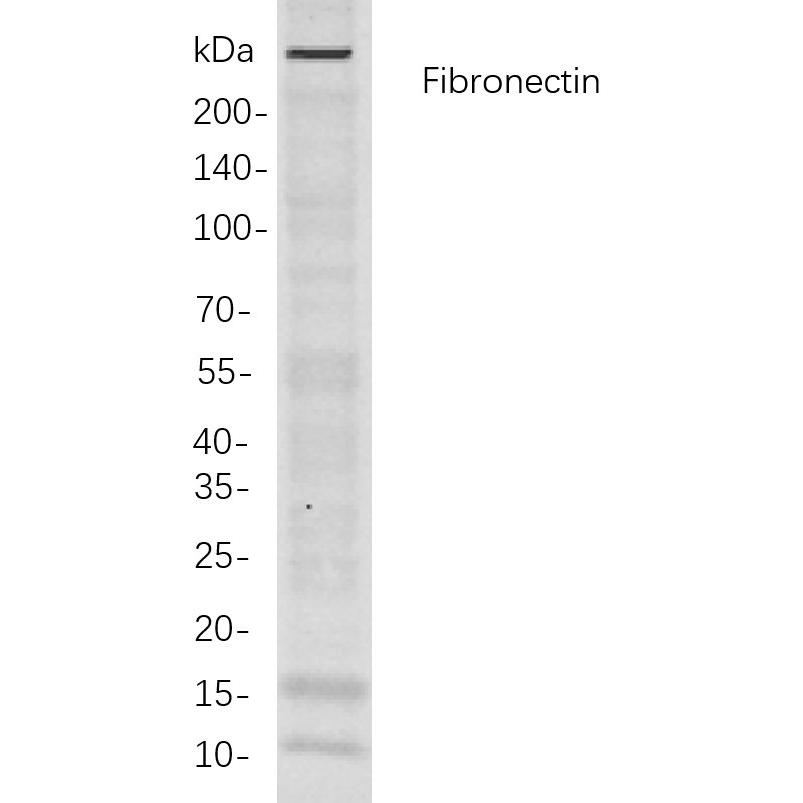
MW(Observed)285kD
Host SpeciesRabbit
IsotypeIgG,Kappa
Conjugate/ModificationUnmodified
Recommended Dilution RatioIHC 1:1000-1:5000; WB 1:2000-1:10000; IF 1:200-1:1000; ELISA 1:5000-1:20000; / Note: For IHC, we suggest antigen retrieval with TE buffer pH 9.0 (Cat#WT1004)
FormulationPBS, 50% glycerol, 0.05% Proclin 300, 0.05%BSA
PurificationRecombinant Antibody expressed in animal component-free (ACF) media, purified via Protein A affinity chromatography.
Storage-15°C to -25°C/1 year(Do not lower than -25°C)
Concentration
ClonalityMonoclonal
Clone NumberRM0476R
ImmunogenThe specific immunogen used to produce this antibody is proprietary information.
SpecificityEndogenous
Gene NameFN1
Protein NameFibronectin
Other NameFN1; / FN; / Fibronectin; / FN; / Cold-insoluble globulin; / CIG
SpeciesHuman
Gene ID2335
UniprotP02751,
Species.1Mouse
Gene ID.114268
Uniprot.1P11276,
Species.2Rat
Gene ID.2
Uniprot.2P04937
Cellular LocalizationSecreted
Tissue ExpressionExpressed in the inner limiting membrane and around blood vessels in the retina (at protein level) (PubMed:29777959). Plasma FN (soluble dimeric form) is secreted by hepatocytes. Cellular FN (dimeric or cross-linked multimeric forms), made by fibroblasts, epithelial and other cell types, is deposited as fibrils in the extracellular matrix. Ugl-Y1, Ugl-Y2 and Ugl-Y3 are found in urine (PubMed:17614963).
Signaling_pathwayCellular Processes >> Cellular community - eukaryotes >> Focal adhesion;Cellular Processes >> Cell motility >> Regulation of actin cytoskeleton;Human Diseases >> Cancer: overview >> Pathways in cancer;Human Diseases >> Cancer: specific types >> Small cell lung cancer;Environmental Information Processing >> Signal transduction >> PI3K-Akt signaling pathway;Environmental Information Processing >> Signaling molecules and interaction >> ECM-receptor interaction
Research Areas>>PI3K-Akt signaling pathway; / >>Focal adhesion; / >>ECM-receptor interaction; / >>Regulation of actin cytoskeleton; / >>AGE-RAGE signaling pathway in diabetic complications; / >>Bacterial invasion of epithelial cells; / >>Yersinia infection; / >>Amoebiasis; / >>Human papillomavirus infection; / >>Pathways in cancer; / >>Proteoglycans in cancer; / >>Small cell lung cancer
FunctionAlternative products:Additional isoforms seem to exist,developmental stage:Ugl-Y1, Ugl-Y2 and Ugl-Y3 are present in the urine from 0 to 17 years of age.,Disease:Defects in FN1 are the cause of glomerulopathy with fibronectin deposits type 2 (GFND2) [MIM:601894]; also known as familial glomerular nephritis with fibronectin deposits or fibronectin glomerulopathy. GFND is a genetically heterogeneous autosomal dominant disorder characterized clinically by proteinuria, microscopic hematuria, and hypertension that leads to end-stage renal failure in the second to fifth decade of life.,Function:Fibronectins bind cell surfaces and various compounds including collagen, fibrin, heparin, DNA, and actin. Fibronectins are involved in cell adhesion, cell motility, opsonization, wound healing, and maintenance of cell shape. Interaction with TNR mediates inhibition of cell adhesion and neurite outgrowth.,online information:Fibronectin entry,PTM:Forms covalent cross-links mediated by a transglutaminase, such as F13A or TGM2, between a glutamine and the epsilon-amino group of a lysine residue, forming homopolymers and heteropolymers (e.g. fibrinogen-fibronectin, collagen-fibronectin heteropolymers).,PTM:It is not known whether both or only one of Thr-2064 and Thr-2065 are/is glycosylated.,PTM:Sulfated.,similarity:Contains 12 fibronectin type-I domains.,similarity:Contains 16 fibronectin type-III domains.,similarity:Contains 2 fibronectin type-II domains.,subunit:Mostly heterodimers or multimers of alternatively spliced variants, connected by 2 disulfide bonds near the carboxyl ends; to a lesser extent homodimers. Interacts with FBLN1, AMBP, TNR, LGALS3BP and COL13A1. Interacts with FBLN7.,tissue specificity:Plasma FN (soluble dimeric form) is secreted by hepatocytes. Cellular FN (dimeric or cross-linked multimeric forms), made by fibroblasts, epithelial and other cell types, is deposited as fibrils in the extracellular matrix. Ugl-Y1, Ugl-Y2 and Ugl-Y3 are found in urine.,
Please login to post questions

Back to Top
Product has been added to your cart
